Facts
The Petitioner claimed possession of land since prior to 1970, which was settled in his favor by a revenue authority on 25.06.1994
Source reference: para. 2On 21.01.1999, the Additional Collector exercised suo motu revisional powers and set aside the settlement order
Source reference: para. 2After a delay of approximately 23 years, the Petitioner challenged this order before the Additional Commissioner, Gwalior Division, who dismissed the appeal on 22.08.2022 on grounds of maintainability and delay
Source reference: para. 2, 6The Petitioner subsequently approached the High Court via this writ petition in 2025, nearly three years after the appellate order
Source reference: para. 3, 7Issues
1. Whether the Additional Commissioner committed a jurisdictional error in dismissing the appeal filed after a 23-year delay as not maintainable
Source reference: para. 62. Whether the High Court should exercise its extraordinary discretionary jurisdiction under Article 226 of the Constitution in favor of a litigant whose claim suffers from gross delay and laches
Source reference: para. 5, 7Law Applied
The Court applied the doctrine of "delay and laches" and the principle of finality of judicial proceedings under Article 226 of the Constitution of India
Source reference: para. 7It relied on the principle that the writ jurisdiction is discretionary and equitable; therefore, a litigant must approach the court with "due diligence and reasonable promptitude"
Source reference: para. 7The court further observed that statutory remedies under the M.P. Land Revenue Code must be exercised within a reasonable period, and stale claims cannot be entertained as they unsettle "settled rights"
Source reference: para. 6, 7Reasoning
The Court reasoned that the Petitioner offered no cogent or legally acceptable explanation for the dual delays: the 23-year gap in challenging the 1999 order and the subsequent 3-year gap in challenging the 2022 appellate order
Source reference: para. 7The Court found that the Additional Commissioner acted correctly because the Petitioner failed to cite any statutory provision allowing the condonation of such an "extraordinary delay"
Source reference: para. 6It was observed that the Petitioner’s attempt to challenge the 2022 order was essentially an indirect method to reopen the 1999 order, which had attained finality
Source reference: para. 7The Court held that entertaining such claims after decades would prejudice parties whose rights had crystallized and would violate the principle that equity ignores those who sleep over their rights
Source reference: para. 7, 8Holding
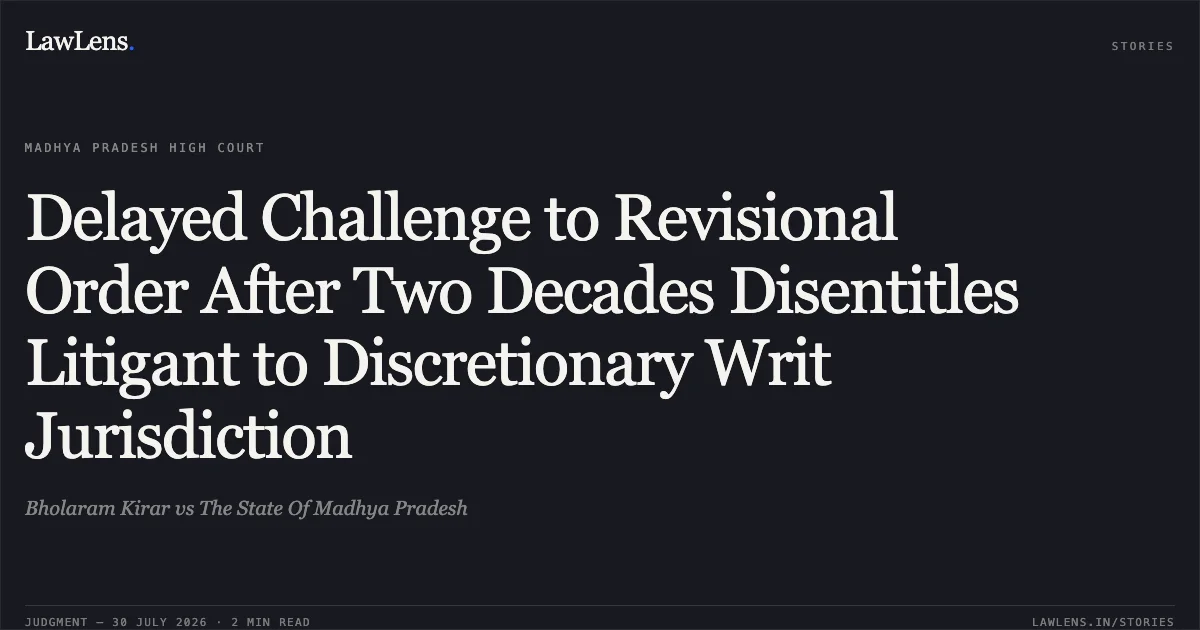
The High Court dismissed the writ petition, holding that the cumulative effect of the gross and unexplained delays disentitled the Petitioner from any relief
The Court affirmed that the Additional Commissioner committed no illegality in dismissing the highly belated appeal as not maintainable
Source reference: para. 6, 8No order was made as to costs
Source reference: para. 10Original Court PDF
Bholaram KirarvsThe State Of Madhya Pradesh
Click to open original judgment
Original judgment, available to read, download and summarize on LawLens.in