Facts
Smt. Lalitha, the appellant’s grandmother, owned 60 cents of land in Sy. No. 152/2B, Padavu Village.
Source reference: paras. 3–15, 18–23Following proceedings under the Urban Land (Ceiling and Regulation) Act, 1976 (“ULC Act”), the State asserted that it had taken forcible possession of the excess land on 12 February 1988 under Section 10(6), supported by a mahazar signed by two witnesses and Lalitha’s alleged representative.
Source reference: paras. 3–15, 18–23The appellant claimed that possession had not been taken, relying in part on a Tahsildar’s 2013 letter reporting her possession; the Tahsildar later stated by affidavit that he had not personally verified the report and that it was contrary to the records.
Source reference: paras. 3–15, 18–23The appellant also relied on an alleged 2007 Will. The Single Judge dismissed her challenge to the 2015 endorsement rejecting her claim, and she appealed
Source reference: paras. 3–15, 18–23Issues
1. Whether the State had taken de facto possession of the subject land before the Urban Land (Ceiling and Regulation) Repeal Act, 1999, commenced in Karnataka, so as to exclude the land from the protection of Section 3(2)(a) of that Act
Source reference: para. 312. Whether taking possession under Section 10(6) before expiry of the Section 10(5) notice period—or without a Section 10(5) notice—invalidated the possession for the purposes of the Repeal Act
Source reference: paras. 44–453. Whether the evidence of possession, including the mahazar and the Tahsildar’s later letter, warranted interference with the Single Judge’s decision
Source reference: paras. 18–23, 57–58Law Applied
Section 10(3) of the ULC Act effects vesting of title and de jure possession in the State, but does not by itself establish de facto possession; possession must be shown to have been voluntarily surrendered, delivered following a Section 10(5) notice, or taken under Section 10(6) [State of U.P. v. Hari Ram, (2013) 4 SCC 280].
Source reference: paras. 32–38Under Section 3(2)(a) of the Repeal Act, the relevant protection applies where land has vested under Section 10(3) but the State has not taken possession; Section 4 provides for abatement of covered proceedings
Source reference: paras. 33–38Under State of Assam v. Bhaskar Jyoti Sarma, (2015) 5 SCC 321, failure to comply with Section 10(5) does not necessarily invalidate possession where the affected person does not challenge the procedural defect within a reasonable time; such delay may amount to waiver.
Source reference: paras. 46–50The Court also relied on A.P. Electrical Equipment Corporation v. Tahsildar, 2025 SCC OnLine SC 447, and Dalsukhbai Bachubai Satasia v. State of Gujarat, 2026 SCC OnLine SC 25, as reaffirming that principle
Source reference: para. 52Reasoning
The Court accepted the mahazar dated 12 February 1988 as evidence that possession had been taken after the Section 10(3) notification.
Source reference: paras. 42–51, 53–59It noted that the mahazar bore the signatures of two witnesses and G. Vasudeva Kamath, identified as Lalitha’s authorised representative, and that the Tahsildar who issued the 2013 letter later disavowed personal verification of its contents.
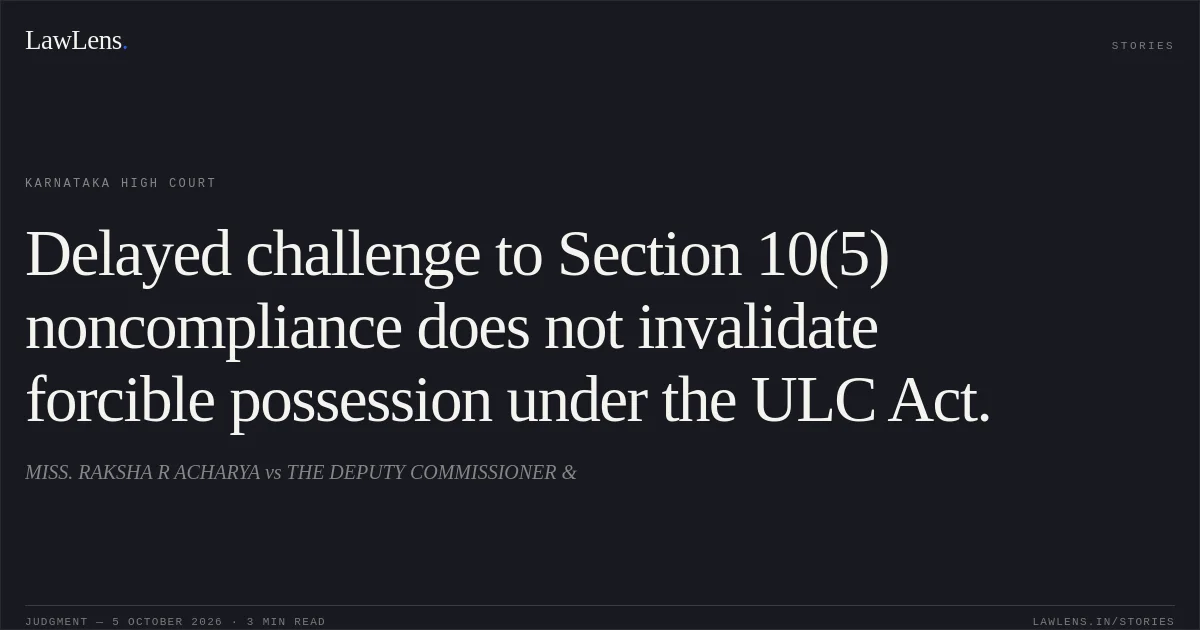
Source reference: paras. 42–51, 53–59The Court held that any failure to allow the full 30-day period under Section 10(5), or to issue the notice, was not raised by Lalitha during her lifetime or within a reasonable time after the alleged dispossession; applying Bhaskar Jyoti Sarma, the defect did not negate possession for the purposes of the Repeal Act.
Source reference: paras. 42–51, 53–59The additional correspondence relied on by the appellant did not establish that possession remained with the landowner when the Repeal Act commenced.
Source reference: paras. 42–51, 53–59Since possession had passed to the State in 1988, Lalitha could not convey an interest in the land through the alleged 2007 Will
Source reference: paras. 42–51, 53–59Holding
The Court held that the State had taken de facto possession of the subject land before the Repeal Act commenced in Karnataka and that the appellant had not satisfied the conditions for relief under Section 3(2)(a).
It found no basis to interfere with the Single Judge’s order and dismissed the appeal, confirming the dismissal of the writ petition; pending applications, if any, were disposed of
Source reference: paras. 59–60; orderActs & Sections Cited
3 provisions across 2 statutes referred to in this judgment. Each provision opens on LawLens.
KARNATAKA HIGH COURT ACT, 19611
Original Court PDF
MISS. RAKSHA R ACHARYAvsTHE DEPUTY COMMISSIONER &
Click to open original judgment
Original judgment, available to read, download and summarize on LawLens.in