Facts
The dispute arose from a CPWD contract awarded to the Respondent for synthetic athletic-track work at Jawaharlal Nehru Stadium in connection with the 2010 Commonwealth Games.
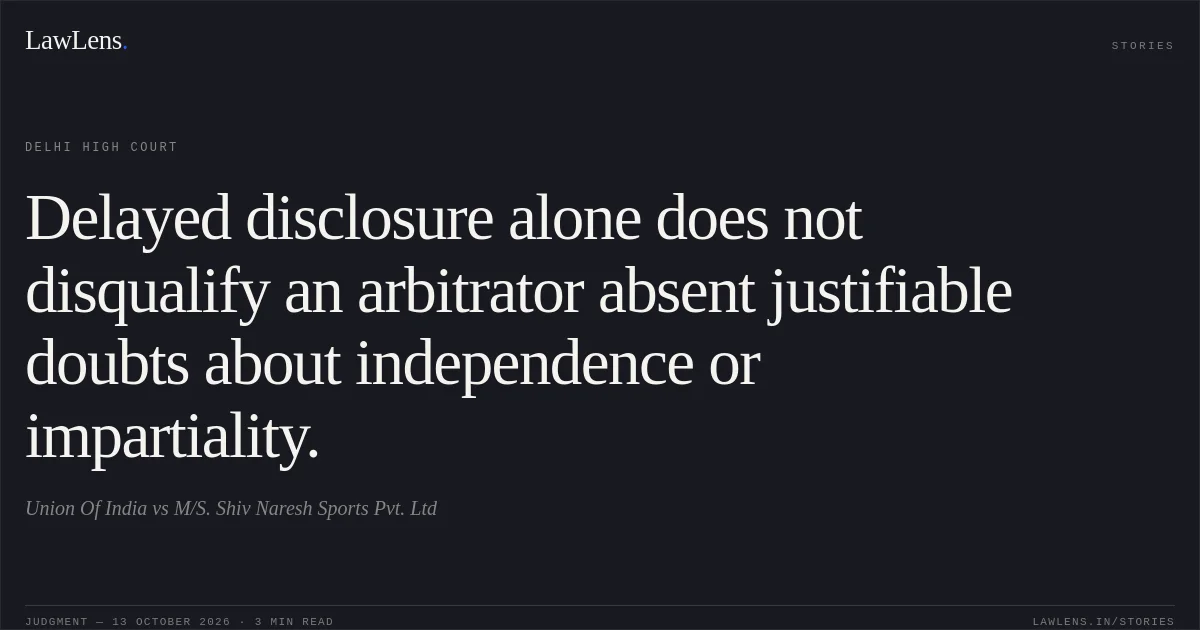
Source reference: para. 1–12The Sole Arbitrator had earlier served on a departmental committee that assessed the Respondent’s tender rates; he disclosed this involvement during the arbitration, after pleadings had been completed.
Source reference: para. 15–17The Petitioner challenged his impartiality, but the Arbitrator rejected the challenge under Section 13 of the Arbitration and Conciliation Act, 1996.
Source reference: para. 22–29The award allowed several of the Respondent’s claims, including amounts relating to FOP Consultant visits, deviated quantities, a discus cage and delay-related damages. The Union’s Section 34 petition challenged the Arbitrator’s impartiality and selected findings, principally those concerning Claims 1(C), 3.4, 4 and 8.
Source reference: para. 37Issues
1. Whether the Arbitrator’s prior participation in the committee assessing the tender rates, and his delayed disclosure of that role, gave rise to justifiable doubts as to his independence or impartiality under the unamended Section 12.
Source reference: para. 46–602. Whether the Tribunal’s findings on the FOP Consultant deduction, rates for deviated quantities and discus-cage recovery warranted interference under Section 34.
Source reference: para. 76–983. Whether the Arbitrator exceeded the scope of the reference by considering the validity and effect of the Respondent’s undertaking not to claim compensation for delay.
Source reference: para. 99–104Law Applied
Under the unamended Section 12 of the Arbitration and Conciliation Act, 1996, non-disclosure or delayed disclosure does not, by itself, invalidate an arbitration; the challenge must establish circumstances giving rise to justifiable doubts about the arbitrator’s independence or impartiality, and Section 12(4) limits challenges to grounds that became known after appointment.
Source reference: para. 50–58Under the pre-2015 regime, Section 34 permitted interference for patent illegality or other recognised public-policy grounds, but not merely because the court preferred a different interpretation or factual conclusion; a reasonable and plausible view supported by the record must stand.
Source reference: para. 72–75The Court relied on Aravali Power Co. (P) Ltd. v. Era Infra Engg. Ltd., applying the principle that a person’s association with a party does not, without more, establish bias; the nature of the person’s role and any specific evidence of partiality are material.
Source reference: para. 64–65An arbitrator may determine a defence raised by a party where its validity or effect is directly relevant to a claim before the tribunal.
Source reference: para. 100–104Reasoning
The Court held that the Petitioner had not shown that the Arbitrator’s prior committee role created justifiable doubts: the committee’s rate assessment was an internal pre-contract exercise, the Arbitrator had no role in executing the contract or making the disputed decisions, and the Petitioner was reasonably presumed to have known of the appointment-related circumstance.
Source reference: para. 61–71The Court also found that the Tribunal’s interpretation of the negotiation letter did not require seven separate FOP Consultant visits for the Stadium; the IAAF certification had been obtained, no deficiency attributable to fewer visits was shown, and the contract provided no agreed recovery mechanism for shortfall in visits.
Source reference: para. 77–86As to deviated quantities, the Tribunal’s construction of Clauses 12.2 and 12.3 was plausible, and the Petitioner had not shown that the required notice for applying a reduced rate was given.
Source reference: para. 88–93The discus-cage deduction lacked a demonstrated contractual basis.
Source reference: para. 94–98Finally, the undertaking was expressly relied on by the Petitioner as a defence to Claim 8 and contested by the Respondent; its effect therefore formed part of the dispute the Arbitrator had to decide.
Source reference: para. 99–104Holding
The Court rejected the challenge to the Arbitrator’s impartiality and found no ground under Section 34 to interfere with the challenged claim findings.
It held that the Arbitrator had not exceeded the reference by considering the undertaking relied upon as a defence.
Source reference: para. 105–108The Section 34 petition was dismissed, and pending applications were disposed of.
Source reference: para. 105–108Acts & Sections Cited
11 provisions across 2 statutes referred to in this judgment. Each provision opens on LawLens.
Arbitration and Conciliation Act, 19967
Indian Contract Act, 18724
Original Court PDF
Union Of IndiavsM/S. Shiv Naresh Sports Pvt. Ltd
Click to open original judgment
Original judgment, available to read, download and summarize on LawLens.in