Facts
The appellant, an airline authorised to collect Foreign Travel Tax (FTT) from passengers, was required to deposit the collected tax with the Central Government within the period prescribed under Section 35(2) of the Finance Act, 1979 and Rule 4 of the Foreign Travel Tax Rules, 1979.
Source reference: paras. 4–6In six instances, the appellant deposited FTT belatedly, with delays ranging from one day to 63 days; in five instances, the demand drafts had been purchased before the due dates but were deposited later because of security restrictions, while the 63-day delay was attributed to the concerned employee’s emergency leave.
Source reference: paras. 4–6, 47–47.2The adjudicating authority initially imposed penalties aggregating to Rs. 12,000 for the delayed payments.
Source reference: paras. 9–14.6On remand, it imposed a substantially enhanced penalty of Rs. 71,29,140 under Section 38(3), in addition to tax and interest.
Source reference: paras. 9–14.6The appellate and revisional authorities upheld the penalty, and the Bombay High Court dismissed the appellant’s writ petition.
Source reference: paras. 9–14.6Issues
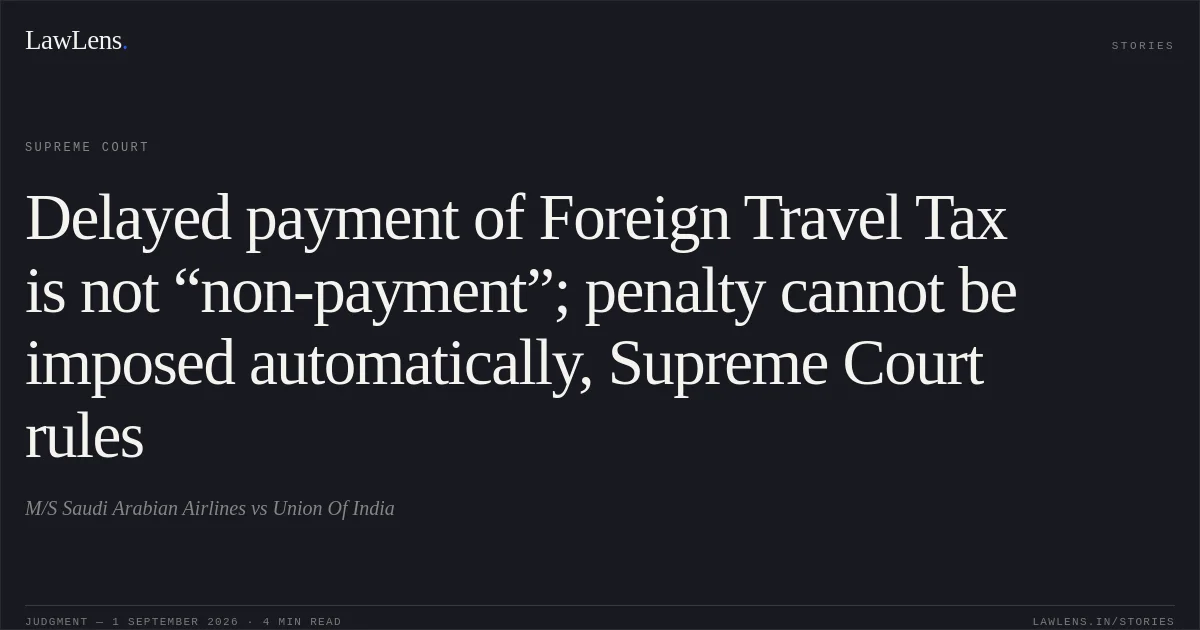
Whether delayed payment of FTT, where the tax was ultimately deposited, constitutes “failure to pay” under Section 38(3) of the Finance Act, 1979, thereby attracting the penalty prescribed under that provision?
Source reference: paras. 15, 23.2–23.3, 35–35.1Whether a penalty under Section 38 is automatic upon breach of the statutory timeline, or whether the adjudicating authority has discretion not to impose penalty after considering the assessee’s explanation and the circumstances of the default?
Source reference: paras. 14.2–14.4, 39–40, 46Whether delayed deposit of FTT is governed by Section 38(4), read with Rules 4 and 9 of the 1979 Rules, rather than Section 38(3)?
Source reference: paras. 15.2–15.4, 37–37.4Whether enhancement of the penalty from Rs. 12,000 to Rs. 71,29,140 on remand impermissibly placed the appellant in a worse position for having pursued its appellate remedy?
Source reference: paras. 50–54Law Applied
The Court applied Section 35(2) of the Finance Act, 1979, concerning collection and payment of FTT; Section 35A, prescribing interest for delayed payment; and Section 38(3), which imposes a penalty for failure to pay FTT to the credit of the Central Government, with the penalty ranging from one-fifth to three times the tax not paid.
Source reference: paras. 20–23.3, 35Section 38(4), read with Rules 4 and 9 of the Foreign Travel Tax Rules, 1979, governs breaches involving delayed payment of FTT and delayed filing of returns.
Source reference: paras. 37–37.3Rule 4 permits the Collector of Customs, upon sufficient cause being shown and having regard to the carrier’s accounting system, to allow payment beyond the ordinary 30-day period; Rule 9 contains a similar relaxation for filing returns.
Source reference: paras. 27, 30, 37.2, 37.4Rule 12 requires notice, an opportunity to respond and a hearing before penalty is imposed, thereby indicating that penalty is not automatic.
Source reference: paras. 32, 39–40Relying on Hindustan Steel Ltd. v. State of Orissa, the Court held that even where a minimum penalty is prescribed, a technical, venial or bona fide breach may justify non-imposition of penalty.
Source reference: para. 42It also relied on U.S. Technologies International (P) Ltd. v. CIT for the distinction between failure to pay and belated payment.
Source reference: para. 36It also relied on the principle against reformatio in peius, recognised in Jyoti Plastic Works Pvt. Ltd. v. Union of India, Jawal Neco Ltd. v. Commissioner of Customs and Nagarajan v. State of Tamil Nadu, that an appellant should not be placed in a worse position merely for pursuing an appellate remedy.
Source reference: paras. 52–54Reasoning
The Court interpreted the expressions “fails to pay” and “the amount of the tax not so paid” in Section 38(3) according to their ordinary and statutory meaning.
Source reference: para. 35.1It held that Section 38(3) addresses non-payment of FTT, and cannot be expanded to cover cases where the tax was paid, albeit belatedly.
Source reference: para. 35.1Since the appellant had ultimately deposited the FTT in all six instances, the defaults constituted delayed payment governed by Section 38(4), read with Rules 4 and 9, rather than non-payment under Section 38(3).
Source reference: paras. 37.1–37.3, 40The Court further held that the timelines under Rules 4 and 9 were not inflexible, as the Collector could condone delay upon sufficient cause being shown.
Source reference: para. 37.4The authorities had failed to consider the appellant’s explanations regarding security restrictions and the employee’s emergency leave; if accepted, the delay could have been condoned and no penalty would have arisen.
Source reference: paras. 47–48The statutory requirement of notice and hearing under Rule 12 also demonstrated that the authority retained discretion not to impose penalty; the word “shall” did not make penalty automatic in every case of breach.
Source reference: paras. 39.1, 40, 46Finally, the Court held that the drastic enhancement of penalty on remand was independently impermissible because an appellant cannot be worse off as a consequence of invoking a statutory appellate remedy.
Source reference: paras. 50–54Holding
The appeal was allowed.
The Court held that the appellant’s belated deposits of FTT did not constitute “failure to pay” under Section 38(3); they fell within the delayed-payment regime under Section 38(4), read with Rules 4 and 9.
Source reference: paras. 48–49Penalty was not automatic, and the authorities were required to consider whether the delay ought to be condoned and whether penalty was warranted in the circumstances.
Source reference: paras. 48–49The penalty imposed for the six instances of delayed payment was set aside, and the relevant portions of the High Court’s judgment, the revisional order, the appellate order and the de novo order-in-original were quashed.
Source reference: para. 55Any amount paid towards the impugned penalty was directed to be refunded with interest at 9% per annum within three months; the appellant’s bank guarantee was discharged.
Source reference: paras. 55–56There was no order as to costs.
Source reference: paras. 55–56Acts & Sections Cited
2 provisions across 1 statute referred to in this judgment. Each provision opens on LawLens.
Customs Act,19622
Original Court PDF
M/S Saudi Arabian AirlinesvsUnion Of India
Click to open original judgment
Original judgment, available to read, download and summarize on LawLens.in