01Facts
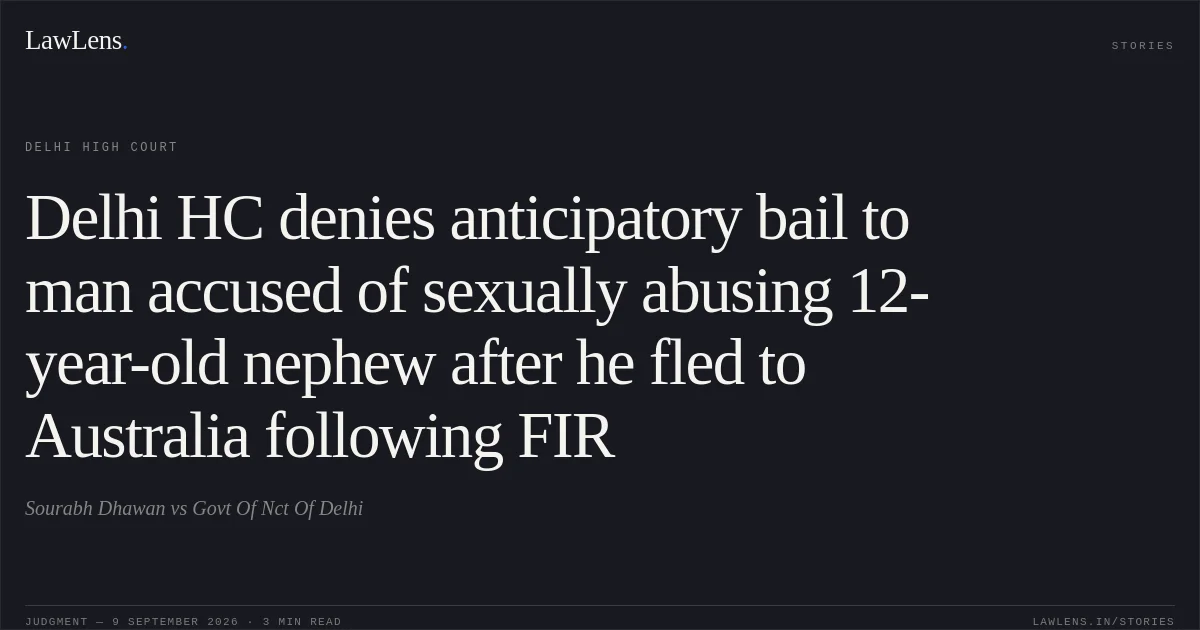
The applicant sought anticipatory bail in FIR No. 73/2026, Police Station Tilak Nagar, registered under Section 351(3) of the Bharatiya Nyaya Sanhita and Sections 6/10 of the POCSO Act.
¶ 1The FIR was lodged by the father of a 12-year-old child, alleging that on 27 February 2026 the applicant forcibly entered the complainant’s house, assaulted and threatened the child, sexually abused him, and threatened to harm his parents.
pp. 2–3 · ¶ 4The applicant admitted breaking open the doors but claimed that the case arose from a civil dispute between him and the complainant and that he had broken the doors after they were not opened despite his repeated knocks.
p. 3 · ¶ 6The FIR was registered on 28 February 2026, and the applicant admittedly left for Australia on 2 March 2026; the police had opened a Look-Out Circular and initiated extradition proceedings.
p. 2 · ¶ 302Issues
i.Whether, in view of the allegations of sexual abuse of a 12-year-old child under the POCSO Act, the applicant was entitled to anticipatory bail.
¶ 1, 4–5ii.Whether the pending civil dispute, the applicant’s explanation for breaking open the doors, and the alleged inconsistencies in timings justified the grant of anticipatory bail.
¶ 6, 8–9iii.Whether the applicant’s departure to Australia shortly after registration of the FIR indicated a likelihood of evasion and justified refusal of anticipatory bail.
¶ 3, 12–1303Law Applied
The Court applied the provisions invoked in the FIR—Section 351(3) of the Bharatiya Nyaya Sanhita and Sections 6/10 of the POCSO Act—treating the alleged sexual abuse of a child as a grave accusation requiring serious consideration.
¶ 1, 4, 8It applied the discretionary principles governing anticipatory bail, under which relief may be refused where the allegations are heinous, the material on record prima facie corroborates the prosecution case, or the applicant’s conduct indicates a risk of absconding or non-appearance during investigation and trial.
¶ 8–13The Court also held that a pending civil dispute does not, by itself, justify disregarding serious criminal allegations, and that a person cannot unilaterally break open the doors of disputed premises merely because the police allegedly failed to act on a PCR call.
¶ 8–9Provisions in the judgment · 3 · Linked ones open on LawLens
Bharatiya Nyaya Sanhita, 2023 Section 351
Protection of Children from Sexual Offences Act, 2012 Section 6Section 10
04Reasoning
The Court found that the allegation of sexual abuse was not capable of being rejected merely on the basis of the parties’ civil dispute.
¶ 8The applicant’s admitted conduct in breaking open the doors, the neighbour’s account, and the CCTV footage corroborated the prosecution’s version regarding his forcible entry and lawless conduct.
¶ 9–11The Court further considered the applicant’s departure to Australia within two days of registration of the FIR, along with the initiation of a Look-Out Circular and extradition proceedings, as demonstrating that he might not appear for investigation or trial if granted protection.
¶ 3, 12In light of the seriousness of the POCSO allegations and the applicant’s conduct, the Court found no basis to exercise its discretion in favour of anticipatory bail.
¶ 1305Holding
The Court answered the issues against the applicant and held that this was not a fit case for anticipatory bail, particularly because of the grave allegations involving a child, the corroborative material concerning forcible entry, and the applicant’s flight to Australia soon after registration of the FIR.
¶ 13The anticipatory bail application was accordingly dismissed.
¶ 14At the applicant’s request, his submission that he had entered the premises accompanied by certain family members was taken on record.
¶ 15Original Court PDF
Sourabh DhawanvsGovt Of Nct Of Delhi
Click to open original judgment
Original judgment, available to read, download and summarize on LawLens.in