Facts
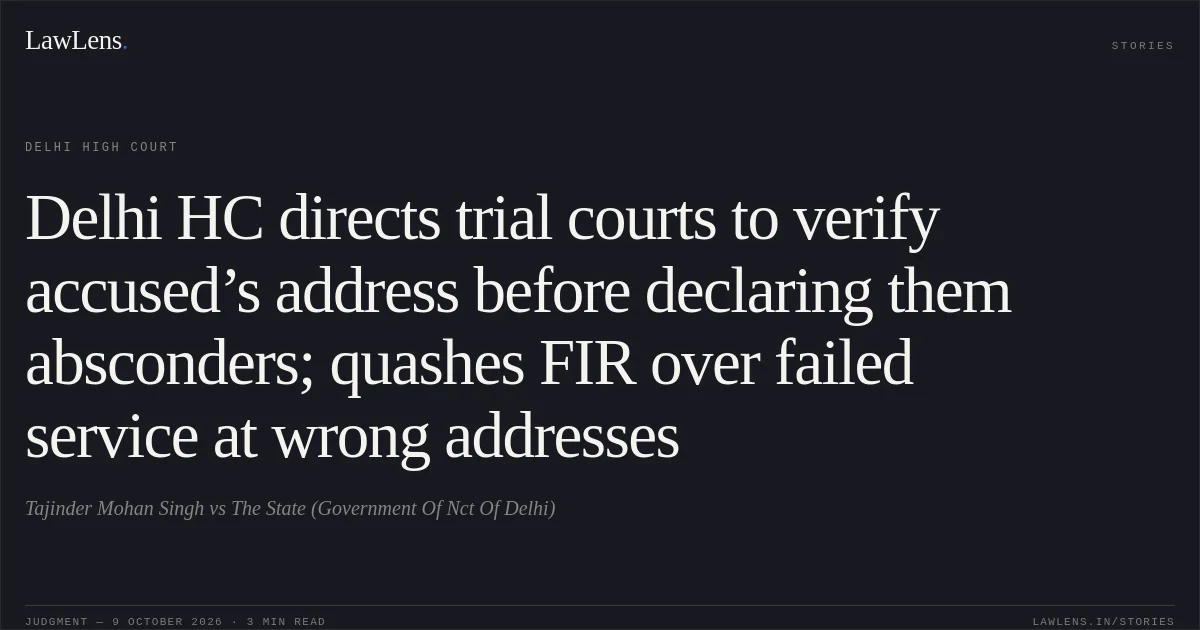
The petitioner, an accused in a complaint under Section 138 of the Negotiable Instruments Act, was declared an absconder on 29 January 2024, following which FIR No. 335/2024 was registered against him under Section 174A IPC.
Source reference: p. 1He sought quashing of the FIR, contending that summons, warrants and proclamation had been issued to two Ludhiana addresses where he had not lived or worked since 2018.
Source reference: p. 2The process-server and police reports stated that he was not found at either address and had shifted elsewhere; despite those reports, the trial court proceeded to issue warrants, order proclamation and declare him an absconder.
Source reference: pp. 7–8The petitioner also relied on his Aadhaar card, which recorded a different address.
Source reference: p. 11The State opposed quashing on the ground that the disputed question of residence required a trial.
Source reference: pp. 2–3Issues
1. Whether the petitioner was validly declared an absconder under Section 82 CrPC when the process was directed to addresses at which the reports stated he did not reside or work.
Source reference: pp. 6, 10–122. Whether the FIR under Section 174A IPC, founded on that declaration, could be quashed in the exercise of the High Court’s inherent jurisdiction.
Source reference: pp. 1–2, 12Law Applied
Sections 62, 64 and 65 CrPC prescribe methods of summons service, including personal service, service on an adult family member residing with the person, and affixation where service cannot otherwise be effected after due diligence; Sections 87 and 82 CrPC govern warrants and proclamations, with a proclamation requiring the court to have reason to believe that a person against whom a warrant has issued has absconded or is concealing himself to avoid execution.
Source reference: pp. 3–4Section 174A IPC criminalises failure to appear in compliance with a proclamation under Section 82 CrPC.
Source reference: p. 4Under Inder Mohan Goswami v. State of Uttaranchal, warrants must be issued judiciously and with careful scrutiny, having regard to their serious consequences for personal liberty.
Source reference: pp. 4–5The court held that processes and proclamations must be directed to the place where the person ordinarily resides, and that findings of service, execution or deliberate avoidance must rest on an objective examination of the record and be supported by reasons.
Source reference: pp. 6, 10Reasoning
The process-server and police reports expressly stated that the petitioner was neither residing nor working at either address provided in the complaint, and that he had shifted to an unknown place.
Source reference: pp. 7–8, 11–12Nevertheless, the trial court repeatedly concluded, without stated reasons or supporting material, that the petitioner was avoiding service or arrest, and ordered proclamation at the same addresses.
Source reference: pp. 8–10The High Court found that the record itself established that the addresses were incorrect, making a trial on that question unnecessary.
Source reference: p. 12Because the statutory process had not been directed to a place where the petitioner ordinarily resided, the declaration of absconder and the resulting prosecution under Section 174A IPC could not stand.
Source reference: pp. 6, 12Holding
The High Court held that the petitioner had been wrongly declared an absconder and allowed the petition, quashing FIR No. 335/2024 and all proceedings arising from it.
It also directed courts dealing with criminal trials to require complainants to provide the accused’s correct residential and electronic-service addresses on affidavit; record reasoned, objective findings on service and execution; seek cogent evidence when process returns with a report that the accused does not reside or work at the stated address; and personally examine process-server and police reports before finding deliberate avoidance.
Source reference: pp. 12–14Acts & Sections Cited
12 provisions across 4 statutes referred to in this judgment. Each provision opens on LawLens.
Negotiable Instruments Act, 18811
Code of Criminal Procedure, 19735
Bharatiya Nagarik Suraksha Sanhita, 20235
Bharatiya Nyaya Sanhita, 20231
Original Court PDF
Tajinder Mohan SinghvsThe State (Government Of Nct Of Delhi)
Click to open original judgment
Original judgment, available to read, download and summarize on LawLens.in