01Facts
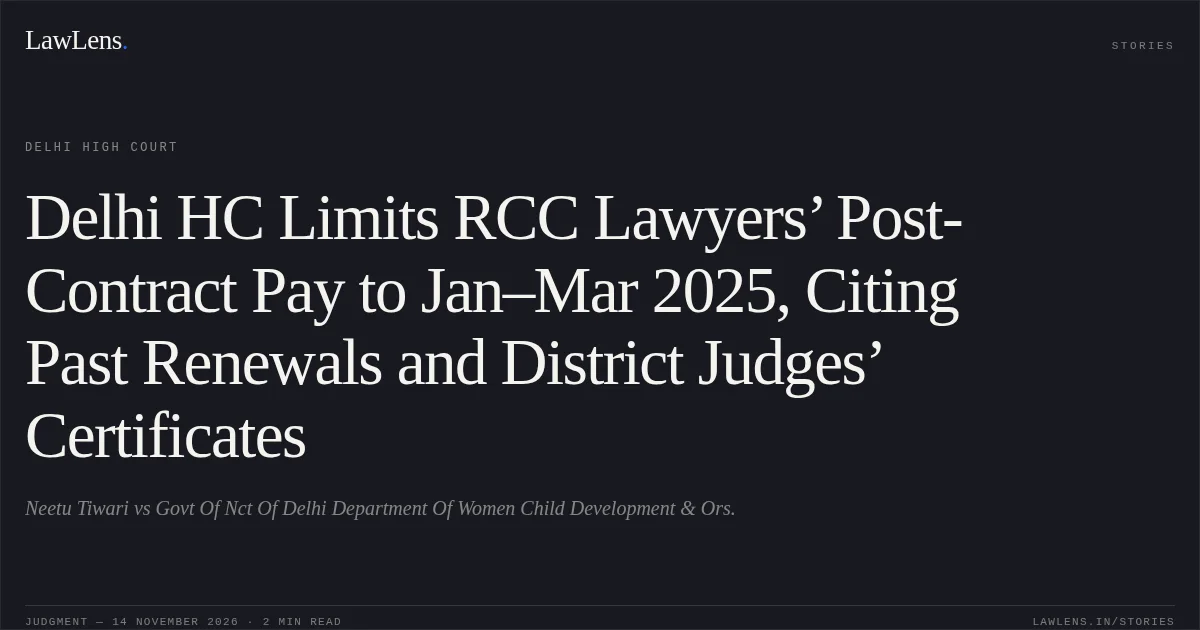
The petitioners were advocates engaged through NGOs under the Delhi Commission for Women’s Rape Crisis Cell (RCC), with contracts that were extended from time to time and were due to expire on 31 December 2024.
¶ 1–13 · pp. 3–6After the respondents withheld contractual dues, the advocates pursued writ and contempt proceedings; the DCW later stated that the RCC programme and related agreements had ended on that date.
¶ 1–13 · pp. 3–6The petitioners claimed they continued to assist victims in court after expiry and sought remuneration for work performed from January to October 2025.
¶ 14–18 · pp. 6–7The DCW denied liability, asserting that the engagements were not renewed and any post-expiry appearances were unauthorised.
¶ 14–18 · pp. 6–7The surviving issue was entitlement to remuneration for services allegedly rendered after 31 December 2024.
¶ 17 · p. 702Issues
i.1. Whether the petitioners were entitled to remuneration for services rendered after their contractual engagements expired on 31 December 2024, despite the RCC programme and related agreements not being extended.
¶ 17 · p. 7ii.2. Whether remuneration, if payable, should extend to the entire period claimed through 31 October 2025 or be limited to a shorter period.
¶ 23–25 · pp. 9–1003Law Applied
The judgment cites no statute, regulation, or precedent as the basis for its decision.
It applies the principles that contractual expiry and absence of formal renewal weigh against continued entitlement to remuneration, while services actually rendered may warrant payment in the circumstances of the case.
¶ 20–25 · pp. 8–9A prior course of belated renewals may support a bona fide expectation of renewal and explain continued work immediately after expiry, but that expectation cannot subsist indefinitely where the workers know their contracts have not been extended.
¶ 20–25 · pp. 8–904Reasoning
The Court accepted that the petitioners knew their contracts had expired and had sought clarification about renewal, and that the RCC programme had been discontinued.
¶ 19, 23 · p. 7, 9However, the previous practice of extensions after expiry made their claimed initial reliance on anticipated renewal not wholly implausible.
¶ 20–22 · pp. 8–9Certificates from District Judges supported their assertion that they continued to provide assistance; the Court considered those certificates relevant notwithstanding the respondents’ objection that the appearances were not recorded in order sheets.
¶ 20–22 · pp. 8–9Balancing that evidence and the past course of dealing against the absence of formal extensions and the programme’s discontinuance, the Court found that payment was justified only for the period immediately following expiry, not for the full period claimed.
¶ 23–25 · p. 905Holding
The Court held that the petitioners were entitled to remuneration for the period from 1 January to 31 March 2025, but not for the entire period claimed through 31 October 2025.
¶ 25 · p. 9The respondents were permitted to withdraw the amount deposited with the Court and directed to disburse the remuneration due for that period, together with accrued interest, within three weeks.
¶ 26–28 · pp. 9–10The petitions and pending applications were disposed of accordingly.
¶ 26–28 · pp. 9–10Original Court PDF
Neetu TiwarivsGovt Of Nct Of Delhi Department Of Women Child Development & Ors.
Click to open original judgment
Original judgment, available to read, download and summarize on LawLens.in