01Facts
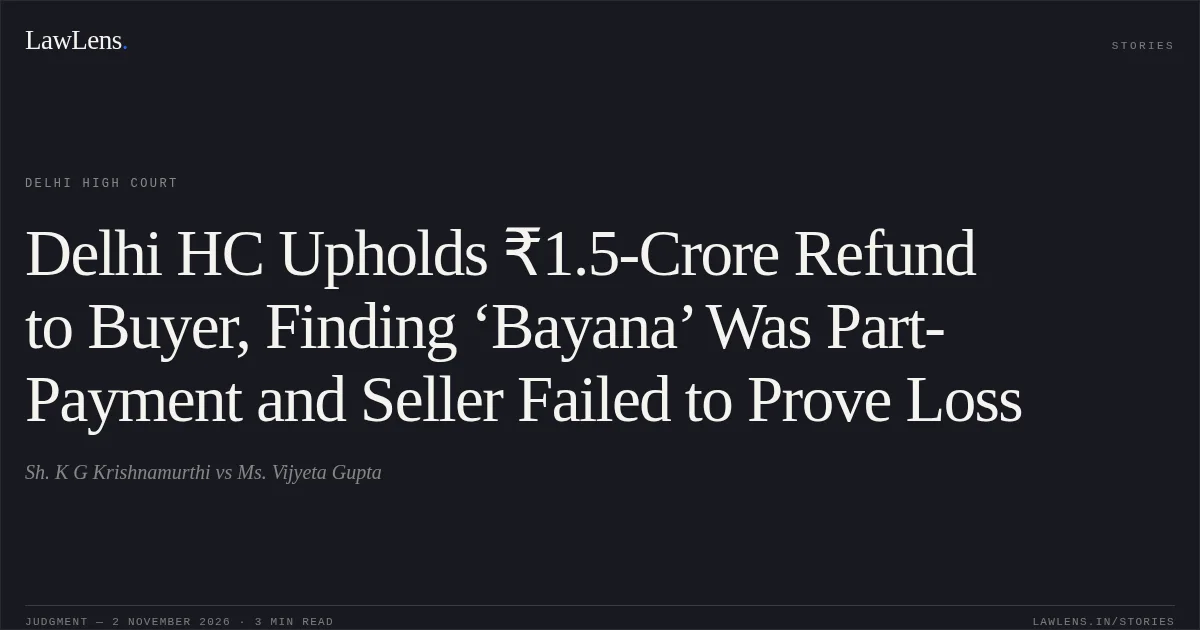
The parties entered into an agreement to sell the appellant’s property for ₹12.8 crore on 15 February 2016.
pp. 10–12The respondent paid ₹1.5 crore, described in the agreement as bayana, and the balance was payable by 15 August 2016; the agreement also recorded that she would obtain a loan to fund the balance.
pp. 10–12, 16After the transaction did not complete, the respondent sued to recover the ₹1.5 crore.
pp. 1, 3–5, 7–8The appellant claimed that the amount had been forfeited and counterclaimed ₹1 crore in damages.
pp. 1, 3–5, 7–8The trial court decreed recovery of ₹1.5 crore with 4% interest and dismissed the counterclaim.
pp. 1, 3–5, 7–8The appellant appealed and sought to introduce additional evidence concerning alleged loss in the property’s value.
pp. 8–10, 2002Issues
i.1. Whether the ₹1.5 crore paid under the agreement was liable to forfeiture as earnest money, or was recoverable as part-payment of the sale consideration
pp. 16–18ii.2. Whether the appellant established loss or legal injury entitling him to forfeit the payment or recover ₹1 crore in damages
pp. 17–20iii.3. Whether the appellant satisfied the requirements of Order XLI Rule 27 CPC to produce additional evidence on appeal
pp. 20–2203Law Applied
Sections 73 and 74 of the Indian Contract Act, 1872, permit compensation for loss caused by breach; under Section 74, a stipulated sum is only a ceiling on reasonable compensation, and proof of the precise amount may be dispensed with only where loss is difficult or impossible to quantify—not proof of legal injury itself.
pp. 17–18Fateh Chand v. Balkishan Das, (1964) 1 SCR 515, and Kailash Nath Associates v. Delhi Development Authority, (2015) 4 SCC 136, establish that loss or damage is a condition for compensation under Section 74, and that a stipulated sum may be awarded where it is a genuine pre-estimate and the loss is difficult to prove.
p. 18Shree Hanuman Cotton Mills v. Tata Air Craft Ltd., (1969) 3 SCC 522; Videocon Properties Ltd. v. Bhalchandra Laboratories, (2004) 3 SCC 711; and Central Bank of India v. Shanmugavelu, (2024) 6 SCC 641, distinguish earnest money from part-payment and require the agreement’s terms, the parties’ intention, and surrounding circumstances to determine the payment’s character.
pp. 13–16Order XLI Rule 27 CPC permits additional evidence on appeal only in the specified circumstances, including due diligence or where the appellate court requires the evidence to pronounce judgment.
pp. 20–21Provisions in the judgment · 4 · Linked ones open on LawLens
Code of Civil Procedure, 1908 Section 96Section 151
Indian Contract Act, 1872 Section 73Section 74
04Reasoning
Although the payment was labelled bayana, the ₹1.5 crore formed part of the ₹12.8 crore consideration, with ₹11.3 crore remaining payable and a loan contemplated for payment of the balance.
pp. 16–17The court therefore treated the amount as part-payment, not forfeitable earnest money merely by virtue of its label.
pp. 16–17The appellant’s reliance on the respondent’s purchase of another property and general newspaper reports did not establish that the suit property had depreciated or that the appellant had suffered the claimed loss; no cogent evidence proved either the alleged ₹1 crore damage or other legal injury.
pp. 19–20The proposed additional documents were available at trial or did not meet the conditions in Order XLI Rule 27, and the application was an attempt to fill evidentiary gaps.
pp. 20–2205Holding
The court held that the ₹1.5 crore was not liable to forfeiture and that the appellant had failed to prove loss supporting his counterclaim.
pp. 16–20It dismissed the application for additional evidence and the appeal, thereby affirming the decree for recovery of ₹1.5 crore with interest at 4% per annum and the dismissal of the ₹1 crore counterclaim.
pp. 21–22Original Court PDF
Sh. K G KrishnamurthivsMs. Vijyeta Gupta
Click to open original judgment
Original judgment, available to read, download and summarize on LawLens.in