01Facts
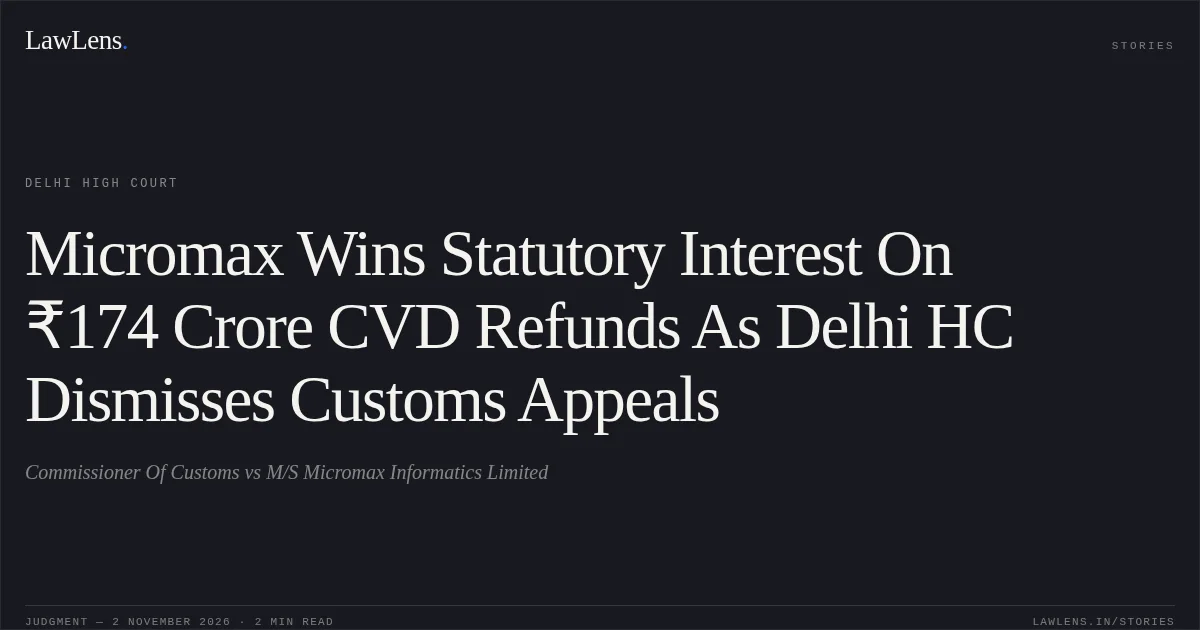
Micromax imported cellular phones and mobile parts during the relevant period and paid countervailing duty (CVD).
pp. 2–6Following the Supreme Court’s decision in SRF Ltd. v. Commissioner of Customs, Chennai, the duty was found not payable, and Micromax sought refunds.
pp. 2–6The adjudicating authority directed that the refunds be credited to the Consumer Welfare Fund under Section 27(2) of the Customs Act, 1962, on the ground of unjust enrichment.
pp. 2–6The Commissioner (Appeals) allowed the claims, finding that the CVD burden had not been passed on to customers; the CESTAT upheld that decision.
pp. 2–6The Department appealed, challenging the finding on unjust enrichment and the evidentiary value of Micromax’s chartered accountant’s certificate and financial records.
pp. 2–602Issues
i.1. Whether Micromax rebutted the presumption under Section 28D of the Customs Act that the incidence of duty had been passed on to buyers, so that the refunds were not liable to be credited to the Consumer Welfare Fund.
pp. 5–6ii.2. Whether the CESTAT’s decision upholding the Commissioner (Appeals)’ factual findings involved an error of law, perversity, or a substantial question of law warranting interference in appeal.
pp. 6–703Law Applied
Section 27(2) of the Customs Act governs whether a refund is payable to the claimant or must be credited to the Consumer Welfare Fund; Section 28D presumes that the incidence of duty has been passed on to the buyer, a presumption the claimant must rebut.
pp. 2, 5–6SRF Ltd. v. Commissioner of Customs, Chennai, (2015) 14 SCC 596, established that CVD was not payable on the relevant imports.
p. 4Board Circular No. 18/2010 dated 7 August 2010 supported reliance on a chartered accountant’s certificate when assessing whether duty incidence had been passed on.
p. 7The Court also relied on Principal Commissioner of Customs (ACC Imports) v. Nokia India Sales Pvt. Ltd., 2025:DHC:5400-DB, for the proposition that a chartered accountant’s certificate should not be ignored, particularly when corroborated by books of account and other documents.
p. 6 · p. 7Provisions in the judgment · 1 · Linked ones open on LawLens
Customs Act,1962 Section 27
04Reasoning
The Court treated the non-payment of CVD as established and the dispute as confined to unjust enrichment and the sufficiency of Micromax’s evidence.
p. 5Micromax had produced invoices, balance sheets for the relevant financial years, and a chartered accountant’s certificate.
pp. 6–7The Commissioner (Appeals) found that the invoices did not show CVD being recovered from buyers and that the accounting treatment relied on by the Department did not, by itself, prove that the burden had been passed on.
pp. 6–7The Court held that the adjudicating authority’s rejection of the certificate was contrary to the Board circular, and that the certificate was supported by other documents.
pp. 6–7The CESTAT’s affirmation of those factual findings disclosed no legal error or perversity.
pp. 6–705Holding
The Court held that the Department’s appeals raised no question of law, much less a substantial question of law, and dismissed all five appeals.
p. 7The orders allowing the refunds to Micromax, rather than crediting them to the Consumer Welfare Fund, were left undisturbed; pending applications were also disposed of.
p. 7Original Court PDF
Principal Commissioner Of Customs Acc Import New DelhivsMs Micromax Informatics Limited
Click to open original judgment
Original judgment, available to read, download and summarize on LawLens.in