Facts
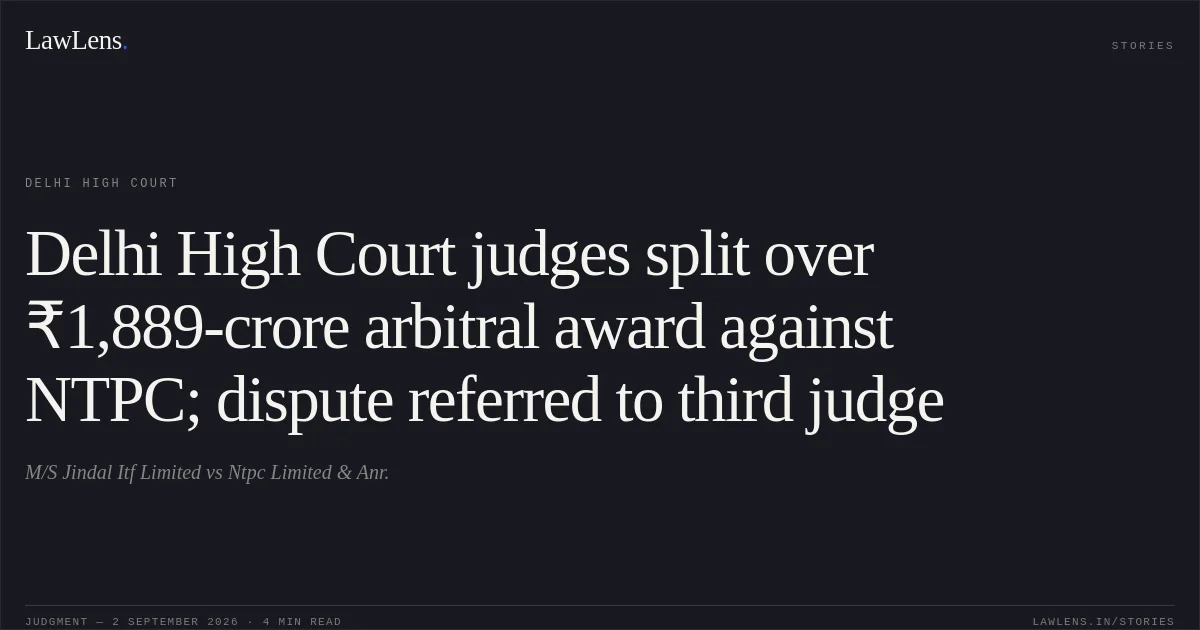
NTPC, IWAI and Jindal ITF Limited (“JITF”) executed a Tripartite Agreement on 11 August 2011 for transportation of imported coal to NTPC’s Farakka Thermal Power Plant through inland waterways.
Source reference: paras. 2–8JITF was required to construct Material Handling Systems in two phases, while NTPC was required to provide specified quantities of coal, including a Minimum Guaranteed Quantity (“MGQ”) of 3 MMTPA during the seven-year operation period.
Source reference: paras. 2–8Phase I and Phase II were completed with delays, and the COD was ultimately declared as 15 June 2015.
Source reference: para. 8JITF invoked arbitration and raised claims for delay-related losses, shortfall in MGQ during the first two operational years, and damages arising from NTPC’s consultation, termination and requisition notices.
Source reference: paras. 9–19The Arbitral Tribunal awarded JITF, inter alia, ₹424.08 crore under Claim 1, ₹158.50 crore and ₹197.81 crore under Claims 3 and 3A, and ₹1,108.93 crore under Claim 5A.
Source reference: paras. 20, 28.1, 32.15, 36.10NTPC challenged the award under Section 34 of the Arbitration and Conciliation Act, 1996. The learned Single Judge set aside the award in its entirety on 30 January 2025. JITF preferred the present appeal under Section 37.
Source reference: paras. 21–23Issues
Whether the learned Single Judge exceeded the limited scope of interference under Sections 34 and 37 of the Arbitration and Conciliation Act, 1996, in setting aside the arbitral award?
Source reference: paras. 25–26.6Whether JITF was entitled to compensation under Claim 1 for NTPC-attributable delays and deviations in construction, notwithstanding Article 3.2(b), which contemplated compensation through extension of COD?
Source reference: paras. 28–30.23Whether NTPC breached its obligation to provide the MGQ under Article 7.3 during the first and second years of the operation period, and whether the environmental-clearance restriction reducing permissible imports to 1.5 MMTPA altered NTPC’s contractual MGQ obligation?
Source reference: paras. 31–35Whether NTPC’s consultation notice, termination notice and requisition notice were invalid, and whether JITF could claim damages for the remaining contractual period by reference to the MGQ mechanism under Article 7.3?
Source reference: paras. 36–38.18Whether the arbitral award relating to claims other than Claims 1, 3, 3A and 5A could be set aside without specific consideration of those claims by the learned Single Judge?
Source reference: paras. 39–40Law Applied
The Court applied Sections 34 and 37 of the Arbitration and Conciliation Act, 1996, holding that a court cannot sit in appeal over an arbitral award, reappreciate evidence or substitute its own view merely because another interpretation is possible.
Source reference: paras. 26.1–26.6Interference is permissible only on the statutory grounds, including conflict with the fundamental policy of Indian law and patent illegality appearing on the face of a domestic award under Section 34(2A).
Source reference: paras. 26.4–26.5Relying on Associate Builders v. DDA, Ssangyong Engineering & Construction Co. Ltd. v. NHAI, MMTC Ltd. v. Vedanta Ltd., PSA Sical Terminals (P) Ltd. v. V.O. Chidambranar Port Trust, Delhi Metro Rail Corporation v. Delhi Airport Metro Express (P) Ltd., and OPG Power Generation (P) Ltd. v. Enexio Power Cooling Solutions (India) (P) Ltd., the Court reiterated that patent illegality must go to the root of the matter; perversity may arise from a finding based on no evidence, irrelevant material or disregard of vital evidence; and a reasonable or possible contractual interpretation by the arbitrator cannot be interfered with.
Source reference: paras. 26.4–26.5Sections 73 and 74 of the Contract Act, 1872 were applied to compensation for breach and reasonable compensation based on genuine pre-estimated damages, subject to the contractual terms and the requirement of legal injury.
Source reference: paras. 30.3, 38.3–38.5Reasoning
The majority held that the learned Single Judge impermissibly reassessed the merits of the award.
Source reference: no citationFor Claim 1, the majority concluded that Article 3.2(b) did not exclude compensation under Section 73 of the Contract Act where extension of COD had become unavailable due to NTPC’s subsequent termination; the tabulated loss was supported by the contractual quantity, actual coal supplied, applicable rates and unchallenged evidence.
Source reference: paras. 30.2–30.4, 30.13–30.21For Claims 3 and 3A, the majority held that Article 7.3 continued to prescribe an MGQ of 3 MMTPA and could not be unilaterally reduced to 1.5 MMTPA by an environmental-clearance communication.
Source reference: paras. 34.3–34.16The restriction was attributed to NTPC’s failure to obtain the necessary environmental approval and study, and NTPC had not established force majeure or any contractual modification of the MGQ.
Source reference: paras. 34.3–34.16Regarding Claim 5A, the majority held that wrongful termination constituted a breach; Article 14.1(c) applied to termination due to NTPC default and not to an allegedly wrongful termination by NTPC, and the MGQ formula could serve as a genuine pre-estimate of damages for the remaining term.
Source reference: paras. 38.1, 38.7–38.18The dissenting Judge disagreed. He held that Article 3.2(b) prescribed the exclusive form of compensation—extension of COD—and that the Tribunal could not replace it with monetary damages.
Source reference: paras. 10–30He further held that Articles 3.1(c)(ii) and 7.1(c)(vii) placed responsibility for permits and clearances on JITF, and that Article 14.1(c) supplied the specific termination-compensation mechanism, making the award of five years’ MGQ a rewriting of the contract.
Source reference: paras. 45–55, 56–75Holding
The majority judgment allowed the appeal, set aside the learned Single Judge’s judgment, and upheld the arbitral award in its entirety, including Claims 1, 3, 3A and 5A, with no order as to costs.
However, Justice Om Prakash Shukla dissented and would have affirmed the Single Judge’s decision setting aside the disputed claims.
Source reference: paras. 75–76Because of the difference of opinion, the Division Bench framed the following point for reference to a third Judge or larger Bench: “Whether the decision of the learned Single Judge, with respect to Claims 1, 3 and 3A and 5A is sustainable in law?”
Source reference: p. 141Accordingly, the matter was directed to be placed before the Chief Justice for appropriate orders; the final binding disposition on those claims remained subject to the reference.
Source reference: p. 141Acts & Sections Cited
14 provisions across 3 statutes referred to in this judgment. Each provision opens on LawLens.
Arbitration and Conciliation Act, 1996
Indian Contract Act, 18722
Original Court PDF
M/S Jindal Itf LimitedvsNtpc Limited & Anr.
Click to open original judgment
Original judgment, available to read, download and summarize on LawLens.in