Facts
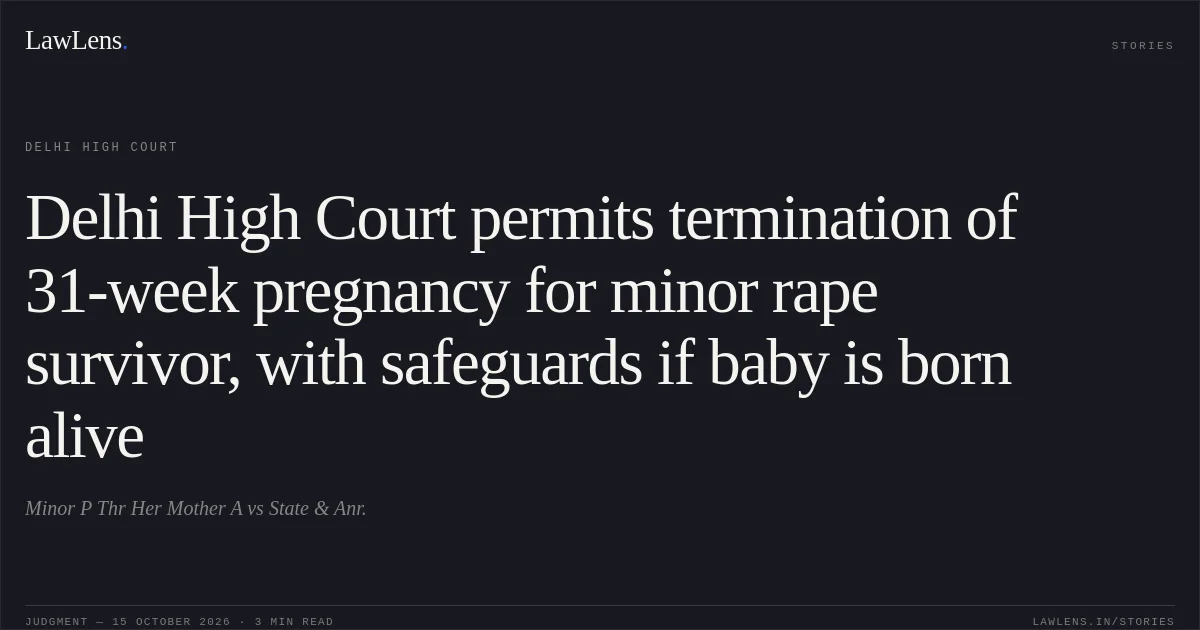
The petitioner, a 16-year-old minor represented by her mother, sought medical termination of a pregnancy resulting from rape.
Source reference: p. 1–3At approximately 31 weeks’ gestation, she and her mother wished to terminate the pregnancy, stating that its continuation would cause grave mental injury to the petitioner.
Source reference: p. 1–3The Medical Board at Lady Hardinge Medical College and Hospital found her physically fit for termination but reported that the baby was likely to be born alive.
Source reference: p. 1–3The petitioner had been admitted to the hospital, and her mother confirmed that the family wished to proceed
Source reference: p. 6–7Issues
Whether the Court could permit termination of the minor’s pregnancy at approximately 31 weeks, beyond the statutory gestational limits under the Medical Termination of Pregnancy Act, 1971
Source reference: p. 1–2, 6–7Whether termination should be permitted in light of the minor’s expressed wishes, the circumstances of the pregnancy, and the Medical Board’s opinion that she was physically fit for the procedure
Source reference: p. 2–3, 6–7Law Applied
The Court invoked Articles 226 and 21 of the Constitution and Section 528 of the Bharatiya Nagarik Suraksha Sanhita, 2023, alongside the Medical Termination of Pregnancy Act, 1971, as amended in 2021.
Source reference: p. 1Relying principally on S v. Union of India & Ors., SLP (C) No. 14454/2026, judgment dated 24 April 2026, the Court applied the principle that constitutional courts exercising jurisdiction under Articles 226 or 32 are not confined to the statutory gestational limits of the MTP Act and must give primary consideration to the pregnant person’s welfare, dignity, bodily integrity, and reproductive autonomy, particularly where the pregnant person is a minor and the pregnancy is unwanted.
Source reference: p. 3–6The Court also referred to decisions permitting termination beyond the statutory limit, including Minor S (Thr. Father B) v. State & Anr., 2025: DHC: 2710; Venkatalakshmi v. State of Karnataka & Ors., 2017 SCC OnLine SC 2156; Mrs. X v. GNCTD & Anr., W.P. (C) 16607/2022; Minor S through her guardian B v. State, Government of NCT of Delhi, W.P. (Crl.) 2763/2026; and Minor R Thr. Mother H v. State NCT of Delhi & Anr., 2023 SCC OnLine Del 383.
Source reference: p. 3, 6Reasoning
The Court treated the petitioner’s status as a minor rape survivor, her and her mother’s express wish to terminate, and the Medical Board’s finding that she was physically fit as central considerations.
Source reference: p. 2–3, 5–7Applying the constitutional principles set out in S v. Union of India, it held that the statutory gestational limit did not bar relief in the Court’s constitutional jurisdiction and that the petitioner’s welfare and reproductive autonomy warranted priority.
Source reference: p. 2–3, 5–7The Board’s assessment that the baby was likely to be born alive informed the safeguards imposed, but did not prevent the Court from granting permission.
Source reference: p. 2–3, 5–7Holding
The Court allowed the petition and permitted termination of the pregnancy, directing that the procedure be performed by competent doctors in accordance with the applicable law and that the hospital maintain a complete record and preserve foetal tissue for DNA testing.
The State was directed to bear the costs of the procedure, hospital stay, and post-operative care.
Source reference: p. 7–8If the child was born alive, the hospital and State were to provide medical support, including incubator care, notify the Child Welfare Committee, and follow the prescribed adoption procedure if so wished by the minor and her family.
Source reference: p. 7–8The Court also ordered protection of the petitioner’s identity and directed that any compensation released under the Delhi Victim Compensation Scheme, 2018, be kept in an FDR until she attained majority.
Source reference: p. 7–8Acts & Sections Cited
1 provisions across 1 statute referred to in this judgment. Each provision opens on LawLens.
Bharatiya Nagarik Suraksha Sanhita, 20231
Original Court PDF
Minor P Thr Her Mother AvsState & Anr.
Click to open original judgment
Original judgment, available to read, download and summarize on LawLens.in