Facts
Himanshi participated in the SSC Combined Higher Secondary Level Examination, 2019, Tier-I, conducted through a computer-based examination. She appeared at Avirat Education Society, Haridwar, and was subsequently declared successful in Tiers II and III and called for document verification.
Source reference: paras. 15–16Her result was withheld along with those of other candidates on suspicion of unfair means involving “de-mapping” from an allotted computer terminal to another allegedly compromised terminal.
Source reference: para. 16An SSC Committee examined CCTV footage, log trails, answering patterns, time differentials, IP/MAC addresses and other technical indicators, and classified Himanshi as a suspect.
Source reference: paras. 17, 26–27Following a show-cause notice and her reply, the SSC cancelled her candidature and debarred her from SSC examinations for seven years under Clause 19(19) of the examination notice.
Source reference: paras. 19–22The Central Administrative Tribunal allowed her Original Application and set aside the cancellation and debarment order.
Source reference: para. 23Issues
Whether the SSC Committee’s finding that Himanshi had used unfair means was supported by sufficient and legally sustainable material, warranting interference under Article 226 of the Constitution.
Source reference: paras. 39–42, 53–59Whether the High Court could interfere with the decision of an expert examination committee when the finding was based on circumstantial and technical evidence.
Source reference: paras. 43–48.7Whether cancellation of Himanshi’s candidature and her seven-year debarment from SSC examinations were sustainable on the facts of her individual case.
Source reference: paras. 49–50, 74–83Law Applied
The Court applied the principles governing limited judicial review under Article 226 in cases concerning unfair means in examinations.
Source reference: no citationUnder Board of High School and Intermediate Education, U.P. v. Bagleshwar Prasad, courts ordinarily defer to examination committees, but may interfere where the decision is unsupported by evidence, procedurally unfair or legally irrational; circumstantial evidence may be relied upon.
Source reference: paras. 44.2–44.8Bihar School Education Board v. Subhas Chandra Sinha established that overwhelming circumstantial evidence may justify action to preserve examination integrity, although a candidate proceeded against individually must receive a fair opportunity to defend.
Source reference: paras. 45.4–45.6Ghazanfar Rashid v. Board of High School and Intermediate Education, as approved in Maharashtra State Board of Secondary and Higher Secondary Education v. K.S. Gandhi, holds that courts should not reappreciate evidence or substitute their view for that of an expert committee, but may intervene where the decision is arbitrary, perverse, based on no evidence, or contrary to natural justice.
Source reference: paras. 46.1–47.6The Court also relied on University of Delhi v. Deepak to hold that a focused inquiry into centres displaying objectively suspicious patterns is not arbitrary if guided by an intelligible criterion.
Source reference: paras. 48.3–48.7However, the Court emphasised that where selected candidates alone are penalised, the authorities must establish the case against each candidate individually.
Source reference: paras. 6–8Reasoning
The Court accepted that the SSC was entitled to identify and scrutinise examination centres with unusually high levels of de-mapping and that such focused scrutiny was not, by itself, arbitrary.
Source reference: paras. 48.6–48.7Nevertheless, the Committee’s general observations regarding Avirat Education Society—such as suspected compromised terminals, remote access and rapid answering—did not establish that Himanshi herself had employed unfair means.
Source reference: paras. 56–59She was not identifiable in the CCTV footage, and there was no evidence showing that she had been shifted for an ulterior purpose or that her original terminal was functioning properly.
Source reference: paras. 59–60, 66, 73, 78More importantly, the SSC’s rejoinder identified her second terminal as having MAC address D4BED9CCAA3B, whereas the Committee’s own Annexure 5 listed different MAC addresses as the allegedly compromised terminals at that centre; the terminal used by Himanshi was therefore not shown to be compromised.
Source reference: paras. 61.1–64The Court also found material inconsistencies between the Committee report and the SSC’s rejoinder regarding the number of questions attempted, the time spent on each terminal and the period during which no questions were attempted.
Source reference: paras. 67–69No remote-access software, external operator, LAN connection or comparable use by another candidate was identified in her case.
Source reference: paras. 70–77Although courts must not reappreciate technical evidence merely because another view is possible, the cumulative discrepancies and absence of candidate-specific evidence rendered the finding against Himanshi arbitrary and unsustainable, rather than merely inadequate.
Source reference: paras. 74, 80–82Holding
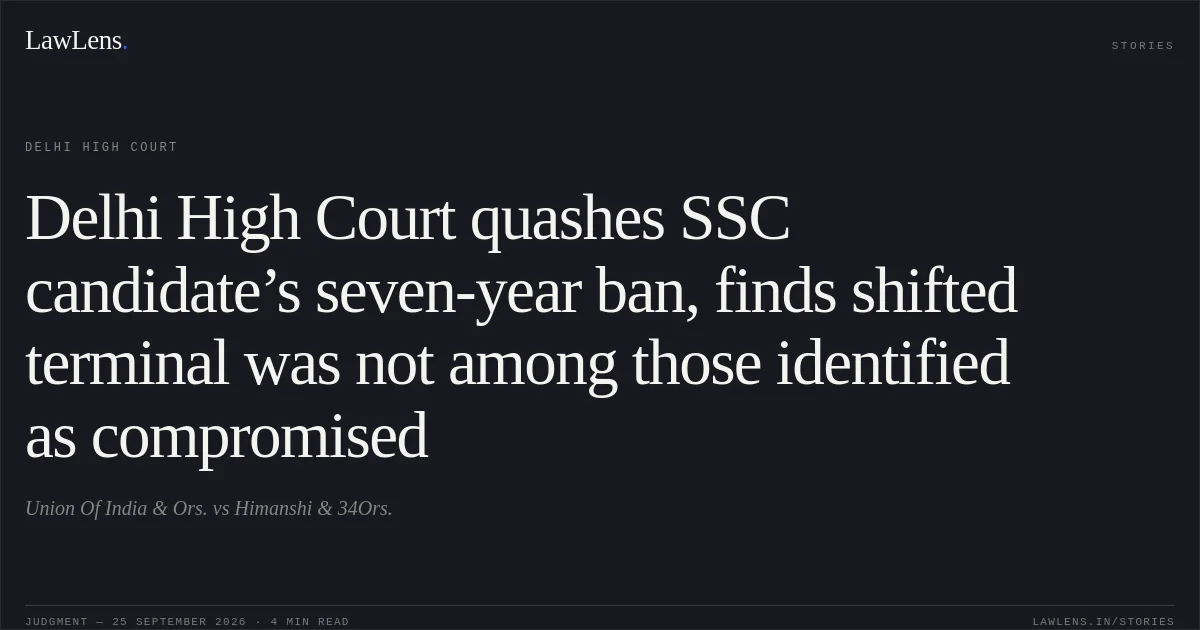
The Delhi High Court held that the SSC had failed to establish, on the material relied upon by its Committee, that Himanshi had used unfair means.
The finding against her, and the consequential cancellation of her candidature and seven-year debarment, were therefore unsustainable on facts and in law.
Source reference: paras. 79–83The writ petition was dismissed without costs, and the Tribunal’s decision was upheld insofar as it concerned Himanshi.
Source reference: paras. 84–85The SSC was directed to pass the resultant orders in accordance with law within four weeks.
Source reference: para. 86The Court clarified that its decision was confined to Himanshi and did not determine the merits of the other candidates’ cases.
Source reference: para. 87Original Court PDF
Union Of India & Ors.vsHimanshi & 34Ors.
Click to open original judgment
Original judgment, available to read, download and summarize on LawLens.in