Facts
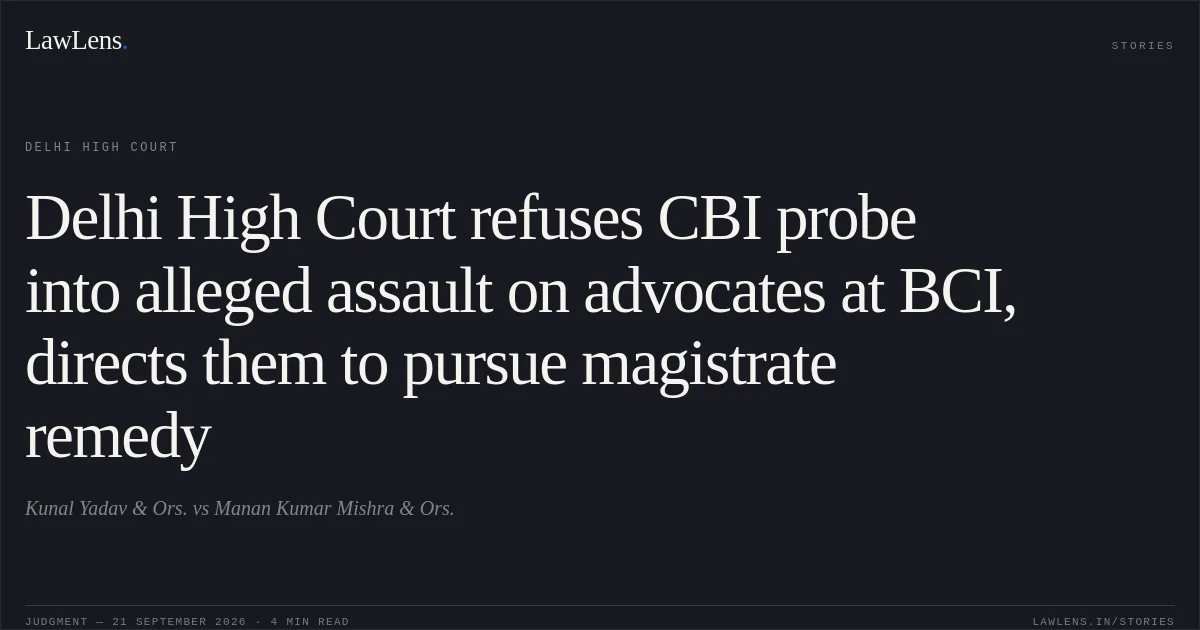
The petitioners, practicing advocates, alleged that they were assaulted by a group of persons inside the Bar Council of India premises during the night of 20–21 August 2026, in the presence of police personnel.
Source reference: pp. 2–4The petitioners submitted a complaint to the SHO, P.S. I.P. Estate, on 22 August 2026, and representations to the Bar Council of India and the President of the Delhi High Court Bar Association, but alleged that no effective action was taken.
Source reference: p. 4They invoked Article 226 of the Constitution seeking directions to the CBI or another independent agency to register an FIR and investigate, preservation and production of CCTV footage, and a direction to the Bar Council of India to decide their representation.
Source reference: pp. 2, 4–5At the preliminary hearing, the Court required the petitioners to address the maintainability of the writ petition in view of the statutory remedies under the BNSS.
Source reference: pp. 5–6Issues
Whether a writ petition under Article 226 of the Constitution is maintainable for seeking directions to register a criminal case and conduct an investigation when remedies under the BNSS have not been exhausted?
Source reference: pp. 6–11; paras. 5–7Whether the allegations made by the petitioners disclosed a cognizable offence warranting a direction for registration of an FIR and investigation by the CBI or another agency?
Source reference: pp. 11–12; para. 8Whether the petitioners were entitled to a writ directing the Bar Council of India to consider and decide their representation dated 20 August 2026?
Source reference: pp. 12–13; para. 9.1Law Applied
The Court applied the principle that the extraordinary and discretionary jurisdiction under Article 226 ordinarily should not be exercised where an alternate efficacious statutory remedy exists, subject to recognised exceptions such as enforcement of fundamental rights, breach of natural justice, lack of jurisdiction, or a challenge to legislative validity.
Source reference: pp. 6–7; para. 5.1Relying on Thansingh Nathmal v. Superintendent of Taxes, 1964 SCC OnLine SC 13, and Sujal Vishwas Attavar v. State of Maharashtra, 2026 INSC 442, the Court held that a person alleging non-registration of an FIR or defective investigation should ordinarily first pursue the sequential remedies under the BNSS.
Source reference: pp. 7, 9–11; paras. 5.2, 6.2Under Sections 173(4) and 175(3) BNSS, the complainant may approach the Superintendent of Police and thereafter the Magistrate; a private complaint may also be instituted under Section 223 BNSS.
Source reference: pp. 8–10; paras. 6.1–6.2Further, under Sections 114 BNS and 174 BNSS, simple hurt was treated as a non-cognizable offence, which could not ordinarily be investigated by the police without a Magistrate’s order.
Source reference: p. 12; para. 8Reasoning
The Court held that the petitioners had approached the High Court prematurely.
Source reference: p. 11; para. 7Although they had complained to the SHO, they had neither approached the concerned DCP, equivalent to the Superintendent of Police, nor invoked the jurisdiction of the Magistrate under Section 175(3) BNSS or filed a complaint under Section 223 BNSS.
Source reference: p. 11; para. 7They also failed to demonstrate why these statutory remedies were unavailable or inefficacious.
Source reference: p. 11; para. 7On the substance of the allegations, the Court found that the complaints principally alleged beating, slapping, thrashing and dragging, without any allegation that the assailants used weapons.
Source reference: pp. 11–12; para. 8In the Court’s view, the allegations at most disclosed the offence of causing hurt under Section 114 BNS, a non-cognizable offence; consequently, the police could not investigate it in the ordinary course under Section 174 BNSS without appropriate magisterial intervention.
Source reference: pp. 11–12; para. 8The Court rejected the argument that a Magistrate could not secure CCTV footage, observing that the Magistrate’s powers under Chapter XVI of the BNSS were sufficient and that the petitioners themselves claimed that videos of the incident were already in the public domain.
Source reference: p. 12; para. 8Since the principal reliefs were not maintainable, the connected prayer seeking a direction to the Bar Council of India to decide the representation was also declined; in any event, the representation’s demands concerning resignation, accountability, welfare, legal education reform and a no-confidence motion were held unrelated to the investigation prayer.
Source reference: pp. 12–13; para. 9.1Holding
The High Court dismissed the writ petition as not maintainable.
It held that the petitioners had an alternate efficacious remedy under the BNSS, including approaching the DCP, the concerned Magistrate under Section 175(3), or filing a complaint under Section 223 BNSS, and that they had not exhausted those remedies.
Source reference: p. 12; para. 9The Court also found that the allegations, as pleaded, did not disclose a cognizable offence justifying a direction to register an FIR or transfer the matter to the CBI.
Source reference: pp. 11–12; paras. 8–9No direction was issued for preservation of CCTV footage or for consideration of the representation by the Bar Council of India.
Source reference: p. 13; para. 9.1The petition was accordingly dismissed.
Source reference: p. 13; para. 10Acts & Sections Cited
8 provisions across 3 statutes referred to in this judgment. Each provision opens on LawLens.
Code of Criminal Procedure, 19733
Bharatiya Nagarik Suraksha Sanhita, 20234
Bharatiya Nyaya Sanhita, 20231
Original Court PDF
Kunal Yadav & Ors.vsManan Kumar Mishra & Ors.
Click to open original judgment
Original judgment, available to read, download and summarize on LawLens.in