Facts
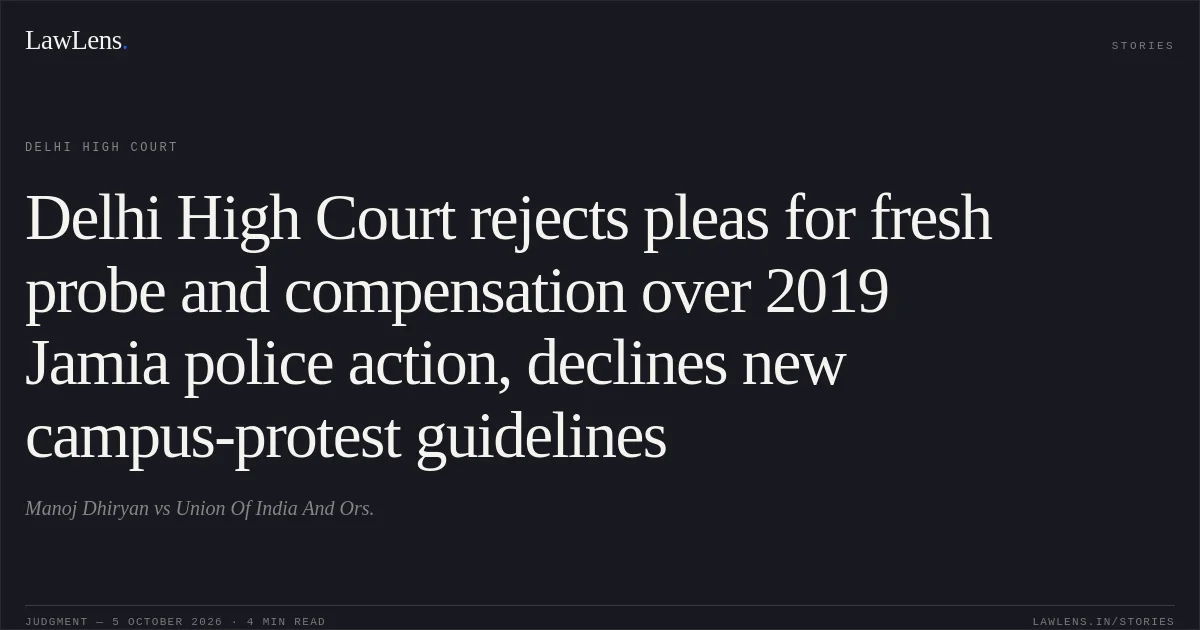
The petitions arose from protests against the Citizenship Amendment Act, 2019 and proposed National Register of Citizens, and alleged police use of excessive force at and around Jamia Millia Islamia University, particularly on 15 December 2019.
Source reference: para. 10–20, 41–46, 59, 77, 94–99Petitioners alleged that police entered the campus without authorisation, used force in academic buildings including the library, and caused injuries and unlawful detentions.
Source reference: para. 10–20, 41–46, 59, 77, 94–99FIR Nos. 242/2019 and 298/2019 were registered; investigation was conducted by the Crime Branch SIT and charge-sheets were filed.
Source reference: para. 10–20, 41–46, 59, 77, 94–99The NHRC investigated the incidents and, while identifying violence and damage to property, also noted a lack of restraint by police and recommended, among other measures, compensation and accountability.
Source reference: para. 10–20, 41–46, 59, 77, 94–99Jamia Millia Islamia’s application under Section 156(3) CrPC seeking criminal proceedings against police officials was dismissed for want of sanction under Section 197 CrPC; that order was not challenged.
Source reference: para. 10–20, 41–46, 59, 77, 94–99The surviving prayers concerned an independent inquiry or investigation, compensation and medical expenses, guidelines for police action at educational institutions, and preservation of evidence.
Source reference: para. 10–20, 41–46, 59, 77, 94–99Issues
1. Whether the Court should order an independent inquiry, committee, SIT or other mechanism into the alleged police excesses, or direct registration and independent investigation of offences against police personnel.
Source reference: para. 29–30, 37–382. Whether the petitioners were entitled to public-law compensation, reimbursement of medical expenses or other monetary relief for alleged injuries and rights violations.
Source reference: para. 59–60, 63–693. Whether fresh guidelines regulating police action during protests within educational institutions should be framed.
Source reference: para. 77–804. Whether further directions were required to preserve CCTV footage and other evidence, or to grant ancillary relief.
Source reference: para. 94–102Law Applied
Under Articles 226 and 32 of the Constitution, constitutional courts may direct an independent investigation in rare and exceptional cases, such as where the existing investigation is demonstrably tainted or incapable of inspiring confidence; dissatisfaction alone is insufficient (State of West Bengal v. Committee for Protection of Democratic Rights, (2010) 3 SCC 571; K.V. Rajendran v. Superintendent of Police, (2013) 12 SCC 480; Romila Thapar v. Union of India, (2018) 10 SCC 753).
Source reference: para. 38–39Criminal-law remedies, including those under Sections 154(3) and 156(3) CrPC, should ordinarily be pursued before invoking writ jurisdiction to challenge police inaction or investigation (Sakiri Vasu v. State of U.P., (2008) 2 SCC 409).
Source reference: para. 40Public-law compensation may be awarded for an established infringement of fundamental rights, particularly Article 21, but is not automatic and is inappropriate where liability depends on disputed facts requiring a trial-like inquiry (Rudul Sah v. State of Bihar, (1983) 4 SCC 141; Bhim Singh v. State of J&K, (1985) 4 SCC 677; Nilabati Behera v. State of Orissa, (1993) 2 SCC 746; Chairman, GRIDCO v. Sukamani Das, (1999) 7 SCC 298).
Source reference: para. 63–70Police action must comply with constitutional and statutory requirements of necessity, reasonableness and proportionality; the right to peaceful assembly under Articles 19(1)(a) and 19(1)(b) does not extend to violence or destruction of property. University status is relevant, but does not absolutely bar police entry where immediate intervention is necessary; authorities should ordinarily be informed or consulted where circumstances permit.
Source reference: para. 84–89Reasoning
The Court declined a fresh inquiry because FIRs had been investigated by a Crime Branch SIT, charge-sheets had been filed, the NHRC had independently examined the events, and no material showed that the existing processes were biased, tainted or fundamentally unreliable.
Source reference: para. 41–58The unchallenged dismissal of the University’s Section 156(3) application and the absence of demonstrated institutional failure further weighed against intervention; the Court left the merits of pending criminal proceedings to the competent courts.
Source reference: para. 41–58Compensation was refused because the parties presented sharply divergent accounts and individual claims required findings on the nature, cause and circumstances of each injury.
Source reference: para. 66–75The NHRC’s recommendations did not establish individual liability, and the petitioners had not shown that they pursued implementation or other available remedies.
Source reference: para. 66–75The Court found no need for new institutional rules: existing constitutional and legal standards already required restraint and proportionality, while the circumstances involved escalating violence and a rapidly developing situation.
Source reference: para. 81–93, 96–99It also noted the State’s affidavit that the CCTV footage had been preserved and that evidentiary questions belonged before the courts handling the criminal proceedings.
Source reference: para. 81–93, 96–99Holding
The Court rejected the prayers for an independent inquiry or investigation, compensation and medical expenses, fresh guidelines for police action at educational institutions, and further evidence-preservation or ancillary directions.
It clarified that the judgment did not determine the merits or culpability of any individual and did not preclude a person from pursuing remedies otherwise available in law.
Source reference: para. 57–58, 76, 93, 99–108All writ petitions were dismissed; pending applications were disposed of, with no order as to costs.
Source reference: para. 57–58, 76, 93, 99–108Acts & Sections Cited
24 provisions across 3 statutes referred to in this judgment. Each provision opens on LawLens.
Indian Penal Code, 1860
Code of Criminal Procedure, 1973
Original Court PDF
Manoj DhiryanvsUnion Of India And Ors.
Click to open original judgment
Original judgment, available to read, download and summarize on LawLens.in