Facts
The prosecutrix alleged that respondent No. 2 secretly recorded a video of her while she was bathing and threatened to circulate it, thereby coercing her into repeated sexual relations.
Source reference: pp. 2–4, 10She also alleged that he pressured her to seek a divorce and to take cash and jewellery.
Source reference: pp. 2–4, 10After investigation, including examination of recovered phones that yielded no data, the police filed charge-sheets.
Source reference: pp. 2–4, 10The Trial Court discharged respondent No. 2, relying in part on the video’s non-recovery, the circumstances of the alleged recording, and the prosecutrix’s conduct. The prosecutrix challenged the discharge order in revision.
Source reference: pp. 2–4, 10Issues
1. Whether the Trial Court applied the correct principles under Sections 227 and 228 Cr.P.C. when it discharged respondent No. 2.
Source reference: para. 182. Whether the Trial Court could reject the prosecutrix’s allegations at the charge stage based on the video’s non-recovery, perceived improbabilities, and her conduct.
Source reference: paras. 22–27Law Applied
Under Sections 227 and 228 Cr.P.C., the court at the charge stage considers whether the material discloses sufficient ground to proceed; grave suspicion may justify framing a charge, but the court must not conduct a mini-trial or meticulously assess evidence (Sajjan Kumar v. CBI, (2010) 9 SCC 368; CBI v. Aryan Singh, (2023) 18 SCC 399).
Source reference: paras. 19–21The court may sift and weigh material for this limited purpose, but should not determine whether conviction will ultimately follow.
Source reference: para. 19Section 53A of the Indian Evidence Act, 1872, provides that evidence of a victim’s character or previous sexual experience is not relevant to consent or its quality in the specified sexual-offence prosecutions.
Source reference: para. 27The High Court exercised revisional jurisdiction under Sections 397 and 401 Cr.P.C. to review the legality of the discharge order.
Source reference: para. 1Reasoning
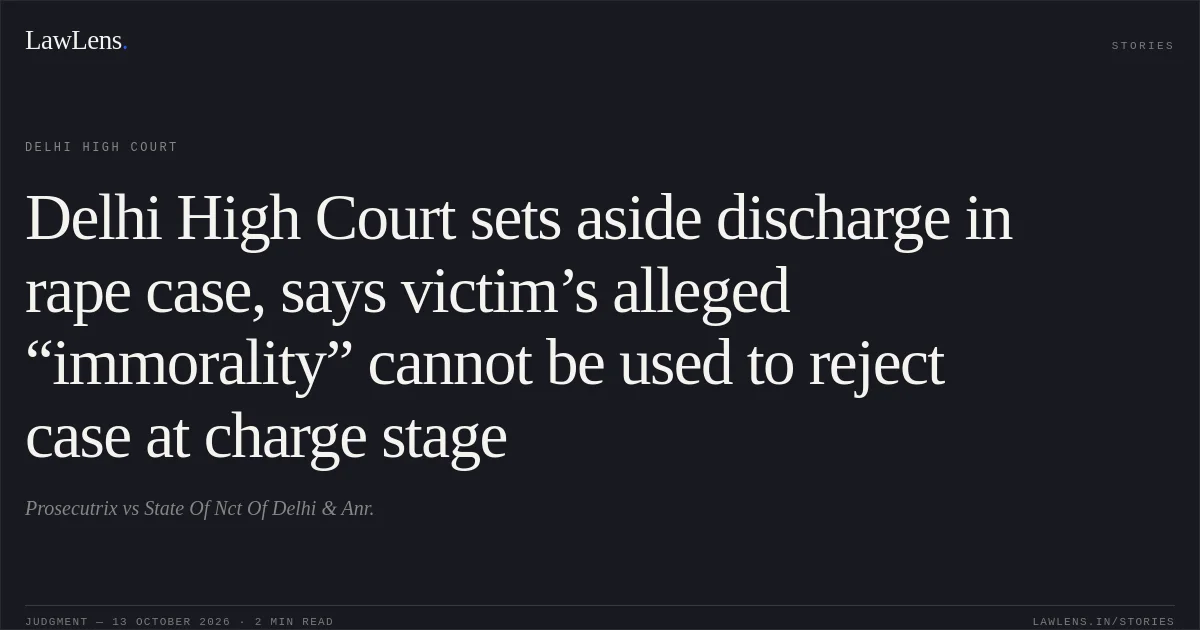
The High Court held that the Trial Court went beyond the permissible charge-stage inquiry by treating the video’s non-recovery and its assessment of how the recording could have occurred as grounds to disbelieve the prosecutrix.
Source reference: paras. 22–24The missing iPhone neither established that a recording existed nor conclusively proved that none existed; the remaining material still required consideration.
Source reference: paras. 22–24Likewise, the prosecutrix’s conduct and alleged relationship with respondent No. 2 could not, without assessing the evidence, conclusively establish consent, and the Trial Court’s observations about her alleged immorality were inappropriate.
Source reference: paras. 25–27By resolving credibility and disputed factual questions, the Trial Court failed to apply the proper threshold for discharge.
Source reference: paras. 29–31Holding
The High Court allowed the revision petition and set aside the discharge order.
It remanded the matter to the Trial Court for fresh consideration of whether charges should be framed, in accordance with law and without treating the High Court’s observations as an opinion on guilt or innocence.
Source reference: paras. 32–35Acts & Sections Cited
7 provisions across 2 statutes referred to in this judgment. Each provision opens on LawLens.
Code of Criminal Procedure, 19736
Indian Penal Code, 18601
Original Court PDF
ProsecutrixvsState Of Nct Of Delhi & Anr.
Click to open original judgment
Original judgment, available to read, download and summarize on LawLens.in