Facts
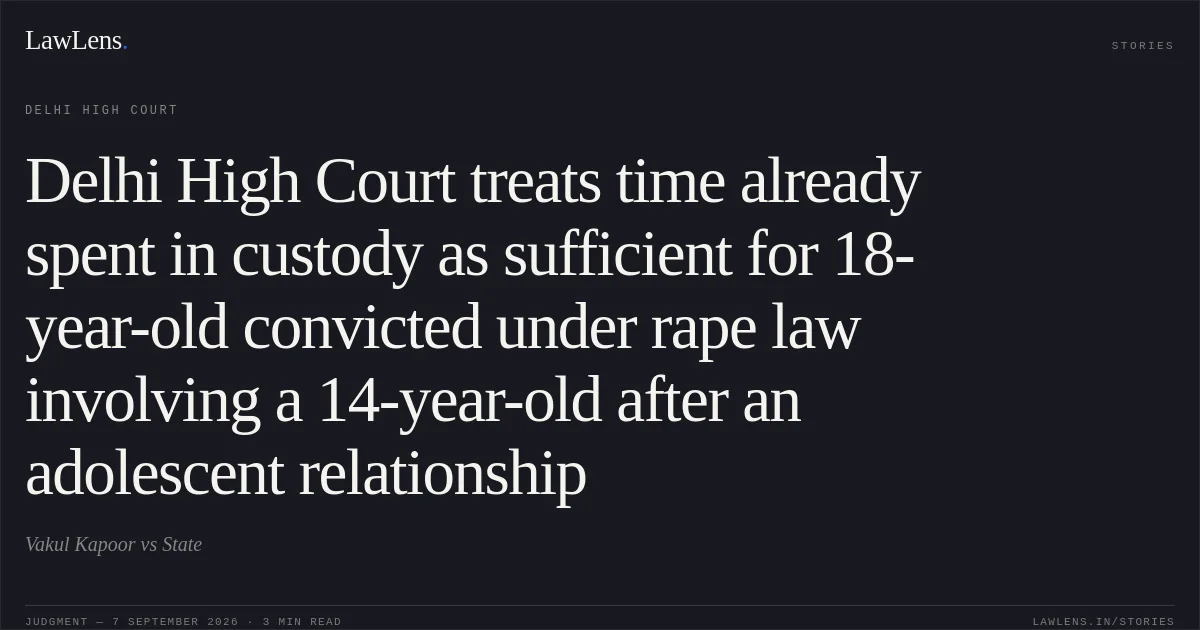
The prosecutrix, aged approximately 14 years, went missing from her home on 15 June 2009. An FIR under Section 363 IPC was registered on 17 June 2009, after which she returned with the appellant from Manali to Delhi. The appellant, who was approximately 18 years old at the time, maintained that the prosecutrix had voluntarily accompanied him and that their relationship was consensual. The prosecutrix initially gave a statement before the medical authorities and the police which was consistent with the appellant’s version, but subsequently made statements under Section 164 CrPC and before the trial court alleging offences against him
Source reference: pp. 2–4, paras. 3–7The Trial Court convicted the appellant under Sections 363, 366 and 376 IPC and sentenced him on 11 May 2011. In appeal, the appellant initially challenged the conviction but subsequently confined his challenge to the sentence. The appellant had undergone approximately two years and four months of imprisonment, and relied upon the parties’ adolescent relationship, the passage of more than 17 years, his clean antecedents, his present family circumstances, and the prosecutrix’s stated unwillingness to continue contesting the matter
Source reference: pp. 1, 4–6, paras. 1, 8–10Issues
Whether, in light of the appellant’s age, the adolescent relationship between the parties, the prosecutrix’s conduct and subsequent position, the long lapse of time, and the appellant’s clean antecedents, the sentence imposed for offences under Sections 363, 366 and 376 IPC should be further reduced
Source reference: pp. 4–8, paras. 8–16Whether the period of incarceration already undergone by the appellant could be treated as sufficient punishment while leaving the fine and the conviction undisturbed
Source reference: p. 8, para. 16Law Applied
The Court applied Sections 363, 366 and 376 of the Indian Penal Code, 1860, governing kidnapping, abduction for specified purposes, and rape, respectively. It recognized that the Trial Court had already imposed a sentence below the then-prescribed minimum under the unamended Section 376 IPC upon recording special and adequate reasons
Source reference: pp. 1–2, paras. 1, 2 and 7The Court relied on Anversinh @ Kiransinh Fatesinh Zala v. State of Gujarat, (2021) 3 SCC 12, for considering the absence of force or coercion, the accused’s young age, and the surrounding circumstances in sentencing. It also referred to State of Uttar Pradesh v. Anurudh & Anr., 2026 SCC OnLine SC 40, and other decisions concerning adolescent relationships and the possible need for a Romeo–Juliet exception in appropriate cases. The governing sentencing principle applied was that punishment must be proportionate and responsive to the circumstances of the offence and offender, including the passage of time, antecedents, age, rehabilitation, and the practical consequences of further incarceration
Source reference: pp. 5–8, paras. 9–16Reasoning
The Court treated the case as involving an adolescent relationship rather than an act accompanied by force, coercion, weapon, or abuse of power. It noted that the appellant was 18 and the prosecutrix 14 at the relevant time, that they had travelled together, had tattoos bearing each other’s names, and that the prosecutrix had initially given accounts consistent with voluntary companionship
Source reference: pp. 2–4, paras. 3–7Although the prosecutrix later testified against the appellant and the conviction was not disturbed, the Court considered her subsequent unwillingness to contest the case, the parties’ settled matrimonial lives, the appellant’s clean antecedents, the substantial period already undergone, and the fact that more than 17 years had elapsed since the incident. Balancing these mitigating circumstances against the statutory offences and the fact that the Trial Court had already granted sentencing leniency, the Court concluded that sending the appellant back to custody would serve little practical or penological purpose
Source reference: pp. 4–8, paras. 8, 12–16Holding
The appeal was allowed to the limited extent of sentence. The conviction under Sections 363, 366 and 376 IPC was not set aside, and the fine remained unaltered. However, the Court held that the period of incarceration already undergone by the appellant was sufficient punishment and directed his release on that basis
The appeal and pending applications were disposed of accordingly, with the judgment directed to be transmitted to the Trial Court and the concerned Jail Superintendent for compliance
Source reference: p. 8, para. 17; p. 9, para. 18Acts & Sections Cited
4 provisions across 2 statutes referred to in this judgment. Each provision opens on LawLens.
Indian Penal Code, 18603
Code of Criminal Procedure, 19731
Original Court PDF
Vakul KapoorvsState
Click to open original judgment
Original judgment, available to read, download and summarize on LawLens.in