Facts
Under a 2010 Concession Agreement, the appellant was granted a concession to develop and operate a highway.
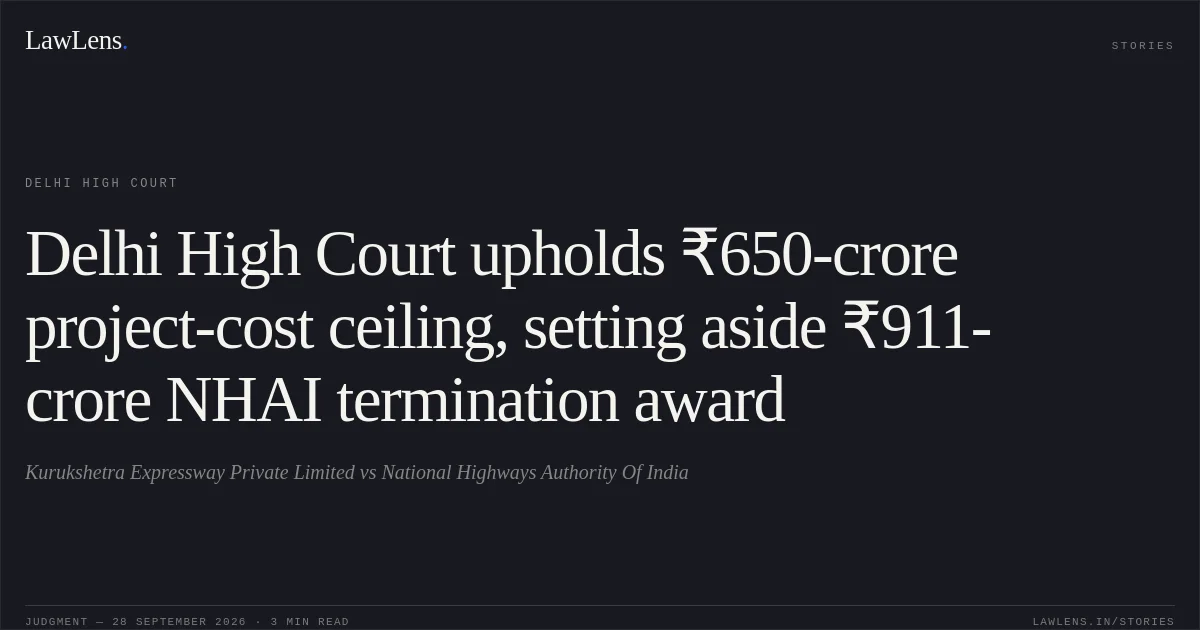
Source reference: para. 4–8The Agreement defined “Total Project Cost” (TPC) as the lowest of three amounts, including a ceiling of ₹650 crore, subject to specified adjustments.
Source reference: para. 4–8Following termination of the Agreement, the appellant claimed termination payment under Article 34.9.2, relying on a Disaggregation Letter that stated a TPC of approximately ₹1,045.55 crore.
Source reference: para. 4–8The arbitral majority awarded ₹911.13 crore on the basis of that figure.
Source reference: para. 4–8On the respondent’s Section 34 application, the Single Judge set aside the award insofar as it concerned Claims 1 and 2, holding that the contractual TPC ceiling applied.
Source reference: para. 4–8The appellant appealed under Section 37; the appeal concerned only those claims.
Source reference: para. 4–8Issues
1. Whether the Single Judge, in setting aside the award on Claims 1 and 2, acted within the limited grounds of Section 34, particularly patent illegality.
Source reference: para. 14, 20–212. Whether the Agreement permitted the Disaggregation Letter or approved Financial Package to displace the TPC ceiling when calculating termination payment under Article 34.9.2.
Source reference: para. 28, 63–67Law Applied
Sections 34(2A) and 37(1)(c) of the Arbitration and Conciliation Act, 1996 governed the review: Section 34 permits interference with an award on the statutory grounds, including patent illegality, while Section 37 review of a Section 34 decision is narrower and does not permit independent reappraisal of the merits.
Source reference: para. 11–13, 20–21An arbitral tribunal’s contractual interpretation ordinarily cannot be disturbed if it is a possible view; interference is permissible where the tribunal adopts a construction no fair-minded or reasonable person could adopt, or effectively rewrites the contract.
Source reference: para. 20, 24–26The Court relied on Associate Builders v. Delhi Development Authority, Ssangyong Engineering & Construction Co. Ltd. v. NHAI and PSA SICAL Terminals Pvt. Ltd. v. Board of Trustees of V.O. Chidambranar Port Trust on this standard.
Source reference: para. 24–26It also applied the principle that contractual provisions should be read harmoniously and that a defined term is displaced only where the context requires it, not merely because its application produces a less favourable result; in that regard, it considered BGS SGS SOMA JV v. NHPC and K.V. Muthu v. Angamuthu Ammal.
Source reference: para. 32–33, 51–55Under the Agreement, the TPC definition in Article 48.1 set the applicable ceiling, while Article 34.9.2 prescribed the termination-payment formula within that contractual framework.
Source reference: para. 30–35Reasoning
The Court held that Article 34.9.2 could not be read in isolation: its “Debt Due” and “Adjusted Equity” components were defined by reference to TPC, and the termination-specific WPI proviso in the TPC definition confirmed that the definition applied on termination.
Source reference: para. 30–38The Disaggregation Letter apportioned TPC between debt and equity; it did not authorise the appellant unilaterally to revalue TPC or amend the agreed ceiling.
Source reference: para. 39–49Nor did scrutiny of the Financial Package do so, absent an express contractual amendment.
Source reference: para. 39–49Reading the Agreement as a whole, the arbitral majority’s approach rendered the ceiling ineffective and permitted a unilateral notification to enlarge the respondent’s liability.
Source reference: para. 63–67The Court therefore agreed that the award did not merely adopt a competing plausible interpretation but departed from the contractual scheme, attracting patent illegality.
Source reference: para. 63–67Holding
The Court held that the Single Judge acted within the scope of Section 34 in setting aside the award on Claims 1 and 2.
It affirmed the impugned judgment and dismissed the appeal, disposing of the pending applications.
Source reference: para. 69–73Acts & Sections Cited
3 provisions across 1 statute referred to in this judgment. Each provision opens on LawLens.
Arbitration and Conciliation Act, 19963
Original Court PDF
Kurukshetra Expressway Private LimitedvsNational Highways Authority Of India
Click to open original judgment
Original judgment, available to read, download and summarize on LawLens.in