Facts
The petitioners were among six persons convicted under Sections 302/201/120B of the IPC for murder and sentenced to life imprisonment with a minimum of 20 years actual imprisonment
Source reference: para 5Petitioner Sandeep was denied furlough via an order dated 05.03.2024 on the sole ground that a co-convict (not a blood relative) had already been granted furlough
Source reference: para 4The prison authorities cited Note-(1) to Rule 1224 of the Delhi Prisons Rules, 2018, which restricts simultaneous release. The petitioners challenged the constitutionality of Note-2 of Rule 1212 (regarding parole) and Note-1 of Rule 1224 (regarding furlough), arguing these rules created a near-absolute prohibition that could indefinitely prevent convicts with multiple co-accused from ever obtaining leave
Source reference: para 6, 11Issues
1. Whether Note-2 of Rule 1212 and Note-(1) of Rule 1224 of the Delhi Prisons Rules, 2018, constitute an absolute prohibition on the simultaneous release of co-accused on parole or furlough
Source reference: para 12. Whether these restrictive notes defeat the reformative object of prison leave and violate the fundamental rights of prisoners under Article 21 of the Constitution
Source reference: para 7, 31Law Applied
The court applied Section 2(h) of the Delhi Prison Act, 2000, defining furlough as a "reward" and Rules 1197-1200 of the Delhi Prisons Rules, 2018, which establish parole and furlough as progressive correctional measures.
Source reference: para 18, 21It relied on the Supreme Court’s distinction in Asfaq v. State of Rajasthan, noting that while parole requires specific grounds, furlough is for breaking the monotony of incarceration.
Source reference: para 17The core principle applied was the "reformative theory" of punishment, which requires balancing the prisoner's right to maintain social ties under Article 21 against the society's interest in safety and preventing recidivism.
Source reference: para 23-24The court also invoked the doctrine of "reading down" to preserve the validity of subordinate legislation.
Source reference: para 8, 32Reasoning
The court reasoned that the term "ordinarily" used in the impugned Notes implies that the restriction is not an absolute embargo but a discretionary guideline.
Source reference: para 32It observed that a literal, strict enforcement of these notes would lead to "unjust consequences," where a convict might never avail leave due to the conduct or timing of numerous co-accused.
Source reference: para 31The court emphasized that the primary purpose of these rules is to prevent co-accused from "combining together to commit fresh crime" or threatening witnesses. However, this risk must be assessed on a case-by-case basis.
Source reference: para 34The court found that the mention of "family members" in the Notes was merely illustrative of one "exceptional circumstance" and did not exhaust the Competent Authority's power to grant simultaneous release to non-relatives if other safeguards (like specific conditions) could merit such a grant.
Source reference: para 35The authority must determine if the "kindness to the convict" results in "cruelty to the society".
Source reference: para 24Holding
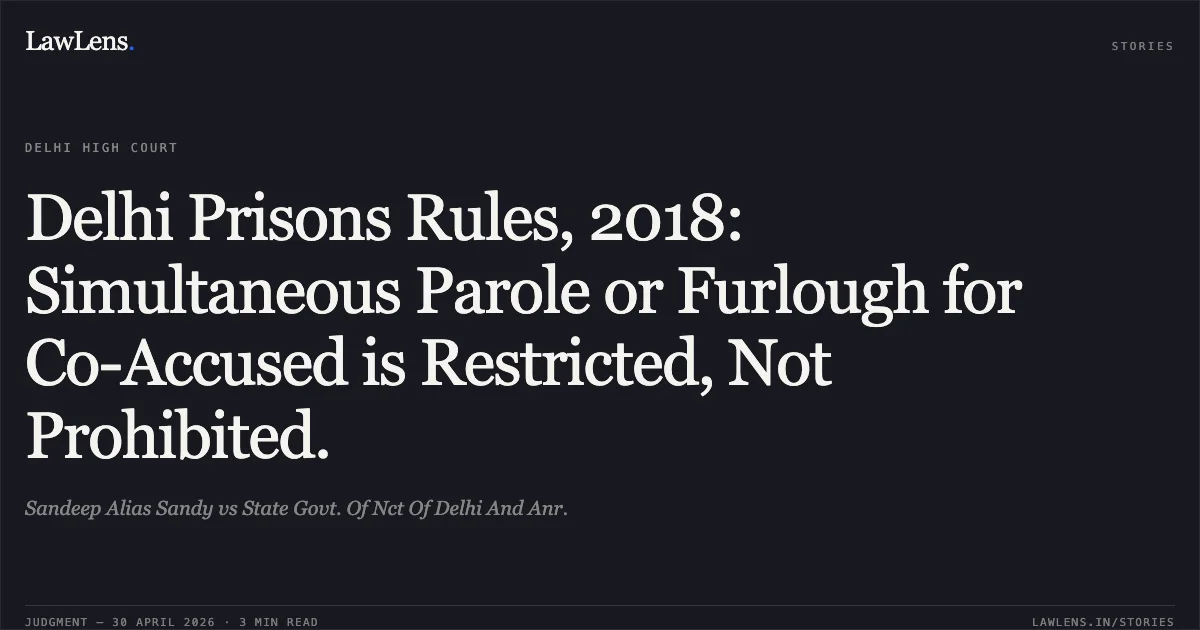
The court held that the challenged Rules are valid and do not merit being struck down, provided they are interpreted as "restricting" rather than "prohibiting" simultaneous release.
The court clarified that the Competent Authority possesses the discretion to grant simultaneous parole or furlough to co-accused even if they are not family members, provided it records reasons in writing and ensures no threat to public peace exists.
Source reference: para 32-34The petitions were disposed of with the direction that the authorities must examine such applications more strictly but without a blanket denial based solely on the co-accused’s release status.
Source reference: para 36Acts & Sections Cited
2 provisions across 2 statutes referred to in this judgment. Linked provisions open on LawLens.
Indian Penal Code, 18601
Delhi Prison Act, 20001
Original Court PDF
Sandeep Alias SandyvsState Govt. Of Nct Of Delhi And Anr.
Click to open original judgment
Original judgment, available to read, download and summarize on LawLens.in