Facts
The wife petitioned under Section 9 of the Hindu Marriage Act, 1955, seeking restitution of conjugal rights.
Source reference: pp. 2–7, 9She alleged that her husband had withdrawn from her society and neglected her and their daughter.
Source reference: pp. 2–7, 9The husband denied her allegations and asserted cruelty, but did not cross-examine her or lead evidence before the Family Court.
Source reference: pp. 2–7, 9The Family Court allowed the petition and directed him to resume matrimonial cohabitation and perform his conjugal obligations within three months.
Source reference: pp. 2–7, 9The husband appealed under Section 28(1), contending that pandemic-related disruption had prevented him from properly participating in the proceedings.
Source reference: pp. 8–10The wife opposed the appeal, including on the ground of delay.
Source reference: pp. 8–10Issues
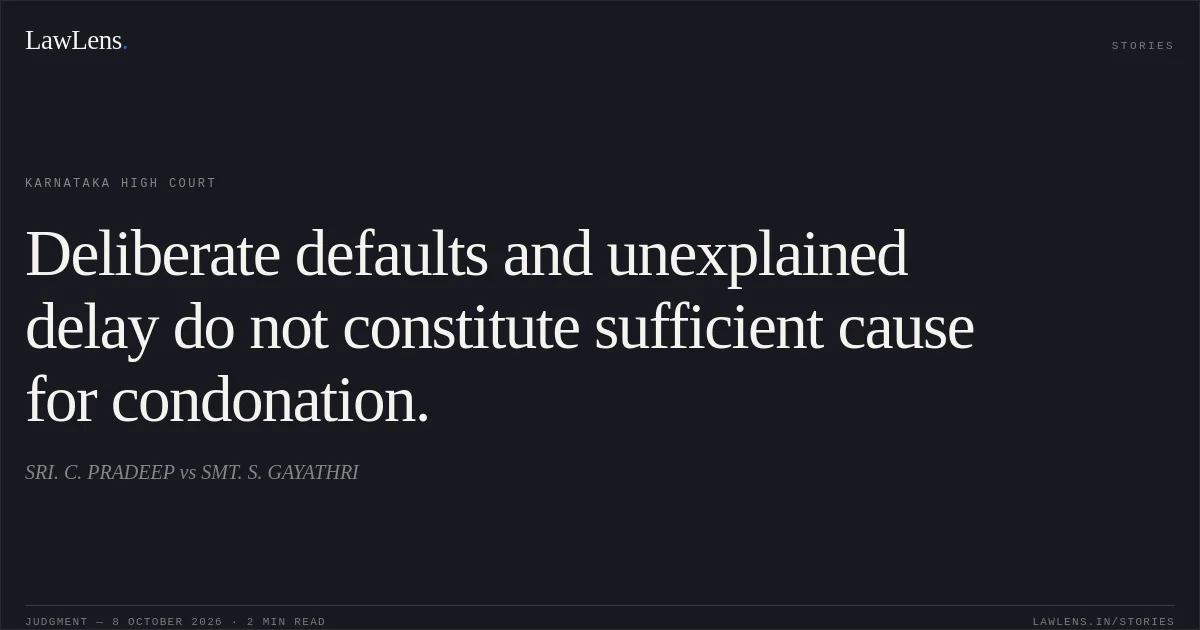
1. Whether the appellant had shown sufficient cause to condone the delay in filing the appeal.
Source reference: p. 10, para. 142. Whether the Family Court was justified in granting restitution of conjugal rights after proceeding in the husband’s absence from the evidentiary hearing.
Source reference: p. 10, para. 14Law Applied
Section 9 of the Hindu Marriage Act, 1955, provides for restitution of conjugal rights where one spouse has withdrawn from the society of the other without reasonable excuse.
Source reference: no citationSection 28(1) provides for an appeal from a decree under the Act.
Source reference: no citationOn delay, the Court applied the principle that courts may adopt a liberal approach to advance substantial justice, but condonation requires “sufficient cause” and is not warranted for gross negligence or disregard of judicial process.
Source reference: p. 10, para. 15No specific precedent was cited in the judgment.
Source reference: no citationReasoning
The Court accepted that pandemic-related disruptions could plausibly explain some difficulty in participating in the proceedings, but found that they did not account for the delay after the husband had knowledge of the decree.
Source reference: p. 11, paras. 16–17He appeared through counsel in the execution proceedings on 21 January 2023, yet did not appeal until 18 November 2023, and offered no explanation for the ensuing delay.
Source reference: p. 11, paras. 16–17The Court also relied on his repeated defaults in the restitution proceedings, his own divorce petition, and domestic-violence proceedings, concluding that his non-participation was not a basis for claiming denial of natural justice after the fact.
Source reference: pp. 11–12, paras. 18–19It found no reason to interfere with the Family Court’s decision, which rested on the wife’s unchallenged evidence and the absence of a demonstrated reasonable excuse for the husband’s withdrawal.
Source reference: pp. 7, 12, paras. 9, 20Holding
The Court found that the husband had not established sufficient cause for the delay and dismissed the appeal.
It affirmed the Family Court’s decree directing him to resume matrimonial cohabitation and perform his conjugal obligations under Section 9 of the Hindu Marriage Act; pending interlocutory applications were disposed of.
Source reference: p. 12, para. 20Acts & Sections Cited
2 provisions across 1 statute referred to in this judgment. Each provision opens on LawLens.
Hindu Marriage Act, 19552
Original Court PDF
SRI. C. PRADEEPvsSMT. S. GAYATHRI
Click to open original judgment
Original judgment, available to read, download and summarize on LawLens.in