Facts
The appellant, an Assistant in the District Education Office, was accused of demanding ₹5,000 from a newly appointed orderly for release of his salary. The complainant reported the demand to the Vigilance Bureau; a trap was laid, and ₹5,000 was later recovered from beneath the appellant’s pillow at his residence. No witness saw the alleged demand or the handing over of the money.
Source reference: para. 2–4, 8–18The Special Judge convicted the appellant under Sections 7 and 13 of the Prevention of Corruption Act, 1988 (PC Act), and the High Court affirmed the conviction. The appellant appealed to the Supreme Court
Source reference: para. 2–4, 8–18Issues
Whether the prosecution proved beyond reasonable doubt the demand and acceptance of illegal gratification, essential to the offences charged under the PC Act
Source reference: para. 18–24Whether recovery of the alleged bribe money, without proof of demand and acceptance, could sustain the appellant’s conviction
Source reference: para. 19–23Law Applied
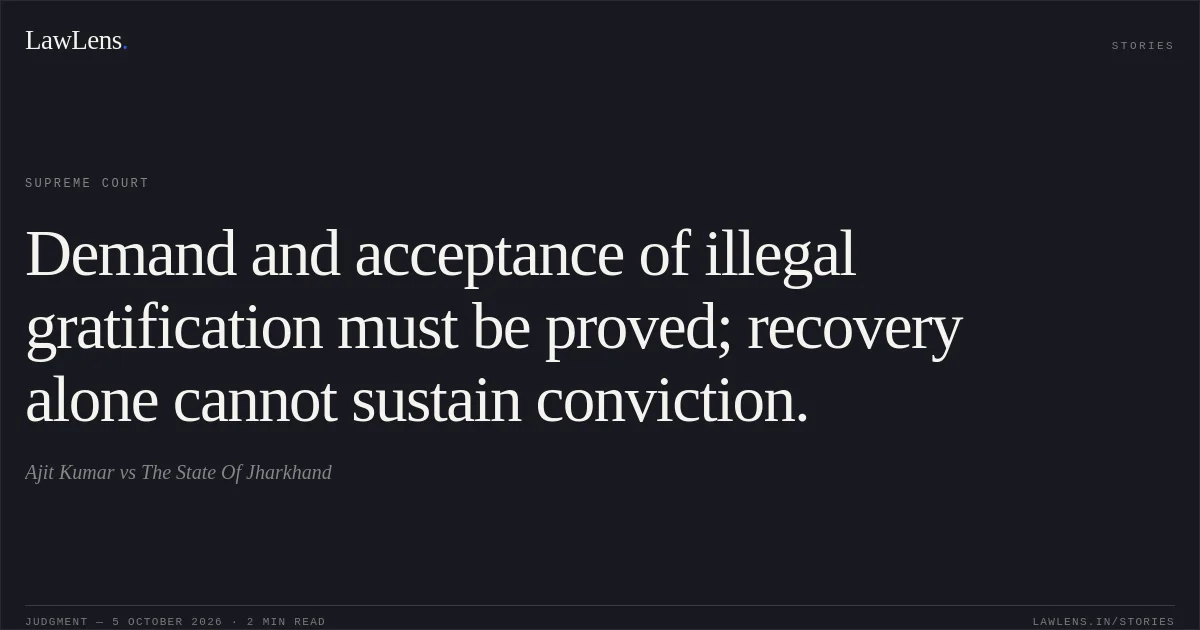
Under Sections 7 and 13(1)(d)(i) and (ii) of the PC Act, proof of demand and acceptance of illegal gratification is essential to establish guilt; the prosecution must prove those facts as matters in issue. Mere recovery or possession of alleged tainted money, without proof of demand, is insufficient for conviction.
Source reference: para. 19–22The Court applied P. Satyanarayana Murthy v. State of A.P., (2015) 10 SCC 152; Neeraj Dutta v. State (Government of NCT of Delhi), (2023) 4 SCC 731; Aman Bhatia v. State, 2025 SCC OnLine SC 1013; and Jaswinder Singh v. State of Punjab, 2026 SCC OnLine SC 1952
Source reference: para. 19–22Reasoning
The complainant’s account of the demand and payment was uncorroborated. Although the money was recovered from the appellant’s residence and the hand-wash solution turned pink, no witness saw the appellant demand or accept the money.
Source reference: para. 18–23The witnesses gave inconsistent accounts of where the transaction occurred and how the appellant was apprehended; some also stated that they signed seizure documents at the vigilance officials’ direction. Applying the settled rule that recovery alone cannot prove the charge, the Court held that the prosecution had not established demand and acceptance
Source reference: para. 18–23Holding
The Court held that the charges under Sections 7 and 13 of the PC Act were not proved.
It allowed the appeal, set aside the judgments of the Special Judge and the High Court, and cleared the appellant of the charges.
Source reference: para. 24–25Acts & Sections Cited
2 provisions across 1 statute referred to in this judgment. Each provision opens on LawLens.
Prevention of Corruption Act, 19882
Original Court PDF
Ajit KumarvsThe State Of Jharkhand
Click to open original judgment
Original judgment, available to read, download and summarize on LawLens.in