Facts
The Petitioner, a Police Constable with eight years of service, was subjected to a departmental enquiry following complaints lodged by his wife in 2018 alleging alcohol consumption, physical abuse, and outraging the modesty of their minor daughter
Source reference: para. 3, 5During the pendency of the proceedings, the marriage was dissolved by mutual consent via a decree dated 13.10.2022
Source reference: para. 4On 29.12.2021, the Petitioner was found guilty of misconduct under the Chhattisgarh Police Regulations
Source reference: para. 5Consequently, the Superintendent of Police (Respondent No. 4) passed an order removing the Petitioner from service, which was subsequently upheld by the appellate and revisional authorities
Source reference: para. 6, 7, 8The Petitioner challenged these orders, contending that the enquiry violated the principles of natural justice as he was denied an effective opportunity to cross-examine material witnesses and that the punishment was disproportionate to a private matrimonial dispute
Source reference: para. 9, 10Issues
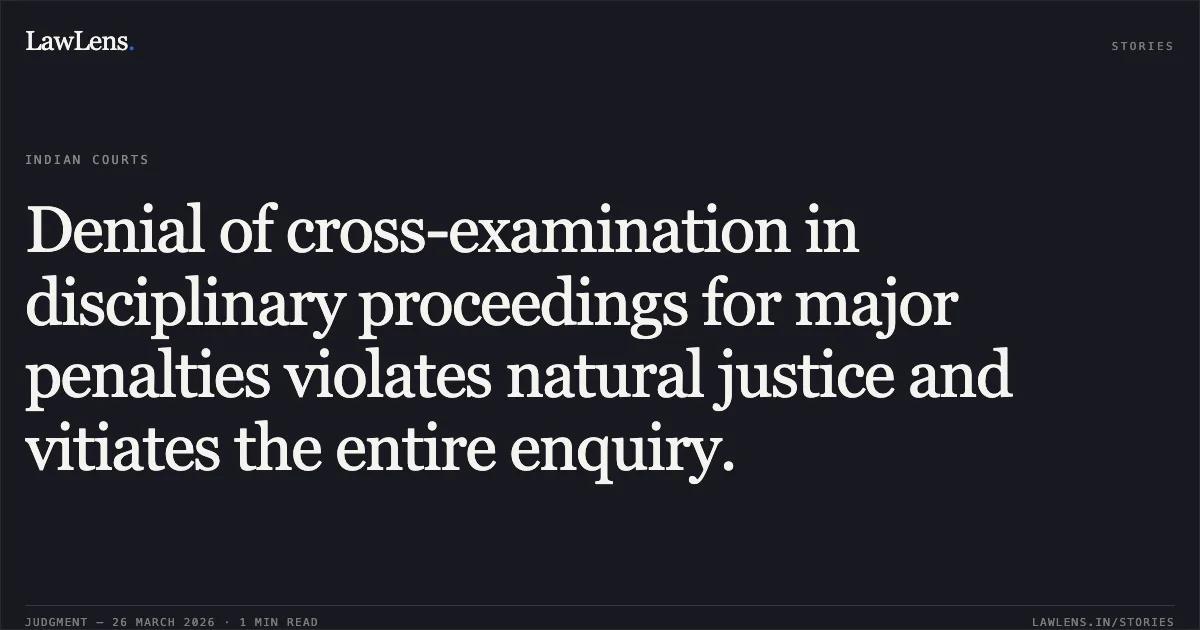
1. Whether the departmental enquiry was vitiated due to the denial of a meaningful opportunity to cross-examine material witnesses, thereby violating the principles of natural justice?
Source reference: para. 27, 342. Whether a private matrimonial dispute, subsequently resolved through mutual divorce, constitutes "misconduct" sufficient to warrant removal under Regulation 64 of the Chhattisgarh Police Regulations?
Source reference: para. 333. Whether the punishment of removal from service was disproportionate to the alleged conduct?
Source reference: para. 35Law Applied
Regulation 64(03) and 64(11) of the Chhattisgarh Police Regulations, which mandate that police personnel maintain high standards of discipline, dignity, and peaceful behavior in both official and private life
Source reference: para. 23-26Article 311(2) of the Constitution of India, ensuring a reasonable opportunity of defense in disciplinary proceedings
Source reference: para. 29, 35State of U.P. v. Saroj Kumar Sinha (2010) and Kashinath Dikshita v. Union of India (1986), establishing that the non-supply of documents and denial of cross-examination vitiate an enquiry
Source reference: para. 29B.C. Chaturvedi v. Union of India (1995) regarding the limited yet necessary scope of judicial review when a punishment shocks the conscience of the court
Source reference: para. 17, 35Reasoning
The court observed that the disciplinary findings were founded almost exclusively on the statements of the Petitioner's wife and her relatives, which were accepted without allowing the Petitioner a fair chance to test their veracity through cross-examination
Source reference: para. 28, 34This procedural lapse constituted a "patent violation of principles of natural justice"
Source reference: para. 34Regarding the nature of the misconduct, the court noted that the dispute was essentially personal and matrimonial, later settled by mutual divorce, and there was no evidence that the Petitioner’s private conduct brought "demonstrable disrepute" to the police force or affected his official duties
Source reference: para. 33The court held that Regulation 64 requires a higher threshold of moral turpitude than a private marital discord
Source reference: para. 33Finally, applying the doctrine of proportionality, the court found that imposing the "harshest civil consequence" of removal based on untested evidence and a private dispute was arbitrary and legally unsustainable
Source reference: para. 35, 36Holding
The High Court allowed the writ petition, quashing the orders of removal, the appellate order, and the revisional order
The court held that the decision-making process was vitiated by procedural unfairness and non-application of mind
Source reference: para. 36The Respondents were directed to reinstate the Petitioner forthwith with continuity of service and all consequential notional benefits
Source reference: para. 37The Petitioner was awarded 50% back wages for the interregnum period, to be paid within three months
Source reference: para. 38The court granted the Respondents liberty to initiate a fresh enquiry from the stage of the procedural defect, provided they strictly adhere to the principles of natural justice
Source reference: para. 38Acts & Sections Cited
1 provisions across 1 statute referred to in this judgment. Each provision opens on LawLens.
Hindu Marriage Act, 19551
Original Court PDF
SHIVKUMAR SAITODEvsSTATE OF CHHATTISGARH
Click to open original judgment
Original judgment, available to read, download and summarize on LawLens.in


