Facts
The respondent’s Release Medical Board had assessed his primary hypertension as neither attributable to nor aggravated by service, and his disability-pension claim was rejected in 2008.
Source reference: p.3, para. 3; p.5, para. 8A medical report prepared while he served on a U.N. mission in Sudan recorded hypertension and ECG changes.
Source reference: pp.4–5, paras. 5, 7In 2024, the Armed Forces Tribunal (AFT) allowed his claim and directed the petitioners to calculate, sanction and issue a Pension Payment Order within four weeks, with interest at 6% per annum in default.
Source reference: p.2, para. 2The Union of India challenged that order, arguing that the claim was delayed, barred under Section 21 of the Armed Forces Tribunal Act, 2007, and unsupported by evidence of a service connection.
Source reference: pp.2–3, paras. 3–4During the High Court proceedings, the PPO had been issued and the amount released.
Source reference: p.6, para. 13Issues
1. Whether the AFT was justified in granting disability pension despite the Release Medical Board’s finding that the respondent’s hypertension was not attributable to or aggravated by service.
Source reference: pp.3–5, paras. 4, 7–102. Whether the respondent’s claim was barred by delay or by his failure to pursue the remedy contemplated under Section 21 of the Armed Forces Tribunal Act, 2007.
Source reference: p.2, para. 3; p.6, paras. 11–12Law Applied
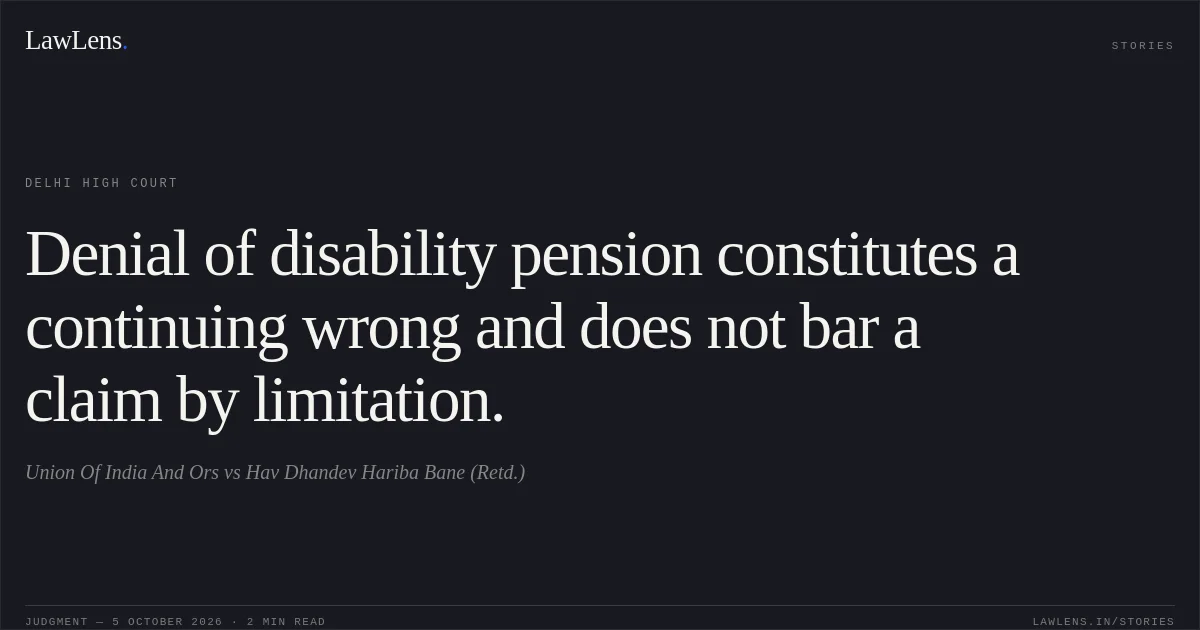
The Court relied on the continuing-wrong principle, as applied in Union of India & Ors. v. Tarsem Singh (2009), in considering whether the continuing denial of disability pension barred the respondent’s claim for delay.
Source reference: pp.3–4, paras. 3, 5; p.5, para. 11It also considered Section 21 of the Armed Forces Tribunal Act, 2007, which the petitioners invoked in support of their objection concerning the respondent’s failure to pursue an available remedy; the Court held that this did not, on the facts, preclude the pension claim.
Source reference: p.3, para. 3; p.6, para. 12The petitioners cited Union of India & Ors. v. Col. NC Issac (Retd.), but the Court did not rely on it as the basis for its decision.
Source reference: p.3, para. 4; p.4, para. 5Reasoning
The Court found that the Sudan medical report recorded hypertension and ECG changes during the respondent’s service, whereas the Release Medical Board later recorded primary hypertension but marked it as neither attributable to nor aggravated by service.
Source reference: pp.5–6, paras. 7–9In the Court’s view, the AFT had assessed these competing medical materials rather than impermissibly substituting its own medical opinion for that of the Board.
Source reference: p.6, para. 10It further held that the continuing denial of disability pension meant the claim was not barred by limitation, and that the failure to pursue the remedy referred to in Section 21 did not defeat entitlement in the circumstances.
Source reference: p.6, paras. 11–12Holding
The Court held that the AFT had committed no error in granting disability pension and rejected the challenges based on limitation, Section 21 and the merits of the claim.
The writ petition was dismissed, and the pending applications were disposed of.
Source reference: p.6, paras. 14–15Acts & Sections Cited
1 provisions across 1 statute referred to in this judgment. Each provision opens on LawLens.
Armed Forces Tribunal Act, 20071
Original Court PDF
Union Of India And OrsvsHav Dhandev Hariba Bane (Retd.)
Click to open original judgment
Original judgment, available to read, download and summarize on LawLens.in