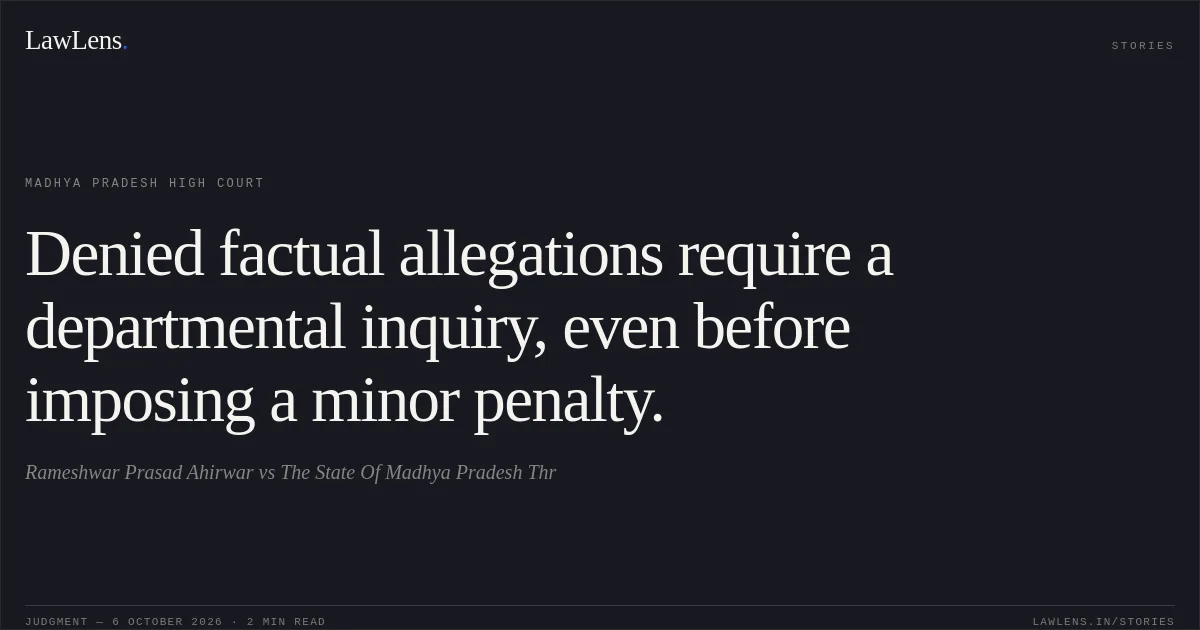
Facts
The petitioner, then working as an In-charge Sub-Registrar, performed registration duties on 12 April 2012.
Source reference: para. 2Following a complaint, a fact-finding inquiry was conducted and show-cause notices were issued.
Source reference: para. 2The petitioner denied the allegations and submitted replies.
Source reference: para. 2Without holding a regular departmental inquiry, the disciplinary authority ordered withholding of three annual increments without cumulative effect on 20 January 2014.
Source reference: para. 2The petitioner’s appeal was dismissed on 7 September 2015.
Source reference: para. 6Issues
Whether the respondents could impose a minor penalty on the basis of a fact-finding inquiry and the petitioner’s reply to a show-cause notice when he specifically denied the factual allegations.
Source reference: paras 7–8Whether the punishment and appellate orders could stand where no regular departmental inquiry was held to determine the disputed facts.
Source reference: paras 7, 13–16Law Applied
In O.K. Bhardwaj v. Union of India, (2001) 9 SCC 180, the Supreme Court held that although withholding increments may be a minor penalty, where the employee denies factual charges, an inquiry is required as a minimum requirement of natural justice.
Source reference: paras 8–10A fact-finding inquiry may establish a basis for disciplinary action but does not, by itself, constitute a regular departmental inquiry proving disputed charges.
Source reference: para. 14The Court also relied on Manmohan Singh v. Home Department, W.P. No. 19843/2022, decided 15 September 2022, and Anurag Pratap Singh v. State of M.P., W.P. No. 19084/2023, decided 19 February 2025, which applied the same principle.
Source reference: paras 11–12Reasoning
The petitioner specifically denied the allegations and raised factual grounds in detailed replies, creating a dispute that could not be resolved merely by relying on the fact-finding report and the show-cause process.
Source reference: paras 13–16Because no regular departmental inquiry was conducted, the petitioner was not given an effective opportunity to meet the evidence or establish his defence.
Source reference: paras 17–19The minor nature of the penalty did not dispense with that requirement, and the disciplinary authority’s consideration of the replies could not substitute for an inquiry into the disputed facts.
Source reference: paras 17–19Holding
The Court held that the punishment was imposed without the required procedure and effective opportunity to defend, and that the appellate order could not be sustained.
It allowed the petition and quashed both orders dated 20 January 2014 and 7 September 2015.
Source reference: paras 20–21The respondents were directed to grant consequential benefits within three months of receiving a certified copy of the order.
Source reference: para. 22The competent authority remained at liberty to take fresh action in accordance with applicable service rules, provided the petitioner receives a full opportunity to defend himself.
Source reference: para. 22Original Court PDF
Rameshwar Prasad AhirwarvsThe State Of Madhya Pradesh Thr
Click to open original judgment
Original judgment, available to read, download and summarize on LawLens.in
![HRA parity claims must be assessed against similarly situated employees, with reasoned orders where parity is denied.. Shaphaba Thokchom vs DY. COMPTROLLER AND AUDITOR GENERAL OF INDIA. CAT - ['Guwahati']. LawLens](/stories/thumbnails/hra-parity-claims-must-be-assessed-against-similarly-situated-employees-with-reasoned-orde-a9c45995b0704be18e4bcf7b91c8e507.webp)
![Article 311(2)(c) dismissal is valid where relevant material shows an inquiry would endanger security sources.. Mohd Rafi vs GENERAL ADMINITRATIVE DEPARTMENT. CAT - ['Jammu']. LawLens](/stories/thumbnails/article-311-2-c-dismissal-is-valid-where-relevant-material-shows-an-inquiry-would-endanger-58dabaa9372a4b41bd304e91e9ebe890.webp)