Facts
The respondent-workman joined the State Bank of India as a clerk-cum-cashier in 1980 and was subsequently promoted as a teller. He was served with a charge-sheet dated 27 January 1998 alleging, inter alia, creation and manipulation of a fictitious savings account, fraudulent entries, issuance and encashment of cheques, and unauthorised transfer of another account.
Source reference: pp. 2–3, paras. 2–3In the departmental enquiry, Charges 1–6 and 8 were held circumstantially proved, while Charges 7, 9 and 10 were held not proved.
Source reference: p. 3, para. 4The Disciplinary Authority disagreed with the finding on Charge 7, held it proved, and dismissed the workman on 20 October 2001; the appeal was dismissed on 6 June 2003.
Source reference: p. 4, paras. 5–6The Industrial Tribunal found the enquiry findings unsupported by cogent evidence, perverse, and based partly on a reversal of the burden of proof. It consequently set aside the dismissal and directed reinstatement with full back wages and consequential benefits. The Bank challenged the award under Articles 226 and 227 of the Constitution. During the writ proceedings, the workman received wages under Section 17B of the Industrial Disputes Act, 1947, and attained the age of superannuation.
Source reference: pp. 4–5, paras. 7–10; pp. 8, 12–13, paras. 21–22, 40Issues
1. Whether the Industrial Tribunal was justified in holding that the findings in the departmental enquiry were perverse, unsupported by evidence, and insufficient to sustain the respondent’s dismissal.
Source reference: pp. 4–5, paras. 8–9; pp. 8–12, paras. 24–362. Whether the Bank should be permitted to lead additional evidence and the matter remanded for a fresh adjudication on the merits.
Source reference: pp. 6–8, para. 14; pp. 12–13, paras. 37–403. Whether, considering the long lapse of time, the respondent’s superannuation, and payments already made under Section 17B, reinstatement and full back wages should be substituted by lump-sum compensation.
Source reference: pp. 12–14, paras. 40–42Law Applied
The Court applied the limited scope of judicial review under Articles 226 and 227, holding that interference with a Labour Tribunal’s award is warranted only where the findings are perverse, based on no evidence, patently illegal, or affected by jurisdictional error; the writ court cannot act as an appellate fact-finding court where the Tribunal has adopted a plausible view.
Source reference: p. 9, para. 24In disciplinary proceedings, misconduct must be established by evidence satisfying the standard of preponderance of probabilities; although proof beyond reasonable doubt is unnecessary, cogent material must still connect the employee with the alleged misconduct. The employer bears the burden of proving the charges and cannot require the employee to disprove allegations or prove a negative.
Source reference: pp. 11–12, paras. 31–35; p. 12, para. 35A disciplinary authority disagreeing with the Enquiry Officer must provide cogent reasons for such disagreement.
Source reference: p. 11, para. 33Where an enquiry is defective, the employer may, if it has made a timely and appropriate request, seek an opportunity before the Tribunal to lead evidence afresh on the merits, subject to the employee’s right to rebut it, as recognised in Workmen of Firestone Tyre & Rubber Co. of India (P) Ltd. v. Management , Delhi Cloth & General Mills Co. v. Ludh Budh Singh , and Amrit Vanspati Co. Ltd. v. Khem Chand .
Source reference: pp. 6–8, 12, paras. 14, 37–38Payments under Section 17B of the Industrial Disputes Act and the superannuation of the workman were relevant to moulding the final relief.
Source reference: pp. 8, 12–14, paras. 22, 40–43Reasoning
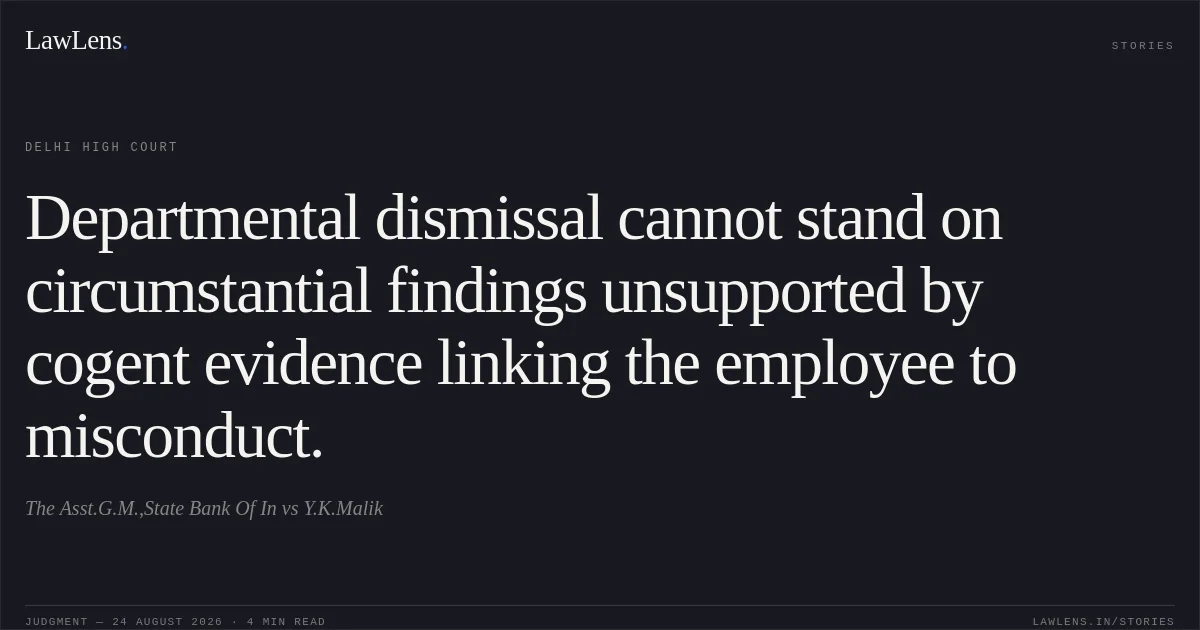
The Court upheld the Tribunal’s assessment that the departmental findings were perverse. Documents relied upon by the Bank, including account-opening forms, ledger records, transaction sheets and interest records, were not shown to establish that the respondent had prepared or manipulated them, and the respondent was not properly confronted with several of those documents.
Source reference: pp. 5, 9–11, paras. 11, 27, 30–32No handwriting expert or other evidence linked the respondent to the disputed entries, cheques, vouchers, or alleged withdrawals.
Source reference: pp. 9–12, paras. 27–35The Enquiry Officer’s repeated conclusions that charges were “circumstantially proved” were unsupported by identified circumstances or reasoned findings, and the Disciplinary Authority reversed the finding on Charge 7 without giving reasons.
Source reference: p. 11, paras. 33–34Accordingly, the Tribunal’s view that the charges were not proved by cogent evidence was at least a plausible view and did not warrant interference under Articles 226 or 227.
Source reference: p. 12, para. 36Although a remand could ordinarily be ordered to permit the employer to lead evidence, the Bank’s request was vague, the proceedings were more than two decades old, and no explanation was given as to how proposed evidence would cure the defects. In light of the respondent’s superannuation and the approximately ₹21 lakh already paid under Section 17B, the Court considered compensation more appropriate than reinstatement.
Source reference: pp. 12–14, paras. 37–42Holding
The Court declined to interfere with the Tribunal’s finding that the dismissal could not be sustained.
However, considering the passage of time, the respondent’s superannuation, and the amounts already paid under Section 17B, it modified the relief by substituting reinstatement and back wages with full and final compensation. The Bank was directed to pay the respondent an additional ₹5,00,000 within eight weeks, while remaining liable to pay any outstanding amount due under the Section 17B orders. The writ petition and pending applications were disposed of accordingly.
Source reference: p. 14, para. 44Acts & Sections Cited
1 provisions across 1 statute referred to in this judgment. Linked provisions open on LawLens.
Industrial Disputes Act, 19471
Original Court PDF
The Asst.G.M.,State Bank Of InvsY.K.Malik
Click to open original judgment
Original judgment, available to read, download and summarize on LawLens.in