Facts
The petitioner, a Sub-Inspector of Police and then Station House Officer of Lakhnaur Police Station, Madhubani, was suspended on 8 July 2011 following allegations concerning the escape of an accused, Md. Farukh, and irregularities in the recovery and seizure of stolen articles in connection with Khar (Mumbai) P.S. Case No. 300 of 2011.
Source reference: pp. 2–3, paras. 3–4A departmental charge-sheet containing five charges was issued on 10 June 2012. The charges alleged, inter alia, that the petitioner proceeded on leave without informing superior officers, concealed recoveries from the Mumbai Police and senior officers, prepared an improper composite seizure list, failed to maintain the accused in custody, and thereby tarnished the reputation of the police force.
Source reference: p. 3, para. 4During the enquiry, the petitioner repeatedly sought copies of defence documents but alleged that they were not supplied. The Conducting Officer commenced recording prosecution evidence before the petitioner could file his preliminary written statement.
Source reference: pp. 4–5, paras. 6–7Five witnesses were examined by the Conducting Officer, but the petitioner was permitted to cross-examine only one witness. The enquiry report dated 11 October 2012 held Charges 2 to 5 proved, while Charge 1 was held not proved.
Source reference: p. 4, para. 7; p. 5, para. 8The petitioner’s dismissal order dated 12 June 2014 was challenged in appeal. Although the High Court had earlier directed the appellate authority to hear the petitioner afresh, the appeal was rejected without granting an effective hearing. The dismissal and appellate orders were consequently challenged in the present writ petition.
Source reference: pp. 8–9, para. 15Issues
Whether failure to supply the documents sought by the petitioner during the departmental enquiry violated the principles of natural justice and caused prejudice to his defence?
Source reference: p. 13, para. 21(i)Whether non-appointment of a Presenting Officer, together with the Conducting Officer’s alleged assumption of the prosecutorial role, vitiated the departmental enquiry?
Source reference: p. 13, para. 21(ii); pp. 15–16, paras. 25–26Whether the disciplinary proceeding, dismissal order, and appellate order were legally sustainable when the appellate authority failed to provide the petitioner a hearing and was the same authority that had passed the dismissal order?
Source reference: pp. 17–18, paras. 28–30Law Applied
The Court held that disciplinary proceedings are quasi-judicial in character and must comply with statutory procedure and the principles of natural justice. Relying on A.K. Kraipak v. Union of India, (1969) 2 SCC 262, it reiterated that natural justice includes absence of bias and a reasonable opportunity of hearing.
Source reference: pp. 9–10, para. 17Under State of U.P. v. Saroj Kumar Sinha, (2010) 2 SCC 772, an Enquiry Officer must act as an independent adjudicator and cannot function as a representative of the disciplinary authority.
Source reference: pp. 10–12, para. 18Roop Singh Negi v. Punjab National Bank, (2009) 2 SCC 570, establishes that findings must be based on material properly brought on record.
Source reference: p. 13, para. 22In Union of India v. Ram Lakhan Sharma, AIR 2018 SC 4860, the Supreme Court held that mere non-appointment of a Presenting Officer does not automatically vitiate an enquiry where the applicable rule does not mandate one; however, the enquiry is vitiated where the Enquiry Officer assumes the role of prosecutor and acts with apparent bias.
Source reference: pp. 9, 15–16, paras. 16 and 25The Court also applied the principle that reliance on undisclosed or unproved documents, where it causes prejudice, violates natural justice, as recognised in Ganesh Pandey v. State of Bihar, LPA No. 410 of 2022.
Source reference: pp. 13–14, para. 23The relevant departmental procedure was governed by Para 12 of Appendix-49 of the Police Manual and Rule 7(d) of Police Order No. 109.
Source reference: pp. 4, 17, paras. 6 and 28Reasoning
The Court found that the petitioner had repeatedly requested documents necessary to defend himself, yet the disciplinary authorities relied upon documents and alleged enquiry reports that were neither duly exhibited nor supplied to him. The Conducting Officer also began recording witness statements before permitting the petitioner to submit his preliminary written statement, contrary to the applicable departmental procedure.
Source reference: pp. 4–5, 17, paras. 6 and 28Although non-appointment of a Presenting Officer is not by itself fatal, the Conducting Officer here allegedly examined witnesses and assumed the prosecutorial role while also determining the charges, thereby compromising the requirement of an impartial enquiry.
Source reference: pp. 15–17, paras. 25–28These defects were cumulative and caused real prejudice, rather than being merely technical irregularities.
Source reference: p. 18, para. 30Further, the appellate authority rejected the appeal without the hearing specifically directed by the Court and was also the authority that had passed the original dismissal order, offending the rule against bias and the principle that no person may be a judge in his own cause.
Source reference: pp. 17–18, paras. 29–30The Court additionally noted that the dismissal of a similarly situated co-delinquent arising from the same incident had already been set aside.
Source reference: p. 18, para. 29Holding
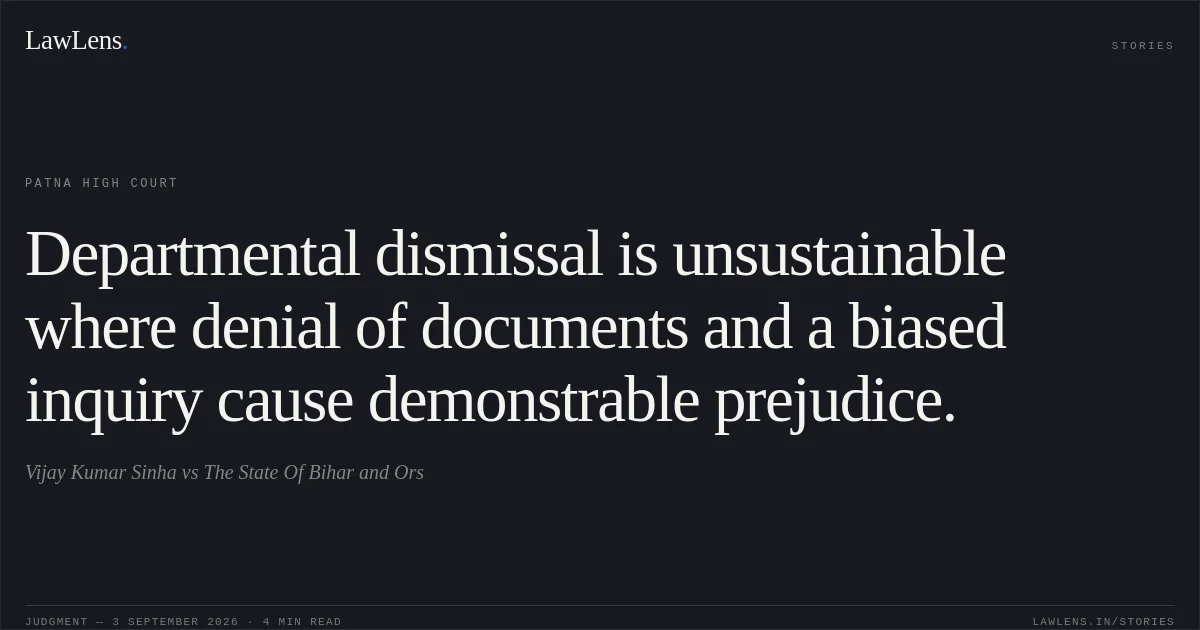
The Court held that the departmental proceeding was vitiated by denial of relevant documents, breach of the prescribed procedure, the Conducting Officer’s assumption of a prosecutorial role, reliance on unproved and undisclosed material, and denial of an effective appellate hearing.
The appellate order dated 2/3 October 2016 and the dismissal order dated 12 June 2014 were quashed and set aside.
Source reference: p. 19, para. 31The petitioner was granted consequential benefits, including notional continuity in service up to his superannuation on 1 October 2014 and admissible retiral and other benefits, to be computed and disbursed within three months of receipt or production of the judgment.
Source reference: p. 19, para. 31The writ petition was accordingly allowed without costs.
Source reference: p. 19, para. 32Original Court PDF
Vijay Kumar SinhavsThe State Of Bihar and Ors
Click to open original judgment
Original judgment, available to read, download and summarize on LawLens.in