01Facts
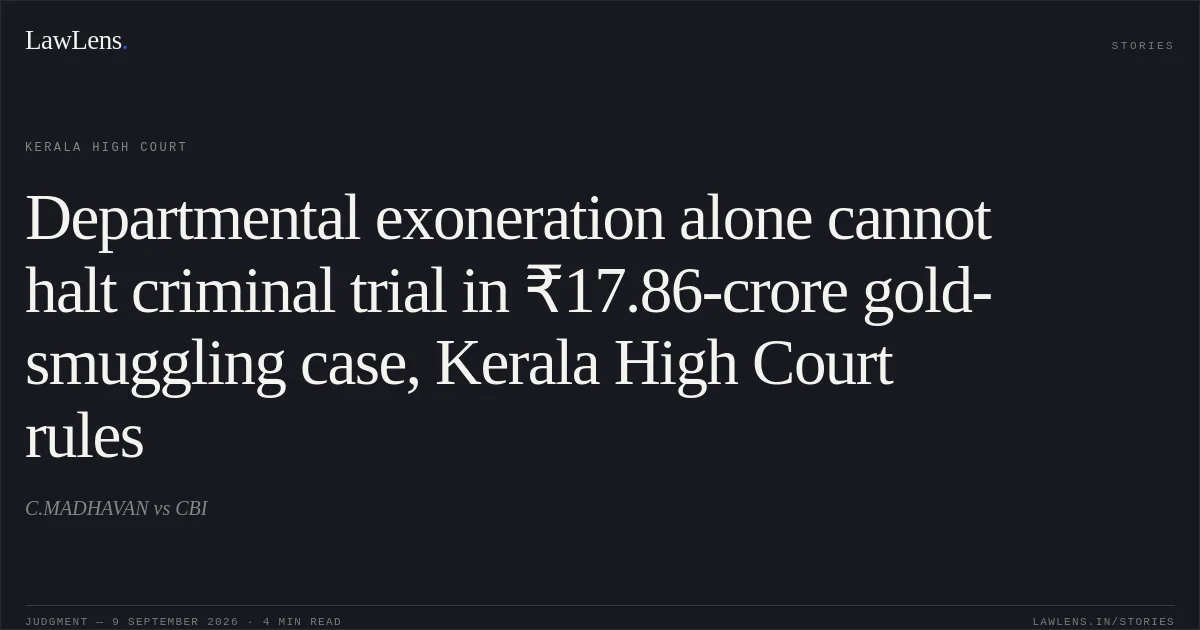
The revision petitioners—C. Madhavan (Accused No. 1), Dr. S. Anil Kumar (Accused No. 8), and Ahmed Suhail (Accused No. 11)—were prosecuted in C.C. No. 2 of 2016 before the Additional Special Court (SPE/CBI-II), Ernakulam, arising from an alleged conspiracy to smuggle 56 kilograms of gold through Cochin International Airport during May–September 2013.
¶ 3, 12Madhavan, then Deputy Commissioner of Customs with additional charge of the Air Intelligence Unit and passenger-clearance section, was alleged to have facilitated the smugglers’ passage and accepted illegal gratification, including a 42-inch LED television and dinner set.
¶ 3, 12Dr. Anil Kumar, an Assistant Commissioner of Customs, was alleged to have facilitated the smuggling operation and received ₹5 lakhs, gifts, and the free use of an Innova vehicle in return for official assistance.
¶ 3, 9, 11Ahmed Suhail was alleged to have accompanied another accused from Dubai, carried four kilograms of smuggled gold, and delivered it through an intermediary to another accused at Calicut.
¶ 4, 10, 13The accused sought discharge under the relevant criminal procedure provisions. The Special Court dismissed their discharge applications by a common order dated 7 February 2025. They consequently filed the present criminal revision petitions.
¶ 1, 5–8Madhavan and Anil Kumar additionally relied on their alleged exoneration in departmental proceedings.
¶ 1, 5–802Issues
i.Whether the prosecution materials disclosed a prima facie case or raised a strong suspicion sufficient to justify framing charges against Accused Nos. 1, 8 and 11, thereby warranting dismissal of their discharge applications?
¶ 16ii.Whether the alleged exoneration of Accused Nos. 1 and 8 in departmental proceedings required their discharge from the criminal prosecution?
¶ 5, 8, 14–15iii.Whether the absence of direct proof of demand of illegal gratification, particularly against Accused No. 8, justified discharge at the pre-trial stage?
¶ 5–6, 1603Law Applied
The Court applied Sections 120B, 201 and 420 of the Indian Penal Code, and Sections 7, 12 and 13(2) read with Section 13(1)(d) of the Prevention of Corruption Act, 1988, concerning criminal conspiracy, cheating, abetment, demand and acceptance of illegal gratification, and criminal misconduct.
¶ 3, 11–13At the stage of discharge, the Court must examine whether the prosecution record discloses the ingredients of the alleged offences or raises a strong suspicion regarding the accused’s involvement; a mere suspicion is insufficient, but the Court need not conduct a detailed evaluation of evidence or determine guilt.
¶ 16Departmental and criminal proceedings are generally independent, and exoneration in departmental proceedings does not ipso facto result in discharge or quashing of a criminal prosecution.
¶ 14–15The Court relied on Radheshyam Kejriwal v. State of West Bengal, P.S. Rajya v. State of Bihar, Ashoo Surendranath Tewari v. Deputy Superintendent of Police, State of N.C.T. of Delhi v. Ajay Kumar Tyagi, and Karnataka Lokayuktha, Bagalkote District v. Chandrashekar for the principles governing departmental exoneration and criminal prosecution.
¶ 14–15The Court also held that the question of demand and acceptance under the Prevention of Corruption Act, including the principle in Neeraj Dutta v. State (Government of NCT of Delhi), could properly be assessed after evidence was led at trial.
¶ 16Provisions in the judgment · 6 · Linked ones open on LawLens
Prevention of Corruption Act, 1988 Section 7Section 12Section 13Section 19
Indian Penal Code, 1860 Section 420
Code of Criminal Procedure, 1973 Section 482
04Reasoning
The Court found prima facie material against Madhavan in the form of witness statements concerning his relationship and meetings with the principal accused, alleged receipt of illegal gratification, contact with persons connected with the smuggling operation, recovery materials, and disclosure and seizure documents.
¶ 9Against Anil Kumar, the prosecution relied on the alleged transfer of ₹5 lakhs, recovery of articles, evidence concerning the Innova vehicle, witness statements regarding assistance rendered to the principal accused, and documents relating to the facilitation of an LED television through customs.
¶ 9Against Ahmed Suhail, the prosecution relied on his travel and hotel records, the statement of the intermediary who collected him from the airport, the alleged handing over of four kilograms of gold and an LED television, and the statement of another accused.
¶ 10These materials, if accepted at trial, were capable of establishing the alleged conspiracy, facilitation, cheating and corruption-related offences.
¶ 16The Court therefore held that it was impermissible at the discharge stage to test the credibility of witnesses, conclusively determine whether demand was proved, or undertake the evidentiary assessment contemplated in Neeraj Dutta.
¶ 16The Court further held that the departmental exoneration of Madhavan and Anil Kumar did not automatically terminate the criminal proceedings.
¶ 14–16The departmental proceedings and the CBI prosecution were conducted by different authorities and involved different standards and purposes.
¶ 14–16Since the prosecution was supported by independent witness statements, documentary evidence, recovery materials and surrounding circumstances, the case did not fall within the exceptional category where a finding in another proceeding completely destroyed the foundation of the criminal prosecution.
¶ 14–1605Holding
The High Court dismissed all three criminal revision petitions and upheld the Special Court’s order refusing discharge to Accused Nos. 1, 8 and 11.
¶ 16It held that the prosecution materials disclosed a prima facie case and raised a strong suspicion sufficient to proceed to trial.
¶ 16The alleged departmental exoneration of Accused Nos. 1 and 8 was held insufficient, by itself, to warrant discharge, and the questions concerning demand, acceptance and evidentiary reliability were left for determination after trial.
¶ 16All interim orders were vacated, and the Special Court was directed to proceed with and conclude the trial within six months from receipt of the High Court’s order.
Original Court PDF
C.MADHAVANvsCBI
Click to open original judgment
Original judgment, available to read, download and summarize on LawLens.in