Facts
The three writ petitions under Article 226 of the Constitution concerned the convening of a Departmental Promotion Committee (DPC) for promotion to the post of Professor in the Department of Prosthodontics. The petitioners, including Dr. Subhash Sonkesriya and Dr. Neha Verma, challenged the proposed consideration process and sought promotion substantially on the basis of seniority, exclusion of allegedly incomplete Annual Confidential Reports (ACRs), and scrutiny of the ACRs and eligibility of competing candidates.
Source reference: paras. 1–6Dr. Sonkesriya was appointed Lecturer on 16 January 2008, possessed an MDS in Prosthodontics, and claimed eligibility for promotion to Professor. His name appeared at serial no. 2 in the gradation list of Readers, while the proposed intervenor’s name appeared at serial no. 3. Following the Commissioner’s direction dated 4 July 2026 to initiate promotion proceedings under the M.P. Public Service Promotion Rules, 2025, the petitioner requested consideration of reservation and promotion in accordance with law.
Source reference: paras. 10–12Earlier, the petitioner had obtained an order directing supply of his ACRs for 2018–2023. After receiving them, he alleged that although the Reporting and Reviewing Authorities had made entries, the Accepting Authority had not recorded any remarks, rendering the ACRs incomplete. He therefore sought that the ACRs be disregarded and that promotion be granted solely on seniority.
Source reference: paras. 13–15The respondents opposed the petitions as premature, asserting that the DPC had not yet convened, that promotion was governed by merit-cum-seniority, and that the DPC could objectively assess the entire service record despite incomplete ACR endorsements.
Source reference: paras. 17–18Issues
1. Whether the petitioners could claim promotion solely on the basis of seniority before the DPC had been convened and before the applicable promotion criteria had been determined and applied?
Source reference: para. 222. Whether the absence of remarks by the Accepting Authority rendered the petitioners’ ACRs unusable for promotion purposes?
Source reference: paras. 14–15, 233. Whether the respondents could place the existing ACRs before the DPC without permitting any subsequent modification by the Accepting Authority?
Source reference: paras. 23, 27–294. Whether the DPC was bound to mechanically adopt the gradings recorded by the Reporting and Reviewing Authorities?
Source reference: paras. 26–27Law Applied
The Court applied Article 226 of the Constitution, observing that promotion is not a fundamental right; Articles 14 and 16 protect only an employee’s right to fair consideration for promotion.
Source reference: para. 22It considered the M.P. Autonomous Medical College Academic Model Service Rules, 2018, as adopted by the institution, and the M.P. Public Service Promotion Rules, 2025, under which the applicable promotion criterion had to be determined according to the relevant service rules.
Source reference: paras. 9, 11, 22The Court further relied on the General Administration Department’s procedure and circulars governing preparation and finalisation of ACRs, including the time limits for remarks by the Reporting, Reviewing and Accepting Authorities and the consequences of an incomplete ACR.
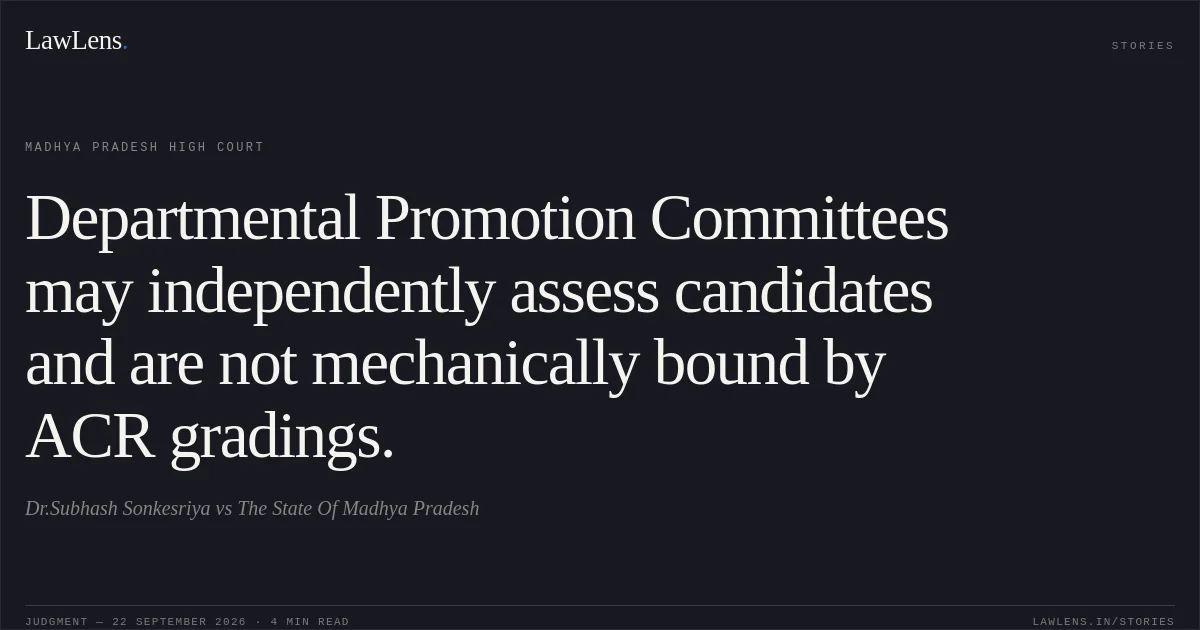
Source reference: para. 17Under the principles stated in Ramanand Prasad Singh v. Union of India, (1996) 4 SCC 64, Union of India v. S.K. Goel, (2007) 14 SCC 641, Ajit Singh (II) v. State of Punjab, (1999) 7 SCC 209, and particularly M.V. Thimmaiah v. UPSC, (2008) 2 SCC 119, a DPC or Selection Committee is not mechanically bound by the gradings of the Reporting or Reviewing Authorities and may make an independent, comparative assessment of the candidates’ overall service records.
Source reference: paras. 19, 26–27Reasoning
The Court held that the request for promotion solely on seniority was premature and legally untenable. Since the DPC had not yet been convened, it was inappropriate for the Court to pre-emptively decide whether the applicable standard would be seniority-cum-merit or merit-cum-seniority; that determination had to be made under the governing rules while considering the relevant classes of the feeder and promotional posts.
Source reference: para. 22Regarding the ACRs, the Court noted that the Reporting and Reviewing Authorities had awarded the petitioner “Very Good” gradings, but the Accepting Authority had not made further remarks. In view of the applicable GAD procedure, the time for such endorsement had expired and the Accepting Authority could not subsequently alter the existing gradings.
Source reference: para. 23The ACRs therefore had to be preserved in their existing form and placed before the DPC. At the same time, the DPC was required to conduct an independent and objective assessment of all candidates within the zone of consideration and was not bound to adopt the ACR gradings mechanically.
Source reference: paras. 26–27The Court distinguished Dr. Padma Shukla v. State of Madhya Pradesh, because that case involved alleged manipulation and unexplained downgrading of an ACR, whereas no such manipulation was established here.
Source reference: paras. 24–25Holding
The Court dismissed the claim for promotion based solely on seniority.
The petitioners’ ACRs shall not be altered by the Accepting Authority because the prescribed time for endorsement had expired.
Source reference: paras. 28–29The ACRs shall be placed before the DPC in their existing form.
Source reference: paras. 28–29The DPC shall objectively assess all eligible candidates within the zone of consideration in accordance with the applicable recruitment rules and lawful promotion criteria.
Source reference: paras. 28–29The petitions were accordingly disposed of, without granting any direct order of promotion to the petitioners.
Source reference: para. 29Original Court PDF
Dr.Subhash SonkesriyavsThe State Of Madhya Pradesh
Click to open original judgment
Original judgment, available to read, download and summarize on LawLens.in