Facts
The appellants, comprising the deceased Noor Ahamad’s wife, children and mother, sought compensation under the Employees’ Compensation Act, 1923, alleging that he worked as a watchman for the Forest Department and died while on duty on 23 October 2014.
Source reference: p.3The Commissioner dismissed the claim, finding that the appellants had not proved either their relationship to the deceased or his employment by the respondents.
Source reference: p.5The appellants challenged that decision in an appeal under Section 30(1) of the Act.
Source reference: p.2Issues
Whether the Tribunal was right in holding that the claimants had failed to prove an employer–employee relationship between the deceased and the respondents.
Source reference: p.6Whether the appellants established their entitlement to compensation on the evidence presented.
Source reference: pp.4–5, 11–12Law Applied
The appeal was brought under Section 30(1) of the Employees’ Compensation Act, 1923.
Source reference: p.2The Court proceeded on the basis that a claimant seeking compensation must establish that the deceased was an employee of the respondent before the question whether the death arose out of and in the course of employment can be considered.
Source reference: pp.8–9It distinguished Daivshala and Others v. Oriental Insurance Co. Ltd. and Another, observing that the employment relationship was not disputed there and that material evidence had been produced.
Source reference: p.9It also discussed The Divisional Manager v. Smt. Mamata and Others, where the employer’s failure to deny the relationship, together with oral and documentary evidence, supported a finding of employment; the Court found that circumstance absent in this case.
Source reference: pp.9–10Reasoning
The Court found that the appellants produced no documentary or other cogent evidence showing that the deceased worked for the Forest Department or received wages from it.
Source reference: pp.7–8, 10–11PW1 admitted that she had no documents proving his employment, and the notice sent to the respondent, without more, did not establish the relationship.
Source reference: pp.7–8, 10–11The FIR and post-mortem report established matters concerning the death but did not prove employment; nor had the appellants sought relevant employment records, wage or bank records, or shift schedules from the respondents.
Source reference: pp.10–11The Court also noted inconsistencies in the evidence regarding the circumstances and timing of the deceased’s work.
Source reference: p.11Because the foundational employment relationship was not proved, the Court held that the appellants could not establish entitlement to compensation.
Source reference: pp.11–12Holding
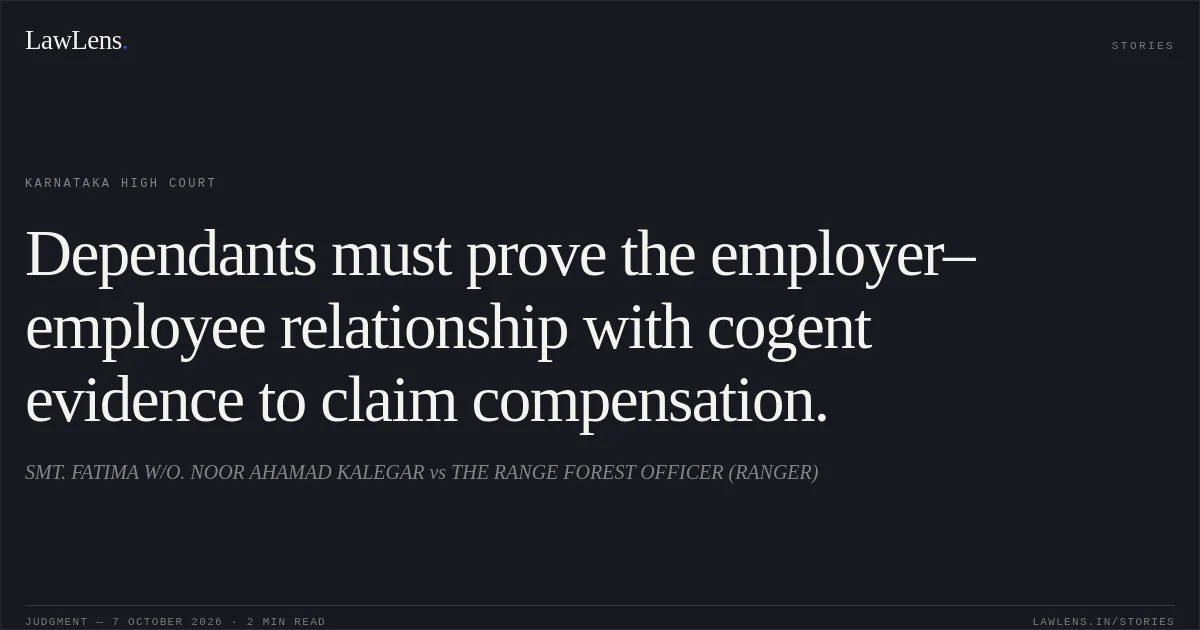
The Court answered the substantial question against the appellants, holding that they failed to prove the employer–employee relationship between the deceased and the respondents.
The appeal was dismissed, and the parties were directed to bear their own costs.
Source reference: p.12Acts & Sections Cited
1 provisions across 1 statute referred to in this judgment. Linked provisions open on LawLens.
Employee1
Original Court PDF
SMT. FATIMA W/O. NOOR AHAMAD KALEGARvsTHE RANGE FOREST OFFICER (RANGER)
Click to open original judgment
Original judgment, available to read, download and summarize on LawLens.in