Facts
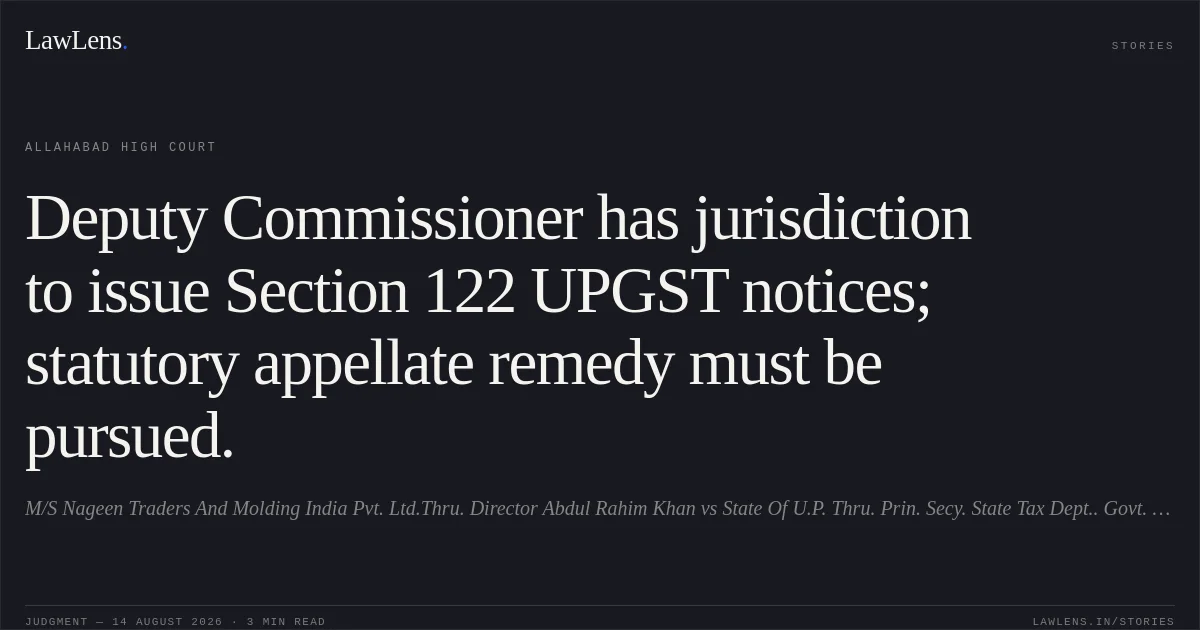
The petitioner challenged a show-cause notice dated 19 November 2025 and accompanying DRC-01 issued under Sections 122(1)(ii) of the UPGST Act, 2017, as well as the consequential penalty order and DRC-07 dated 24 June 2026 under Sections 122(1)(ii) and 122(1)(vii).
Source reference: para. 2The petitioner contended that the Deputy Commissioner of State Tax who issued the notice lacked jurisdiction because the proposed penalty exceeded ₹1 crore and, according to Circular No. 254/11/2025-GST dated 27 October 2025, the notice ought to have been issued by an Additional Commissioner or Joint Commissioner of Central Tax.
Source reference: paras. 3–5The State relied on its circulars dated 11 December 2018 and 10 May 2022, asserting that proceedings under Section 122 were governed by Section 127 and that the Deputy Commissioner possessed the requisite jurisdiction, particularly in cases involving turnover exceeding ₹2.5 crores.
Source reference: paras. 6–7The petitioner had appeared before the assessing authority and made submissions on the merits without initially objecting to jurisdiction.
Source reference: para. 9Issues
Whether the Deputy Commissioner of State Tax had jurisdiction to issue the show-cause notice under Section 122 of the UPGST Act, 2017, where the proposed penalty exceeded ₹1 crore?
Source reference: paras. 3–8Whether the petitioner was entitled to invoke the writ jurisdiction under Article 226 after participating in the proceedings on merits, or should be relegated to the statutory appellate remedy?
Source reference: paras. 9–11Whether the petitioner would be entitled to the benefit of Section 14 of the Limitation Act, 1963, for the period spent pursuing the writ petition?
Source reference: para. 13Law Applied
Section 127 of the CGST/UPGST Act empowers the proper officer to impose a penalty in cases not covered by specified proceedings, after providing a reasonable opportunity of hearing.
Source reference: para. 6The State circular dated 11 December 2018 clarified that the proper officer competent to issue proceedings under Section 122 would be determined with reference to Section 127.
Source reference: para. 6The State circulars dated 11 December 2018 and 10 May 2022 allocated jurisdiction and indicated that, in cases involving turnover exceeding ₹2.5 crores, the Deputy Commissioner could exercise jurisdiction.
Source reference: para. 7Although a jurisdictional objection may ordinarily be raised before a Constitutional Court at any stage, the exercise of writ jurisdiction under Article 226 is discretionary and must be judicious.
Source reference: para. 10A litigant who participates in proceedings on merits may be denied writ relief on the basis of the doctrine of election and may be directed to pursue the statutory appellate remedy.
Source reference: para. 11Section 14 of the Limitation Act may exclude the time spent prosecuting proceedings before a forum lacking jurisdiction, subject to satisfaction of its statutory requirements.
Source reference: para. 13Reasoning
The Court rejected the petitioner’s jurisdictional objection.
Source reference: no citationIt found, on a prima facie consideration of the applicable UPGST circulars, that the Deputy Commissioner was authorised to issue a show-cause notice under Section 122 and that the relevant pecuniary jurisdiction lay with that officer in cases involving turnover exceeding ₹2.5 crores.
Source reference: para. 8The Court therefore did not accept the petitioner’s reliance on the Central Government’s Circular No. 254/11/2025-GST as demonstrating a lack of jurisdiction under the State enactment.
Source reference: paras. 4–8Further, the petitioner had participated in the proceedings and advanced submissions on merits without challenging jurisdiction at the notice stage.
Source reference: para. 9Having raised the objection only after the adverse penalty order, the petitioner was held to be hit by the doctrine of election.
Source reference: para. 9In view of the availability of a statutory appeal and the discretionary nature of Article 226 jurisdiction, the Court declined to examine the matter further in writ proceedings.
Source reference: paras. 10–11Holding
The Court held that the authority issuing the show-cause notice was not prima facie lacking jurisdiction and that the petitioner’s belated jurisdictional challenge, after participation on merits, did not warrant interference under Article 226.
The writ petition was accordingly disposed of, with liberty to the petitioner to avail the statutory appellate remedy in accordance with law.
Source reference: para. 12The Court further observed that the petitioner could claim the benefit of Section 14 of the Limitation Act for the period during which the writ petition remained pending, subject to fulfilment of the statutory requirements.
Source reference: para. 13Acts & Sections Cited
12 provisions across 3 statutes referred to in this judgment. Each provision opens on LawLens.
Central Goods and Services Tax Act, 2017
Integrated Goods and Services Tax Act, 20171
Limitation Act, 19631
Original Court PDF
M/S Nageen Traders And Molding India Pvt. Ltd.Thru. Director Abdul Rahim KhanvsState Of U.P. Thru. Prin. Secy. State Tax Dept.. Govt. Lko. And 2 Others
Click to open original judgment
Original judgment, available to read, download and summarize on LawLens.in