Facts
The husband petitioned for divorce under Sections 13(1)(ia) and 13(1)(ib) of the Hindu Marriage Act, 1955, alleging cruelty and desertion.
Source reference: para. 1, 4–9He claimed that his wife repeatedly left the matrimonial home, insisted on separate accommodation, and ultimately departed on 27 November 2016.
Source reference: para. 4–9The wife denied the allegations and alleged that the husband doubted her character and assaulted her.
Source reference: para. 4–9The Family Court dismissed the petition, finding that cruelty had not been proved and that the statutory two-year period of desertion had not elapsed when the petition was filed on 15 December 2016.
Source reference: para. 12, 19, 22–23The husband appealed.
Source reference: para. 1Issues
1. Whether the husband established that the wife had treated him with cruelty within the meaning of Section 13(1)(ia) of the Act
Source reference: para. 10, 292. Whether the husband established desertion for the statutory period immediately preceding presentation of the petition, as required by Section 13(1)(ib)
Source reference: para. 10, 19–21, 303. Whether the Family Court was justified in dismissing the divorce petition
Source reference: para. 27Law Applied
Section 13(1)(ia) of the Hindu Marriage Act permits divorce on the ground of cruelty, which must be established by evidence; ordinary wear and tear or matrimonial quarrels do not, by themselves, amount to cruelty.
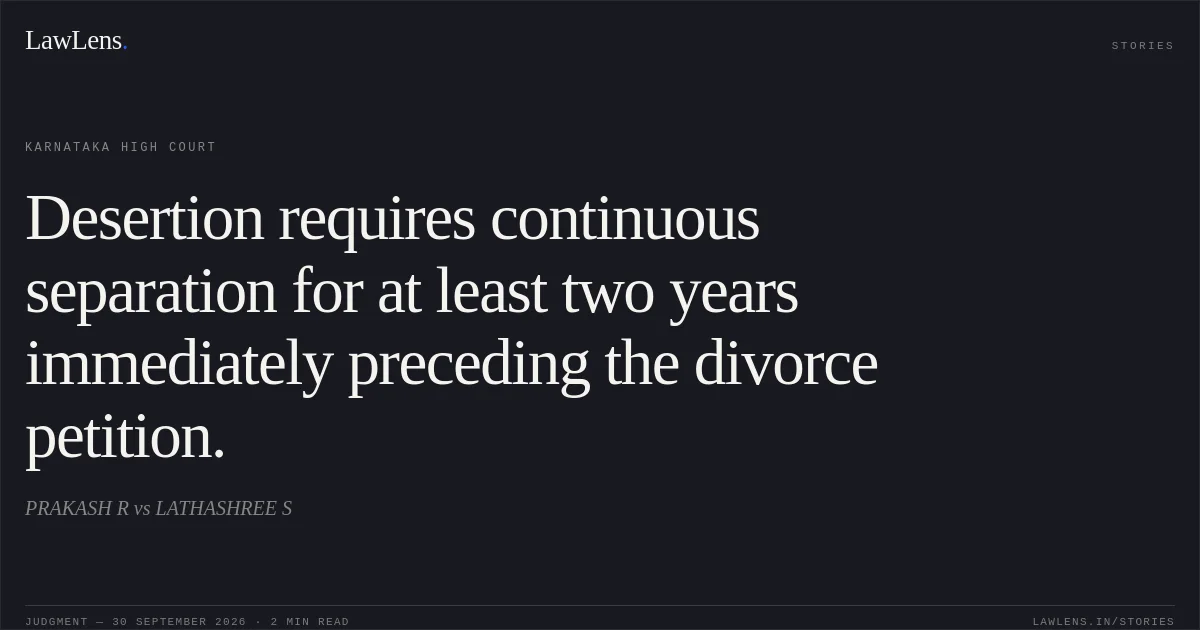
Source reference: para. 16, 29Under Section 13(1)(ib), desertion requires continuous desertion for at least two years immediately preceding presentation of the petition.
Source reference: para. 19–21, 30–31It involves both the factum of separation and animus deserendi—an intention permanently to abandon the matrimonial relationship—and must be without reasonable cause.
Source reference: para. 19–21, 30–31The Family Court also relied on Sidda Shetty v. Rajamma and Rajesh Haribha Patil v. Ranjana Rajesh Patil for the propositions that unsupported pleadings and vague, general allegations are insufficient to establish cruelty or desertion.
Source reference: para. 17Reasoning
The High Court found no specific or cogent evidence supporting the husband’s allegations of cruelty; his documentary evidence did not substantiate them, and ordinary matrimonial quarrels were insufficient to prove the statutory ground.
Source reference: para. 29Desertion was also not established: although the wife had been living at her parental home since 27 November 2016, the petition was filed less than a month later, well short of the required two-year period.
Source reference: para. 30Further, the wife maintained that she was willing to resume cohabitation, while the husband stated that she was “not necessary” to him, undermining the claim that she intended permanently to end the relationship.
Source reference: para. 31Holding
The Court held that the husband failed to establish either cruelty or desertion and found no perversity, illegality, or misappreciation of evidence warranting appellate interference.
The appeal was dismissed, and the Family Court’s judgment and decree dismissing the divorce petition were confirmed.
Source reference: para. 33Acts & Sections Cited
3 provisions across 2 statutes referred to in this judgment. Each provision opens on LawLens.
Family Courts Act, 19841
Hindu Marriage Act, 19552
Original Court PDF
PRAKASH RvsLATHASHREE S
Click to open original judgment
Original judgment, available to read, download and summarize on LawLens.in