Facts
The Appellants developed Ardee City, Sector 52, Gurugram, where electricity was supplied by Dakshin Haryana Bijli Vitran Nigam (“DHBVN”) up to a single point, after which the internal distribution infrastructure, metering, billing, collection, and maintenance were undertaken by the Appellants.
Source reference: paras. 2–5; pp. 4–6The Appellants charged an additional 12% in the electricity bills, initially described as “Admin/Service Charges” and subsequently as charges for transmission losses, maintenance, and common facilities.
Source reference: paras. 37–41; pp. 15–16Residents filed a petition before the Haryana Electricity Regulatory Commission (“HERC”) under Regulation 5.5 of the Haryana Electricity Regulatory Commission (Single Point Supply to Employers’ Colonies, Group Housing Societies and Residential or Commercial-cum-Residential Complexes of Developers) Regulations, 2013.
Source reference: paras. 6–7; p. 6HERC restrained the Appellants from charging amounts above the Commission-approved tariff and directed refund of the excess amounts.
Source reference: paras. 6–7; p. 6Issues
Whether HERC had jurisdiction to entertain complaints of overcharging under Regulation 5.5 despite arbitration clauses contained in the electricity agreements?
Source reference: paras. 52–55; pp. 20–21Whether the Single Point Supply Regulations, 2013 applied to the Appellants as private developers and prohibited recovery of charges relating to transformation or LT losses and installation and maintenance of internal electrical infrastructure?
Source reference: paras. 56–64; pp. 21–24Whether the Appellants could recover amounts over and above the Commission-approved domestic tariff towards reasonable infrastructure-related costs?
Source reference: paras. 59–64; pp. 22–24Whether the claim for refund was subject to limitation and, if so, what period was relevant for determination of the claim?
Source reference: paras. 65–67; pp. 24–25Whether relief could be extended to all similarly situated residents and whether residents’ alleged non-electricity dues could be set off against refundable electricity charges?
Source reference: paras. 68–70; pp. 25–26Law Applied
The Tribunal applied Section 12 of the Electricity Act, 2003, under which distribution of electricity requires a licence, and held that supply from a single point through an internal network to end-users constitutes distribution.
Source reference: para. 57; p. 22Regulation 5.3 of the HERC Single Point Supply Regulations, 2013 provides a 4% or 5% rebate to cover obligations such as individual metering, billing and collection, while Regulations 5.2(c)–(d) recognise that the developer, GHS, RWA or employer may bear the cost of operation and maintenance of internal infrastructure.
Source reference: paras. 51, 59–60; pp. 18–23Regulation 5.5 prohibits charging residents a tariff higher than the Commission-approved Domestic Supply tariff but permits residents to approach HERC in cases of overcharging.
Source reference: para. 51; pp. 19–20The Tribunal relied on PTC India Ltd. v. CERC, (2010) 4 SCC 603, for the principle that binding regulations prevail over inconsistent contractual terms.
Source reference: para. 53; p. 20The Tribunal relied on K. Raheja Corporation Pvt. Ltd. v. MERC, 2011 SCC OnLine APTEL 105, for the proposition that internal supply of electricity constitutes distribution.
Source reference: para. 57; p. 22It further applied the limitation principles recognised in A.P. Power Coordination Committee v. Lanco Kondapalli Power Ltd., (2016) 3 SCC 468, holding that claims before an Electricity Commission cannot be entertained beyond the period permissible in an ordinary civil action.
Source reference: paras. 65–67; pp. 24–25Section 175 of the Electricity Act was applied to hold that proceedings under the Act may coexist with proceedings under other laws.
Source reference: para. 68; p. 25Reasoning
The Tribunal rejected the arbitration objection because Regulation 5.5 specifically authorised aggrieved residents to approach HERC regarding overcharging, and a contractual arbitration clause could not defeat a binding statutory regulation.
Source reference: paras. 52–55; pp. 20–21It held that the Regulations applied to the Appellants because, notwithstanding their status as private developers, they operated as intermediaries in the distribution of electricity through the colony’s internal network.
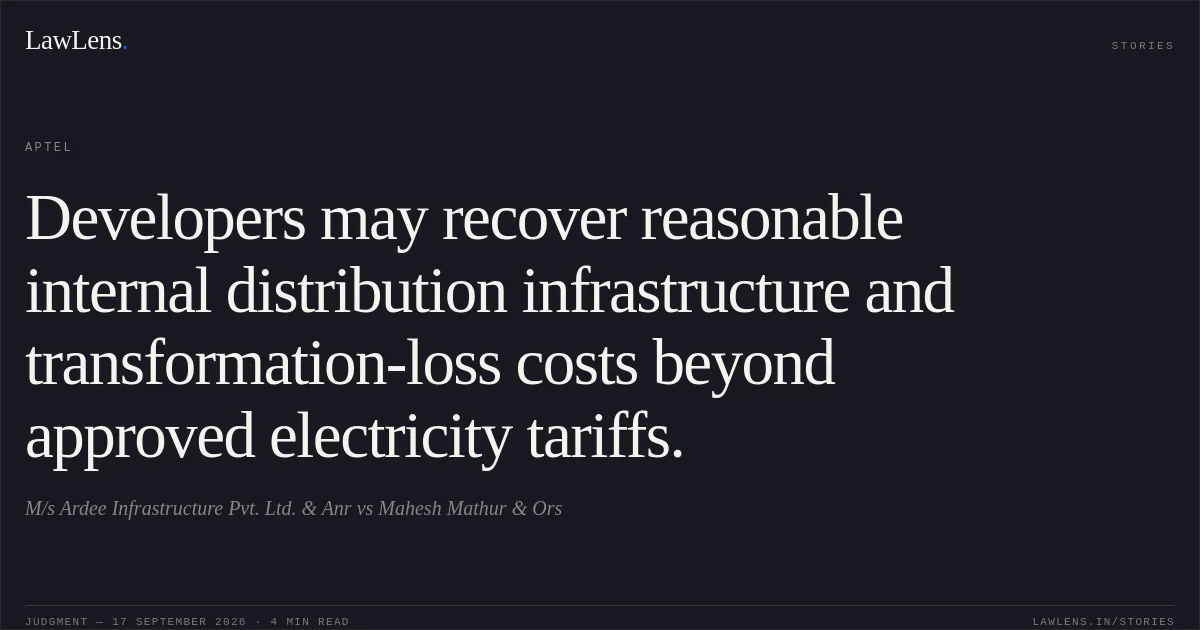
Source reference: paras. 56–58; pp. 21–22However, the Tribunal distinguished the Commission-approved electricity tariff from additional reasonable costs incurred for transformation or LT losses and for installation and maintenance of internal infrastructure.
Source reference: paras. 59–63; pp. 22–24Regulation 5.3 already recognised certain costs through the rebate mechanism, while Regulations 5.2(c)–(d) placed infrastructure-related obligations upon the developer or similar entity.
Source reference: paras. 59–63; pp. 22–24Accordingly, HERC erred in imposing an absolute prohibition on recovery of all amounts above the applicable tariff.
Source reference: para. 64; p. 24Nevertheless, the Tribunal found no basis to accept the Appellants’ entire 12% levy as reasonable and remanded the matter for determination of the actual reasonable costs.
Source reference: para. 64; p. 24The claim was limited to the three-year period preceding the filing of the HERC complaint and ending when DHBVN took over distribution.
Source reference: paras. 65–67; pp. 24–25The Tribunal also held that relief could extend to similarly situated residents, but unrelated maintenance or other dues could not be adjusted against electricity-charge refunds.
Source reference: paras. 69–70; pp. 25–26Holding
The appeal was allowed in part.
The Tribunal set aside the HERC order to the extent that it absolutely prohibited the Appellants from recovering from residents any amount above the Commission-approved tariff towards transformation or LT losses and installation and maintenance of internal electrical infrastructure.
Source reference: Order; pp. 26–27The matter was remanded to HERC to: (i) determine the reasonable cost of those components; (ii) calculate the amount, if any, refundable by the Appellants towards excess electricity charges; and (iii) issue appropriate directions for refund or adjustment to the residents of Ardee City.
Source reference: Order, pp. 26–27The determination was confined to the period beginning three years before the HERC complaint and ending upon DHBVN’s takeover of supply.
Source reference: paras. 64–67; pp. 24–25; Order, pp. 26–27Acts & Sections Cited
19 provisions across 4 statutes referred to in this judgment. Each provision opens on LawLens.
Electricity Act, 2003
Limitation Act, 19631
Code of Civil Procedure, 19081
Indian Contract Act, 18721
Original Court PDF
M/s Ardee Infrastructure Pvt. Ltd. & AnrvsMahesh Mathur & Ors
Click to open original judgment
Original judgment, available to read, download and summarize on LawLens.in