Facts
The appellants, residents of Block Harwan, challenged the jurisdiction of the J&K Lakes Conservation and Management Authority (LCMA) over their villages
Source reference: p. 2They contended that since their area comprises Rural Panchayat Halqas, they are governed exclusively by the J&K Panchayati Raj Act, 1989, and building permissions should be regulated under Section 12(iv) of said Act
Source reference: p. 2-3The dispute arose when LCMA issued demolition notices under Section 7 of the J&K Control of Building Operation Act, 1988, for unauthorized constructions within areas notified under SRO 109 and SRO 57
Source reference: p. 3-4A Single Judge of the High Court dismissed the writ petition, ruling that the area falls within LCMA’s notified jurisdiction and that the appellants lacked locus standi to challenge notices issued to specific individual violators
Source reference: p. 4-5The appellants filed this Letters Patent Appeal (LPA) against that dismissal
Source reference: p. 5Issues
1. Whether constructions in Block Harwan fall within the regulatory control of the LCMA or are governed by the J&K Panchayati Raj Act, 1989?
Source reference: p. 6 / para. 82. Whether the appellants were entitled to file a writ in a representative capacity to challenge demolition orders issued to specific individuals?
Source reference: p. 6 / para. 8Law Applied
The court primarily applied the J&K Development Act, 1970, which empowers the Government to declare "local areas" for planned development and constitute authorities like LCMA to regulate construction
Source reference: p. 7Section 54 of the Development Act specifies which statutes (such as the Town Planning Act) cease to apply in a notified zone, notably excluding the Panchayati Raj Act from this list
Source reference: p. 9-10The court also examined the J&K Panchayati Raj Act, 1989, specifically Section 12, which imposes a duty on Halqa Panchayats to "regulate" buildings but does not explicitly grant power to sanction or demolish specific individual structures
Source reference: p. 11It further scrutinized Rule 155 of the J&K Panchayati Raj Rules, 1996, regarding its validity as delegated legislation
Source reference: p. 13Reasoning
The Court reasoned that although the Panchayati Raj Act has an overriding effect under Section 3, there is no actual conflict between it and the Development Act regarding building permissions
Source reference: p. 10, 14The court found that the "regulation" of buildings mentioned in Section 12 of the Panchayati Raj Act refers to broad land-use planning (e.g., earmarking residential vs. commercial zones) rather than the technical process of granting individual building permits or enforcement
Source reference: p. 14-15It noted that Halqa Panchayats lack the expertise, infrastructure, and specific statutory power to function as a building control authority
Source reference: p. 12, 15Crucially, the Court held that Rule 155 of the Panchayati Raj Rules, which outlines building permission procedures, was ultra vires because the parent Act did not confer such rule-making power upon the Government
Source reference: p. 13-14Since Block Harwan was expressly notified under the Development Act (via SRO 109 and 57), the LCMA retains exclusive jurisdiction
Source reference: p. 15Holding
The Court dismissed the appeal, holding that LCMA has the sole jurisdiction to regulate constructions in Block Harwan as a notified area
The Court answered the first issue by affirming LCMA's control and the second issue by upholding the Writ Court's finding on lack of merit
Source reference: p. 15The Court directed the Government to revisit the Panchayati Raj Rules to delete Rule 155 and suggested legislative amendments to Section 54 of the Development Act to resolve future statutory overlaps
Source reference: p. 15-16Acts & Sections Cited
15 provisions across 5 statutes referred to in this judgment. Linked provisions open on LawLens.
Jammu and Kashmir High Court Staff (Revised Pay) Rules, 20181
Jammu and Kashmir Control of Building Operation Act, 19981
Jammu and Kashmir Panchayati Raj Act, 19894
Jammu and Kashmir Development Act, 19707
Jammu and Kashmir State Town Planning Act, 19632
Original Court PDF
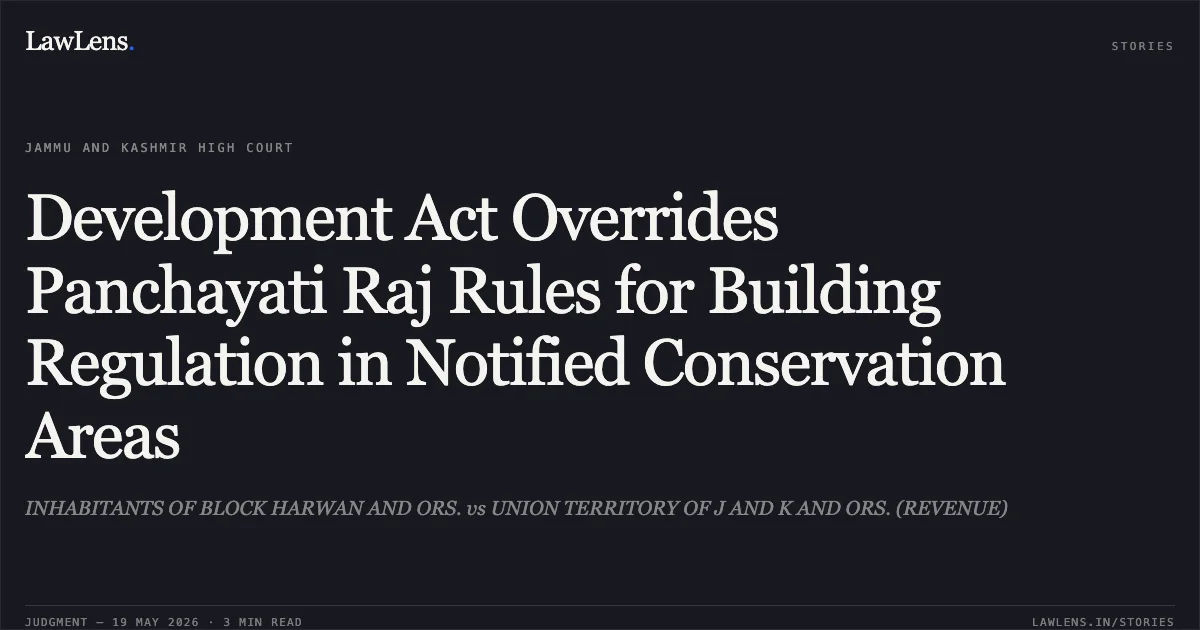
INHABITANTS OF BLOCK HARWAN AND ORS.vsUNION TERRITORY OF J AND K AND ORS. (REVENUE)
Click to open original judgment
Original judgment, available to read, download and summarize on LawLens.in