Facts
The appellants (landowners) entered into registered development agreements and powers of attorney in 2016 with the respondents (developers).
Source reference: para. 2Alleging delays in construction, the appellants filed suits in 2020 before an ordinary Civil Court for cancellation of these agreements.
Source reference: para. 3The suits remained defective regarding court fees until 2022, after which the defendants were served and subsequently filed applications under Order VII Rule 10 of the Code of Civil Procedure (CPC).
Source reference: para. 16The trial court allowed these applications, returning the plaints on the ground that the disputes were "commercial" under the Commercial Courts Act, 2015 (CC Act).
Source reference: para. 3The landowners appealed, contending the agreements involved transfers of title in praesenti and were not merely construction contracts.
Source reference: para. 4Issues
1. Whether the disputes arising out of development agreements involving both construction and transfer of rights are "commercial disputes" under Section 2(1)(c)(vi) of the CC Act.
Source reference: para. 22-232. Whether the "specified value" of the suit is determined by the plaintiff’s valuation for court fees or by the market value of the property under Section 12(1)(c) of the CC Act.
Source reference: para. 22-233. Whether a suit filed in an ordinary court after the commencement of the CC Act can be transferred to a Commercial Court or must be returned for fresh presentation.
Source reference: para. 22-23Law Applied
Section 2(1)(c)(vi) of the CC Act, which defines "commercial dispute" as those arising from construction and infrastructure contracts.
Source reference: para. 27Section 21 of the CC Act, which gives the Act overriding effect over inconsistent laws, including the Court Fees Act.
Source reference: para. 39Section 12(1)(c) of the CC Act was applied to determine "specified value" based on the market value of the immovable property.
Source reference: para. 43Precedent in Patil Automation Pvt. Ltd. v. Rakheja Engineers Pvt. Ltd. [(2022) 10 SCC 1] and Aase Ram v. Amit Kumar regarding the mandatory nature of the CC Act and the procedure for return of plaints.
Source reference: paras. 12, 14, 50Reasoning
The court reasoned that the expression "arising out of" in Section 2(1)(c) lends an expansive meaning to "commercial dispute".
Source reference: para. 28It held that a contract does not lose its character as a construction/infrastructure contract simply because it contains additional elements like the transfer of ownership rights.
Source reference: para. 33Regarding valuation, the court rejected the "harmonious construction" with the Court Fees Act proposed in Mrs. Soni Dave [2016 SCC OnLine Del 4282], ruling that Section 21's overriding effect makes the market value of the property the sole determinant of "specified value" under Section 12(1)(c).
Source reference: paras. 41-45Finally, the court determined that since the suits were filed in 2020 (post-2015 enactment), Section 15 of the CC Act (transfer of pending suits) did not apply; because the ordinary civil court lacked inherent subject-matter jurisdiction, the only legal recourse was the return of the plaint under Order VII Rule 10 of the CPC.
Source reference: paras. 52-55Holding
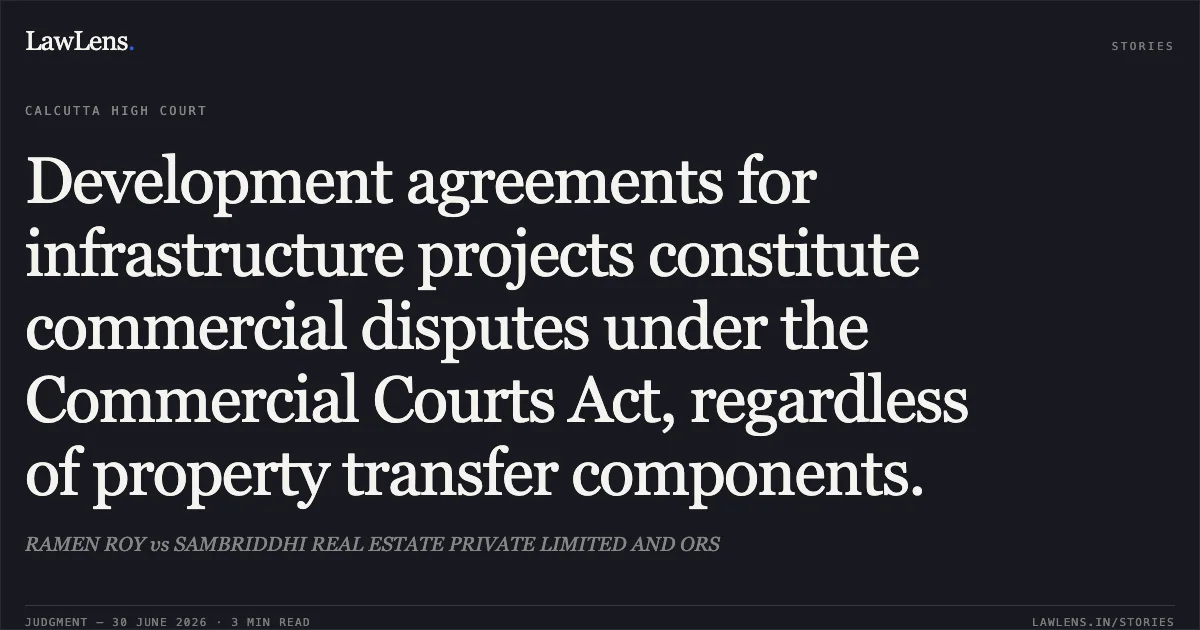
Development agreements for housing projects are commercial disputes under Section 2(1)(c)(vi).
The "specified value" is the market value of the property, which in these cases exceeded the ₹30 Lakh threshold.
Source reference: para. 46Suits filed in the wrong forum after the CC Act's enactment cannot be transferred but must be returned for fresh presentation.
Source reference: para. 55The High Court dismissed the appeals and affirmed the trial court's orders returning the plaints.
Source reference: paras. 60-63Acts & Sections Cited
7 provisions across 4 statutes referred to in this judgment. Each provision opens on LawLens.
Code of Civil Procedure, 19081
Commercial Courts Act, 20154
west bengal court-fees act, 19701
Limitation Act, 19631
Original Court PDF
RAMEN ROYvsSAMBRIDDHI REAL ESTATE PRIVATE LIMITED AND ORS
Click to open original judgment
Original judgment, available to read, download and summarize on LawLens.in


![Subsequent exoneration does not retrospectively invalidate a finalized promotion select list.. UNNIKRISHNAN M vs M/o Environment And Forests. CAT - ['Ernakulam']. LawLens](/stories/thumbnails/subsequent-exoneration-does-not-retrospectively-invalidate-a-finalized-promotion-select-li-ce80a0e84f2f4887857271e8b4341c42.webp)