Facts
The Petitioners purchased property in Ulhasnagar and obtained development permissions from the Ulhasnagar Municipal Corporation (UMC) in 2020 and 2021 to construct a building up to 16 floors.
Source reference: p.4-5They executed Release Deeds for DP Roads and constructed up to 14 floors.
Source reference: p.4-5On August 16, 2024, UMC issued an order revoking the development permissions under Section 51 of the MRTP Act and ordered demolition.
Source reference: p.3UMC alleged the permissions were obtained by misleading facts, as a subsequent site inspection and superimposition of the development plan revealed that 80% of the plot was affected by DP Roads.
Source reference: p.7The UMC also took disciplinary action against the Town Planner who originally granted the permissions.
Source reference: p.7Issues
1. Whether the revocation of development permission under Section 51 of the MRTP Act was valid where such permission was allegedly obtained through misrepresentation.
Source reference: p.6, 82. Whether the investment by the developer or the extent of construction (80%) provides a legal ground to regularize an illegal structure.
Source reference: p.9Law Applied
The Court primarily applied Section 51 of the Maharashtra Regional Town Planning Act, 1966 (MRTP Act), which empowers authorities to revoke or modify development permissions.
Source reference: p.3, 6The Court relied on the principle that "fraud vitiates all orders," rendering permissions procured by misrepresentation non-est in law.
Source reference: p.8The Court further applied precedents from the Supreme Court in Rajendra Kumar Barjatya v. UP Avas Evam Vikas Parishad (2024) [p.9-10] and Kaniz Ahmed v. Sabuddin (2025) [p.11], which establish that illegal constructions must be dealt with "iron hands" and that judicial regularization should not be granted even on grounds of administrative failure or cost of construction.
Source reference: p.9-11Reasoning
The Court found that the Petitioners "approbated and reprobated" by claiming the land was unaffected by DP roads to get permissions while simultaneously releasing land for those same roads.
Source reference: p.12It held that the petitioners, with their architect, presented misleading documents to obtain permissions fraudulently.
Source reference: p.8, 12Although the petitioners argued that 80% of the construction was complete and substantial funds were invested, the Court applied the Rajendra Kumar Barjatya ruling to hold that investment or regulatory inefficiency cannot shield unauthorized constructions from demolition.
Source reference: p.9-10The Court emphasized that since the permissions were void ab initio due to fraud, the entire structure remained illegal regardless of the stage of completion.
Source reference: p.12-13Holding
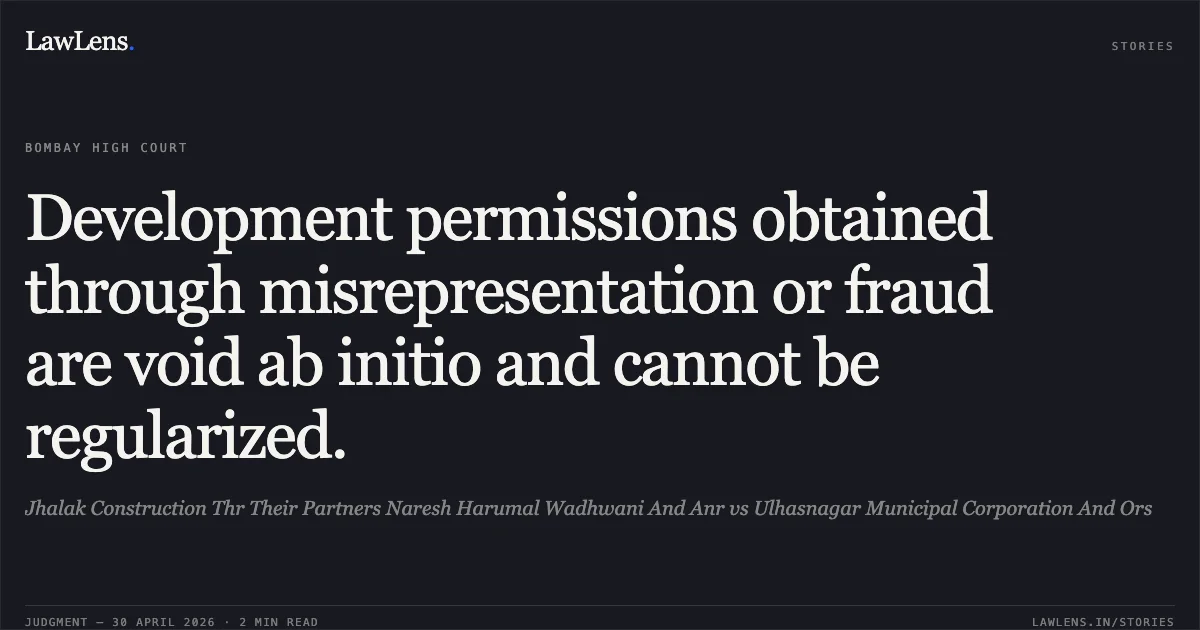
The Court dismissed the petition, answering that fraud vitiates the development permissions and no equitable relief can be granted to a party with "unclean hands".
The Court upheld the UMC’s revocation order and directed the Corporation to proceed with the demolition notice in accordance with the law.
Source reference: p.14All interim applications were disposed of, and the request for a stay on the operation of the judgment was rejected.
Source reference: p.14Acts & Sections Cited
3 provisions across 2 statutes referred to in this judgment. Each provision opens on LawLens.
Maharashtra Regional and Town Planning Act, 1966.2
Real Estate (Regulation and Development) Act, 2016.1
Original Court PDF
Jhalak Construction Thr Their Partners Naresh Harumal Wadhwani And AnrvsUlhasnagar Municipal Corporation And Ors
Click to open original judgment
Original judgment, available to read, download and summarize on LawLens.in


![Subsequent exoneration does not retrospectively invalidate a finalized promotion select list.. UNNIKRISHNAN M vs M/o Environment And Forests. CAT - ['Ernakulam']. LawLens](/stories/thumbnails/subsequent-exoneration-does-not-retrospectively-invalidate-a-finalized-promotion-select-li-ce80a0e84f2f4887857271e8b4341c42.webp)