Facts
On May 24, 2011, a dispute arose between the complainant (Ashaben) and Accused No. 3 (Gangaben) over a trivial water-splashing incident involving a child from the previous day.
Source reference: p. 2Accused No. 3 allegedly instigated Accused Nos. 1 and 2, who attacked the deceased (Sureshbhai) with swords, inflicting multiple wounds on vital parts.
Source reference: p. 2The deceased attempted to flee but was chased and further assaulted near the house of witness Monghabhai (PW-5).
Source reference: p. 2-3Sureshbhai succumbed to his injuries during treatment at Civil Hospital, Ahmedabad.
Source reference: p. 3The Trial Court convicted Accused Nos. 1 and 2 under Section 302 r/w 34 of the IPC but acquitted Accused No. 3 of the murder charge.
Source reference: p. 1-2Accused Nos. 1 and 2 appealed their conviction, while the State appealed the acquittal of Accused No. 3.
Source reference: p. 2Issues
1. Whether the prosecution established a complete chain of ocular, medical, and circumstantial evidence to prove the guilt of Accused Nos. 1 and 2 for murder under Section 302 r/w 34 IPC.
Source reference: p. 8, 232. Whether the acquittal of Accused No. 3 was justified based on the lack of evidence regarding common intention for murder.
Source reference: p. 21-22Law Applied
The Court primarily applied Section 302 of the Indian Penal Code (IPC) for murder and Section 34 regarding common intention.
Source reference: p. 2, 23It utilized Section 27 of the Indian Evidence Act for the admissibility of facts discovered leading from information provided by the accused.
Source reference: p. 19-20The Court relied on *Goverdhan v. State of Chhattisgarh* (2025 INSC 47) regarding the sifting of grain from chaff in witness testimonies.
Source reference: p. 18The Court primarily applied Section 27 of the Indian Evidence Act for the admissibility of facts discovered leading from information provided by the accused.
Source reference: p. 19-20It utilized Section 34 of the Indian Penal Code regarding common intention.
Source reference: no citationThe Court relied on *Raja Khan v. State of Chhattisgarh* (2025 INSC 167) concerning the doctrine of confirmation by subsequent events under Section 27.
Source reference: p. 19-21For the acquittal appeal, it followed principles from *Rajesh Prasad v. State of Bihar* (2022) 3 SCC 471 and *H.D. Sundara v. State of Karnataka* (2023) 9 SCC 581.
Source reference: p. 22-23Reasoning
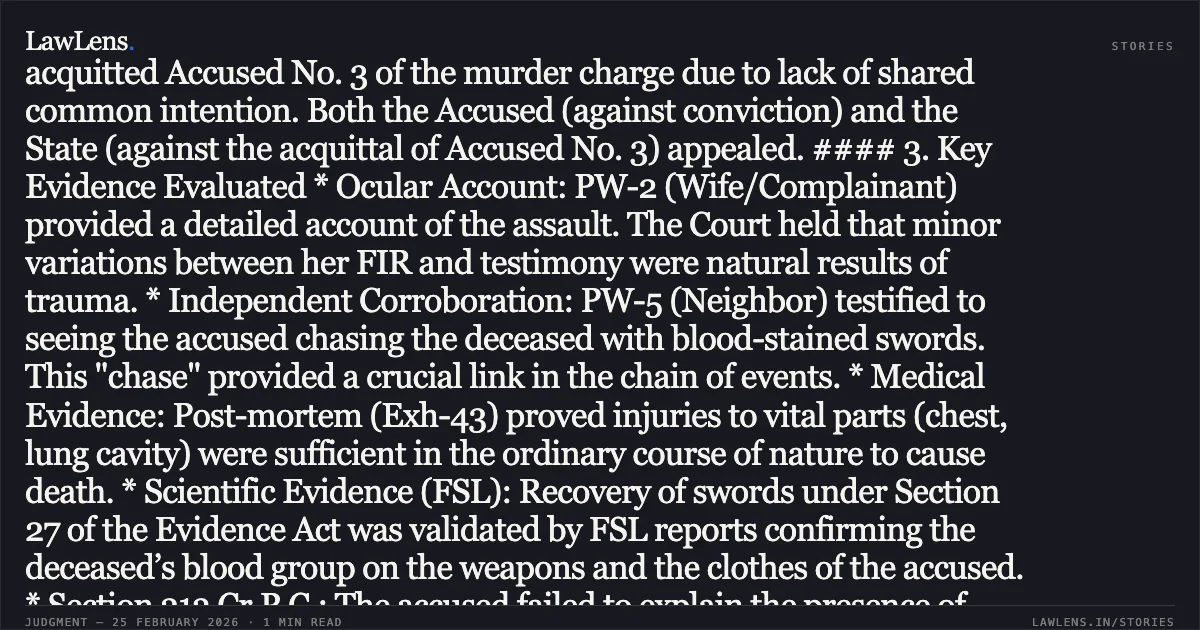
The Court found that the testimony of the complainant (PW-2), although an interested witness, was corroborated by the independent testimony of PW-5, who witnessed the accused chasing the deceased with blood-stained swords.
Source reference: p. 12-13, 17The medical evidence (Post-Mortem Report at Exh-43) confirmed that the injuries were sufficient in the ordinary course of nature to cause death.
Source reference: p. 9, 18Under Section 27 of the Evidence Act, the recovery of swords at the instance of the accused was deemed a reliable incriminating link, further strengthened by FSL reports confirming the deceased’s blood group on the weapons and the clothes of the appellants.
Source reference: p. 15, 21Regarding Accused No. 3, the Court noted that while she participated in the quarrel, there was no evidence of her sharing a common intention to kill or inflicting sword blows; hence, her acquittal was a "possible view" that did not warrant interference.
Source reference: p. 21-22Holding
The Court dismissed the appeals of Accused Nos. 1 and 2, confirming their conviction and life imprisonment, holding that the prosecution proved their guilt beyond reasonable doubt.
It also dismissed the State’s appeal against the acquittal of Accused No. 3, finding no perversity in the Trial Court's decision.
Source reference: p. 24The Court ordered Accused Nos. 1 and 2 to surrender within six weeks to undergo the remainder of their sentence.
Source reference: p. 24Acts & Sections Cited
8 provisions across 2 statutes referred to in this judgment. Each provision opens on LawLens.
Indian Penal Code, 18606
Code of Criminal Procedure, 19732
Original Court PDF
Parmar Chhaganbhai Bhojabhai & Anr. v. State of Gujarat R/Criminal Appeal Nos. 1515 of 2013 and 1315 of 2013
Click to open original judgment
Original judgment, available to read, download and summarize on LawLens.in


![Subsequent exoneration does not retrospectively invalidate a finalized promotion select list.. UNNIKRISHNAN M vs M/o Environment And Forests. CAT - ['Ernakulam']. LawLens](/stories/thumbnails/subsequent-exoneration-does-not-retrospectively-invalidate-a-finalized-promotion-select-li-ce80a0e84f2f4887857271e8b4341c42.webp)