Facts
The Petitioner, Accused No. 3, sought to quash an order dated 26.12.2019 passed by the Metropolitan Magistrate, Ahmedabad, which issued a summons in Criminal Case No. 116617 of 2019.
Source reference: p. 1The underlying complaint was filed under Section 138 of the Negotiable Instruments (NI) Act regarding six dishonoured cheques totaling ₹16,89,00,000/- issued on 28.09.2019 and 04.10.2019.
Source reference: p. 3The Petitioner contended that he was an Independent Director who had resigned effective 26.08.2019, supported by Form DIR-11 and communications to the BSE and NSE.
Source reference: p. 2-3He argued he was neither a signatory to the cheques nor involved in the day-to-day management of the company.
Source reference: p. 2The Respondent (complainant) argued that the Petitioner was liable as a Director under the "consent and connivance" theory per Section 141 of the NI Act.
Source reference: p. 3-4Issues
1. Whether a Director can be held vicariously liable under Section 141 of the NI Act solely based on their designation without specific roles attributed in the complaint.
Source reference: p. 4 / para. 5.12. Whether the criminal proceedings against the Petitioner are maintainable if he had resigned before the issuance/dishonour of the subject cheques and was not a signatory.
Source reference: p. 3 / para. 3.4Law Applied
The Court applied the principles of vicarious liability under Sections 138 and 141 of the Negotiable Instruments Act, 1881.
Source reference: p. 4It relied on National Small Industries Corporation Ltd. v. Harmeet Singh Paintal (2010), which established that Section 141 is a penal provision requiring strict construction; a bald statement that a Director is "in charge" is insufficient without spelling out their specific role.
Source reference: p. 4It further cited N.K. Wahi v. Shekhar Singh (2007) and S.M.S. Pharmaceuticals Ltd. v. Neeta Bhalla (2005), which mandate clear and unambiguous allegations regarding a Director's specific part in the transaction to sustain a prosecution.
Source reference: p. 5Reasoning
The Court observed that the Petitioner did not sign the dishonoured cheques.
Source reference: p. 4It noted that the complaint contained only "bald and omnibus" averments regarding the "consent and connivance" of the Directors without detailing the Petitioner’s specific role.
Source reference: p. 2, 5Upon reviewing Form DIR-11 and the resignation letter dated 26.08.2019, the Court found that the Petitioner had ceased to be a Director before the cheques were even issued in late September and October 2019.
Source reference: p. 3, 6Applying the SMS Pharmaceuticals doctrine, the Court reasoned that since the Petitioner was an Independent Director not involved in day-to-day business or financial decisions, the mandatory requirements of Section 141 were not satisfied.
Source reference: p. 6Consequently, fastening liability merely due to his former designation was deemed legally unsustainable.
Source reference: no citationHolding
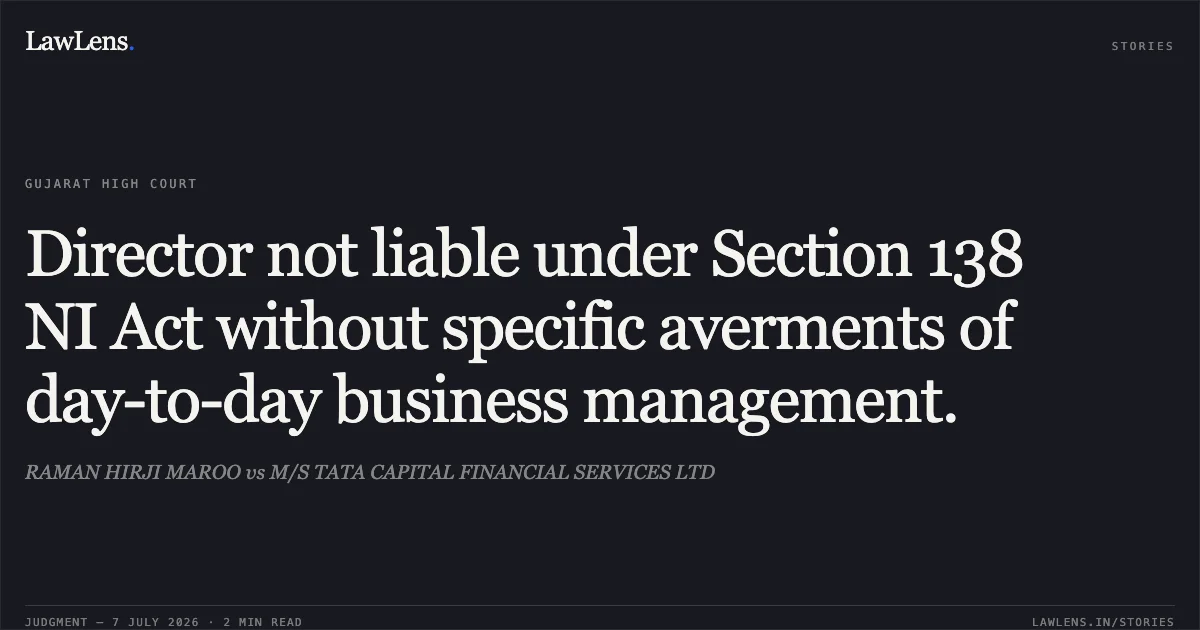
The Court answered the issues in the negative, holding that mere description as a Director is insufficient to attract criminal liability under Section 141 of the NI Act in the absence of specific averments of active involvement.
The Court allowed the petition, quashing and setting aside the order dated 26.12.2019 and all consequential proceedings in Criminal Case No. 116617 of 2019 qua the Petitioner to prevent an abuse of the process of law.
Source reference: p. 6-7Acts & Sections Cited
3 provisions across 1 statute referred to in this judgment. Each provision opens on LawLens.
Negotiable Instruments Act, 18813
Original Court PDF
RAMAN HIRJI MAROOvsM/S TATA CAPITAL FINANCIAL SERVICES LTD
Click to open original judgment
Original judgment, available to read, download and summarize on LawLens.in


