Facts
The petitioner is the widow of Late Gautam Nath, a Constable in the CRPF since 1999.
Source reference: para. 2On 23.08.2015, while serving at the Group Centre Silchar and residing in authorized "out-living" accommodation due to lack of official quarters, the deceased complained of chest pain while on duty as a canteen salesman.
Source reference: para. 2, 21While returning home that evening, he suffered an intracerebral hemorrhage resulting in right-side hemiplegia and 87% disability.
Source reference: para. 2, 3A Medical Invalidation Board declared him unfit for service from 01.09.2016.
Source reference: para. 3The discharge order dated 24.05.2017 specifically noted that his disability "arose out of official duty".
Source reference: para. 5, 14Following his death on 25.09.2017, the petitioner’s claim for ex-gratia compensation was rejected by the respondents on 01.02.2019 on the grounds that he was not on "active duty" at the time of the stroke and the ailment was not duty-related.
Source reference: para. 7, 8Issues
1. Whether the intracerebral hemorrhage suffered by the deceased while returning from his designated place of duty can be considered as occurring "on duty" or "active duty" for the purpose of ex-gratia compensation.
Source reference: para. 15, 172. Whether the disability and subsequent death of the employee are attributable to or aggravated by service conditions.
Source reference: para. 11, 15Law Applied
The court applied Rule 38 of the CCS (Pension) Rules regarding invalidation.
Source reference: para. 5The CCS (Extraordinary Pension) Rules, specifically the schedule classifying hypertension as a disease connectable to service.
Source reference: para. 23CRPF Standing Order No. 51/2001, which defines "on duty" to include travel between one's quarter and the place of duty.
Source reference: para. 19The liberal interpretation of "active duty" established in Madan Singh Shekhawat v. Union of India, Venkatesh v. Union of India, and Union of India v. Rajbir Singh, which established a legal presumption that a person is in sound health upon entry into service, shifting the burden to the employer to prove a disconnect between disability and service.
Source reference: para. 16, 17, 22Reasoning
The court reasoned that "on duty" for a member of the armed forces cannot be pedantically restricted to "office hours" or "actual job performance" at a specific workplace.
Source reference: para. 20, 22Since the deceased had authorized permission to live outside the campus, his transit from the canteen to his residence fell within the scope of service.
Source reference: para. 21The court noted that the respondents' own discharge order dated 24.05.2017 explicitly admitted the disability arose from official duties.
Source reference: para. 14, 22Since the respondents failed to produce any medical evidence from the time of entry into service to rebut the presumption of sound health, the hypertension-led stroke must be presumed as aggravated by service conditions.
Source reference: para. 22, 23The court dismissed the "peace station" argument, noting that psychological and physical stress from previous deployments (like the Rapid Action Force) and the nature of force service are cumulative.
Source reference: para. 21, 22Holding
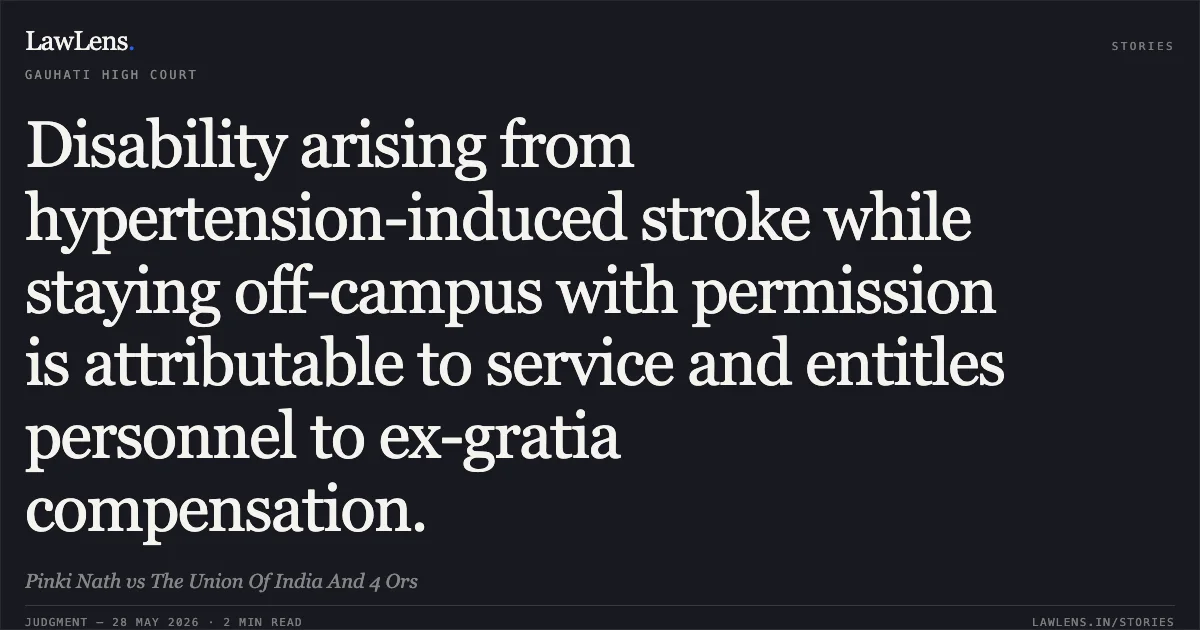
The court allowed the writ petition, holding that the deceased was "on duty" and his ailment was attributable to service.
The court quashed the rejection orders dated 09.02.2018 and 01.02.2019 and directed the respondents to process and ensure payment of the ex-gratia compensation to the petitioner within three months of receipt of the order.
Source reference: para. 25, 26Acts & Sections Cited
1 provisions across 1 statute referred to in this judgment. Each provision opens on LawLens.
Border Security Force Act, 19681
Original Court PDF
Pinki NathvsThe Union Of India And 4 Ors
Click to open original judgment
Original judgment, available to read, download and summarize on LawLens.in