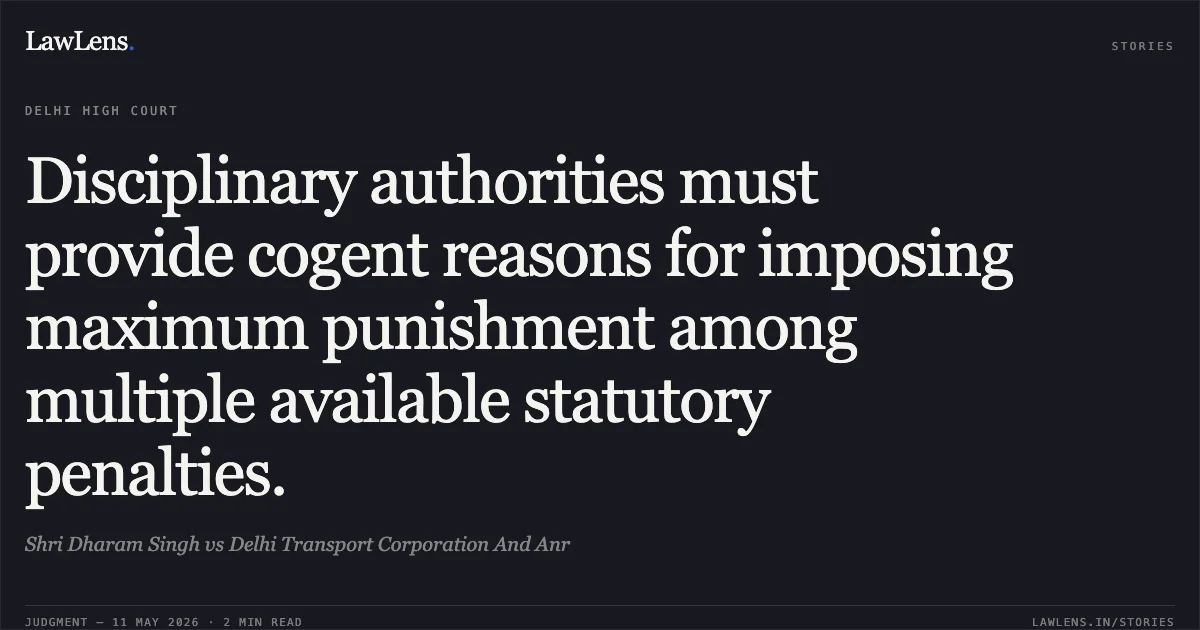
Facts
The Petitioner, a driver with the Delhi Transport Corporation (DTC), was convicted under Sections 289 and 308/34 of the Indian Penal Code, 1860, on 1 May 2008.
Source reference: para. 2Following a show-cause notice, the DTC dismissed him from service on 14 July 2008 under Regulation 15(2)(vii) of the DRTA (Conditions of Appointment and Services) Regulation, 1952.
Source reference: paras. 3-4Although the High Court later upheld his conviction in 2015, it granted him the benefit of probation under the Probation of Offenders Act, 1958.
Source reference: para. 6The Petitioner challenged his dismissal before the Central Administrative Tribunal (CAT), which dismissed his application (TA 121/2013) on 9 February 2017.
Source reference: paras. 7-8The Petitioner then filed this writ petition, which the High Court limited to the question of the proportionality of the punishment.
Source reference: para. 10Issues
1. Whether the punishment of dismissal from service was disproportionate given the Petitioner's 29 years of service and the specific circumstances of the case.
Source reference: para. 102. Whether the disciplinary authority is required to provide cogent reasons for selecting the maximum penalty among various available options under Regulation 15(2).
Source reference: para. 11Law Applied
The court applied Regulation 15(2) of the DRTA (Conditions of Appointment and Services) Regulation, 1952, which prescribes eight distinct penalties for misconduct, ranging from censure to dismissal.
Source reference: para. 4Paras 9(g) and 10(a)-(c) of the Executive Instructions, which dispense with detailed disciplinary procedures when an employee is convicted by a criminal court.
Source reference: para. 4Discretionary powers to impose punishment must be exercised by providing "cogent reasons," especially when the maximum penalty is invoked.
Source reference: para. 11Reasoning
The court noted that Regulation 15(2) offers a spectrum of eight penalties.
Source reference: para. 11The DTC’s dismissal order dated 14 July 2008 invoked the harshest possible penalty—dismissal—without "adducing any clear reasons" for choosing it over lesser sanctions.
Source reference: para. 11While the court explicitly declined to substitute its own judgment for the DTC's regarding the specific quantum of punishment, it emphasized that the authority must demonstrate application of mind.
Source reference: paras. 12-13The court held that the 29 years of service rendered by the Petitioner was a relevant factor that the competent authority should consider when re-evaluating the proportionality of the sentence.
Source reference: para. 10Holding
The High Court disposed of the writ petition by directing the competent authority of the DTC to pass a "de novo" reasoned order regarding the quantum of punishment within eight weeks.
The court held that while the DTC retains latitude in determining the penalty, it must provide clear reasons for the specific punishment awarded.
Source reference: paras. 12-13The original dismissal order remains in effect until the fresh decision is rendered.
Source reference: para. 15Acts & Sections Cited
3 provisions across 1 statute referred to in this judgment. Each provision opens on LawLens.
Indian Penal Code, 18603
Original Court PDF
Shri Dharam SinghvsDelhi Transport Corporation And Anr
Click to open original judgment
Original judgment, available to read, download and summarize on LawLens.in

![Authorities must decide pensionary and retiral-benefit claims through a reasoned order within eight weeks.. Habibullah khan vs HOME DEPARTMENT. CAT - ['Srinagar']. LawLens](/stories/thumbnails/authorities-must-decide-pensionary-and-retiral-benefit-claims-through-a-reasoned-order-wit-d0cbe8a8119c48fbabe7df9f2d353488.webp)