Facts
The petitioner, an employee of SAIL, was a lessee of company quarters under a 2000 Housing Scheme
Source reference: p. 2, 5Between 2010 and 2011, the respondent authority alleged that the petitioner encroached upon 4,620 sq. ft. of company land by constructing a brick wall and fencing without permission
Source reference: p. 3, 8Despite multiple requests and a show-cause notice, the petitioner failed to remove the structures
Source reference: p. 3A departmental inquiry followed, and the inquiry officer found the charge of "unauthorized use of company's land" proved
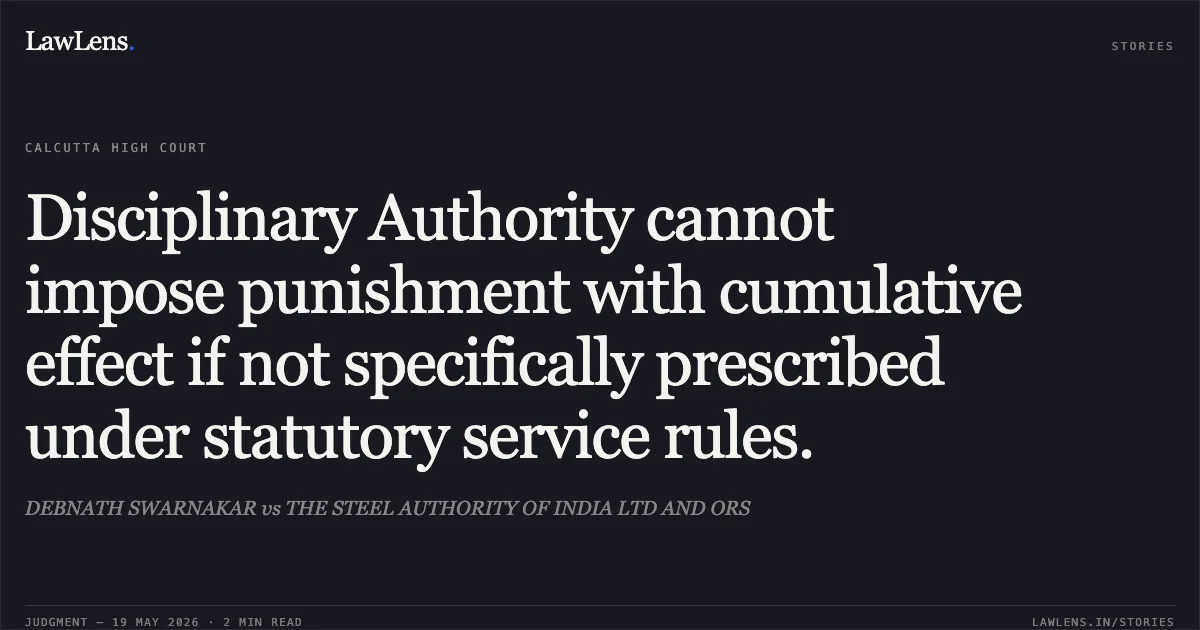
Source reference: p. 3-4The Disciplinary Authority imposed a major penalty of "reduction of existing basic pay by one stage... with cumulative effect"
Source reference: p. 4, 19This order was upheld by both the Appellate and Reviewing authorities, and subsequently by the Central Administrative Tribunal (CAT)
Source reference: p. 4-5The petitioner challenged these orders via a writ petition, arguing the matter was a contractual lease dispute rather than service misconduct
Source reference: p. 6Issues
1. Whether the unauthorized encroachment and construction on company land by an employee/lessee constitutes "misconduct" under the relevant Service Standing Orders
Source reference: p. 15 / para. 20-212. Whether a disciplinary authority can impose a punishment (stoppage of increment with "cumulative effect") not explicitly prescribed in the statutory Standing Orders
Source reference: p. 19 / para. 283. Whether the punishment imposed was shockingly disproportionate to the proved delinquency
Source reference: p. 25 / para. 32Law Applied
Clause 29(xix) of the SAIL Standing Order (1997), which defines "unauthorised use of company’s quarters or lands" as an act of misconduct
Source reference: p. 15-16The principle that disciplinary authorities must strictly adhere to statutory punishment rules, as established in Vijay Singh v. State of U.P. and State of U.P. v. Madhav Prasad Sharma
Source reference: p. 20The distinction between "withholding increment simpliciter" (minor) and "withholding with cumulative effect" (major/perpetual) as defined in Punjab State Electricity Board v. Raj Kumar Goel
Source reference: p. 23-24The principle of judicial review regarding "disproportionality of punishment" was drawn from Union of India v. P. Balasubrahmanayam
Source reference: p. 17Reasoning
The Court first rejected the petitioner’s argument that the dispute was purely contractual (relying on Nandita B. Palekar), noting that unlike the cited case, SAIL’s Standing Orders specifically codified "unauthorized use of land" as service misconduct
Source reference: p. 15-17/para. 19-22Regarding the penalty, the Court observed that Clause 30(2)(a) of the Standing Orders only prescribed "Stoppage of increment" without mentioning "cumulative effect"
Source reference: p. 18-19Applying Vijay Singh, the Court reasoned that imposing a penalty not explicitly provided in the rules is a nullity and an arbitrary exercise of executive power
Source reference: p. 21/para. 30The Court found that making the reduction perpetual (cumulative) was "shockingly disproportionate" given the nature of the allegation
Source reference: p. 25/para. 32-33Holding
The Court upheld the finding of misconduct but held that while the reduction of basic pay by one stage was valid, the "cumulative effect" was illegal as it lacked statutory backing
The Court quashed the "cumulative effect" portion of the order and directed the respondents to recalculate and disburse arrears of pay and retiral dues within 180 working days, along with 3% per annum simple interest from the date of superannuation
Source reference: p. 25-26/para. 36Acts & Sections Cited
5 provisions across 2 statutes referred to in this judgment. Linked provisions open on LawLens.
Electronic Furnishing Of Return Of Income Scheme, 20074
Public Premises (Eviction Of Unauthorised Occupants) Act, 19711
Original Court PDF
DEBNATH SWARNAKARvsTHE STEEL AUTHORITY OF INDIA LTD AND ORS
Click to open original judgment
Original judgment, available to read, download and summarize on LawLens.in


![Subsequent exoneration does not retrospectively invalidate a finalized promotion select list.. UNNIKRISHNAN M vs M/o Environment And Forests. CAT - ['Ernakulam']. LawLens](/stories/thumbnails/subsequent-exoneration-does-not-retrospectively-invalidate-a-finalized-promotion-select-li-ce80a0e84f2f4887857271e8b4341c42.webp)