Facts
The Respondent, an Assistant in the Ministry of Home Affairs (MHA), was accused of accepting a bribe of ₹10,000 for visa extensions in 2009.
Source reference: para. 3-4A disciplinary inquiry was initiated under Rule 14 of the CCS (CCA) Rules, 1965.
Source reference: no citationThe first Inquiry Officer (IO) absolved the Respondent of all charges on 07.04.2014.
Source reference: para. 8The Disciplinary Authority (DA), citing procedural lapses in evidence evaluation, ordered a "further inquiry" by a different IO under Rule 15(1).
Source reference: para. 9The second inquiry found the Respondent guilty based on "preponderance of probabilities".
Source reference: para. 11Despite conflicting advice from the UPSC and DoPT regarding the legality of the second inquiry and the quantum of punishment, the Petitioner dismissed the Respondent on 09.11.2017.
Source reference: para. 13-19The Central Administrative Tribunal (CAT) set aside the dismissal, leading to this writ petition.
Source reference: para. 20Issues
1. Whether the Disciplinary Authority was legally permitted to order a second inquiry by a different Inquiry Officer under the guise of "further inquiry" under Rule 15(1) of the CCS Rules.
Source reference: para. 272. Whether the reasons recorded by the Disciplinary Authority (disagreement with evidence evaluation) constituted "procedural lapses" justifying a further inquiry.
Source reference: para. 32Law Applied
The Court applied Rule 15(1) of the CCS (CCA) Rules, 1965, which allows a case to be remitted for "further inquiry" for recorded reasons.
Source reference: para. 28It relied on the Supreme Court precedent in K.R. Deb v. CCE, which clarifies that Rule 15 provides for only one inquiry; a further inquiry is permissible only to cure serious defects or examine unavailable witnesses, but not because the DA finds the IO's report unpalatable.
Source reference: para. 29The Court also applied the principle from Union of India v. S.K. Verma, stipulating that a further inquiry must ordinarily be conducted by the same IO unless they are incapacitated.
Source reference: para. 45Rule 15(2), which requires a "disagreement note" to be served to the delinquent officer if the DA disagrees with the IO's findings.
Source reference: para. 43-44Reasoning
The Court found that the DA’s reasons for ordering a second inquiry—primarily the "improper evaluation" of identification evidence—were not procedural lapses but rather a substantive disagreement with the IO's appreciation of evidence.
Source reference: para. 34-37The Court reasoned that if the DA disagreed with the first IO's findings, the correct legal procedure under Rule 15(2) was to issue a "disagreement note" to the Respondent, not to initiate a de novo inquiry to fill gaps in the prosecution's case.
Source reference: para. 41-44Furthermore, the Petitioner's appointment of a new IO for a "further inquiry" without justifying the original IO's unavailability was held to be a violation of established law, effectively making it a fresh/de novo inquiry which is impermissible after an acquittal.
Source reference: para. 45-46The Court noted that the Petitioner appeared to have pursued the proceedings with a pre-determined objective of dismissal.
Source reference: para. 48-49Holding
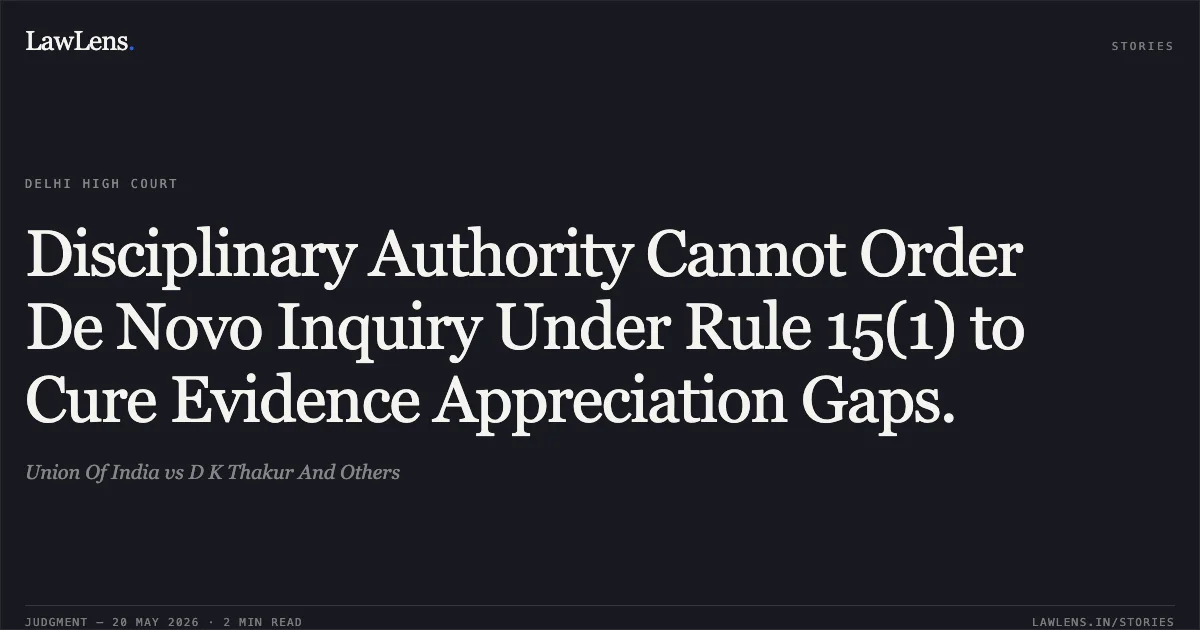
The Court held that the order directing a second inquiry was void ab initio as it exceeded the scope of Rule 15(1) and bypassed the mandatory "disagreement note" procedure under Rule 15(2).
The High Court dismissed the writ petition and upheld the Tribunal's order setting aside the dismissal, directing the Petitioner to comply with the Tribunal’s order (reinstatement with consequential benefits) within four weeks.
Source reference: para. 52Acts & Sections Cited
3 provisions across 1 statute referred to in this judgment. Linked provisions open on LawLens.
Central Civil Services (Classification, Control & Appeal) Rules, 19653
Original Court PDF
Union Of IndiavsD K Thakur And Others
Click to open original judgment
Original judgment, available to read, download and summarize on LawLens.in


![Authorities must decide pensionary and retiral-benefit claims through a reasoned order within eight weeks.. Habibullah khan vs HOME DEPARTMENT. CAT - ['Srinagar']. LawLens](/stories/thumbnails/authorities-must-decide-pensionary-and-retiral-benefit-claims-through-a-reasoned-order-wit-d0cbe8a8119c48fbabe7df9f2d353488.webp)