Facts
The petitioner, an Inspector of Police, was issued a show-cause notice by the Inspector General of Police (I.G.), Gwalior Range.
Source reference: para 2, 5Following the petitioner's reply, the disciplinary authority (Respondent No. 4) passed an order on 14.11.2022, imposing a punishment of withholding one increment without cumulative effect.
Source reference: para 2, 5The petitioner did not appeal this order. Subsequently, the same authority (Shri D. Sriniwas Verma) issued an order on 09.01.2023, recalling/revising the previous punishment and directing the issuance of a fresh charge-sheet for a regular departmental inquiry.
Source reference: para 2The petitioner challenged this revision as being without jurisdiction and in violation of natural justice.
Source reference: para 2Issues
1. Whether the disciplinary authority is competent to review or recall its own order of punishment under the Police Regulations or M.P. Civil Services (Classification, Control and Appeal) Rules, 1966?
Source reference: para 2, 52. Whether the impugned revision order was passed in violation of the principles of natural justice and the proviso to Regulation 270 of the Police Regulations?
Source reference: para 2, 6Law Applied
Regulation 270 of the Police Regulations, which stipulates that every order of punishment is liable to revision suo motu by an authority superior to the one making the order.
Source reference: para 6, 7The proviso to Regulation 270(4) explicitly mandates that no order shall be varied or reversed unless a notice has been served on the interested parties and an opportunity of being heard is provided.
Source reference: para 6Division Bench precedent in Sant Lal v. State of M.P. and others (W.A. No. 404/2017) and the coordinate bench decision in Rajendra Kumar Chaturvedi v. State of M.P. and others [2010 (1) MPLJ 417], both establishing the necessity of a hearing before passing adverse orders in revision.
Source reference: para 2, 6Reasoning
The court observed that the same authority that passed the original punishment order on 14.11.2022 had purportedly exercised revisional powers to recall it on 09.01.2023.
Source reference: para 2, 7Regulation 270(1) clarifies that the power of revision lies with an authority superior to the one that passed the original order.
Source reference: para 7The authority failed to comply with the mandatory proviso of Regulation 270(4), as the impugned order was passed without issuing a show-cause notice or affording the petitioner an opportunity of hearing.
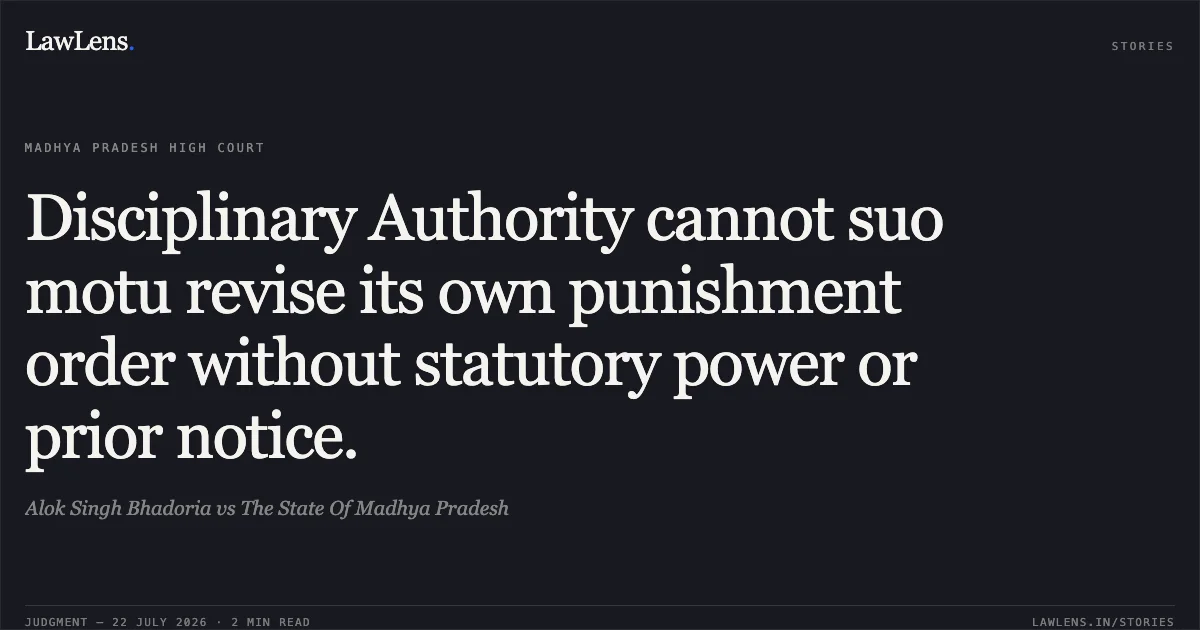
Source reference: para 5, 8No power is delegated under the applicable Service Rules or Police Regulations for an authority to suo motu review its own concluded disciplinary order without following the statutory procedural safeguards.
Source reference: para 2Holding
The court answered the issues in favor of the petitioner, holding that the impugned actions were without jurisdiction and violated natural justice.
The High Court quashed the order dated 18.11.2022 (Annexure P/1), the order dated 09.01.2023 (Annexure P/2), and the charge-sheet dated 02.01.2023 (Annexure P/3), along with all consequential actions. The writ petition was allowed.
Source reference: para 8, 9Original Court PDF
Alok Singh BhadoriavsThe State Of Madhya Pradesh
Click to open original judgment
Original judgment, available to read, download and summarize on LawLens.in