Facts
The petitioner, a Surveyor in the Agriculture Department, was suspended on 29.06.1996 and served a charge-sheet on 07.08.1996 alleging unauthorized construction of a harvesting tank and negligence leading to its damage during rain.
Source reference: para. 2A regular departmental enquiry under Rule 14 of the M.P. Civil Services (CCA) Rules, 1966, resulted in a report dated 19.12.2002, which exonerated the petitioner on both counts, citing that work followed superior orders and damage was caused by a natural calamity (unprecedented rainfall).
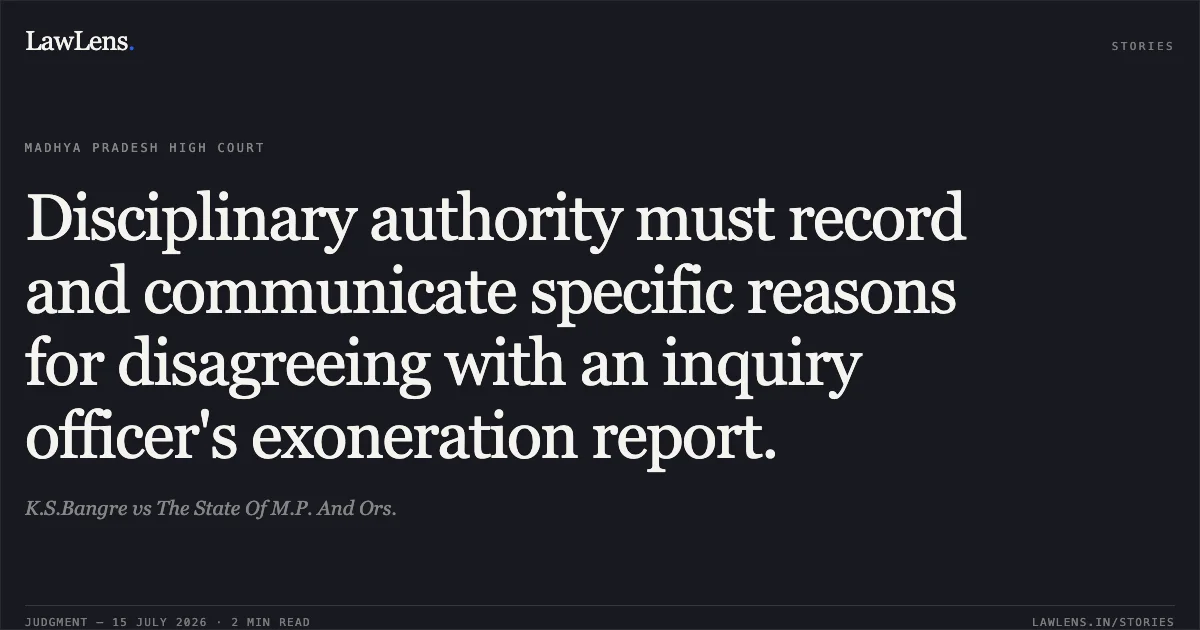
Source reference: para. 4Disregarding these findings, the Disciplinary Authority issued a show-cause notice labeling charges "partly proved" without providing reasons for disagreement.
Source reference: para. 5Subsequently, the Authority imposed penalties including a character warning, withholding of an increment with cumulative effect, and denial of full salary for the suspension period.
Source reference: para. 6The Appellate Authority dismissed the appeal on 31.08.2004 despite noting the punishment seemed excessive.
Source reference: para. 7Issues
1. Whether the Disciplinary Authority can record a finding of guilt contrary to the Inquiry Officer's exoneration without recording and communicating specific reasons for such disagreement.
Source reference: para. 102. Whether the imposition of a penalty more severe than the one proposed in the show-cause notice, or not mentioned therein, vitiates the punishment order.
Source reference: para. 16Law Applied
The court applied Rule 15(2) of the Madhya Pradesh Civil Services (Classification, Control and Appeal) Rules, 1966, which mandates that a disciplinary authority must record reasons if it disagrees with the inquiring authority.
Source reference: para. 11It further applied Rule 17, which requires the communication of such reasons to the delinquent employee.
Source reference: para. 12The court relied on the Supreme Court precedent in Punjab National Bank v. Kunj Behari Misra (1998), which established that principles of natural justice require the disciplinary authority to provide "tentative reasons" for disagreement to allow the delinquent officer an opportunity to represent their case before a final finding is recorded.
Source reference: para. 14Reasoning
The court reasoned that the word "shall" in Rule 15(2) constitutes a legislative command, making the recording of reasons a condition precedent to reversing an exoneration.
Source reference: para. 13In this case, the Disciplinary Authority’s show-cause notice was found deficient as it merely stated charges were "partly proved" without addressing the specific evidence (rainfall data and site registers) that led the Inquiry Officer to exonerate the petitioner.
Source reference: para. 15The court noted that a "mere label is not a reason".
Source reference: para. 13Furthermore, the court found a violation of natural justice because the final order imposed a "character warning" and "cumulative effect" on the increment—penalties either absent from or more severe than those in the show-cause notice.
Source reference: para. 16The Appellate Authority also erred by failing to correct these procedural illegalities despite acknowledging the harshness of the quantum.
Source reference: para. 17Holding
The court answered the issues in the affirmative, holding that an unreasoned or uncommunicated departure from a favorable enquiry report renders the punishment order void.
The High Court allowed the writ petition and quashed the orders dated 02.07.2003 and 31.08.2004. The petitioner was deemed exonerated of all charges. The respondents were directed to withdraw the character warning, restore withheld increments, and release the balance salary/allowances for the suspension period (29.06.1996 to 01.09.1998), treating it as duty for all purposes, within three months.
Source reference: para. 20Original Court PDF
K.S.BangrevsThe State Of M.P. And Ors.
Click to open original judgment
Original judgment, available to read, download and summarize on LawLens.in