Facts
The respondent, then a Revenue Inspector, was accused of demanding ₹500 to enter names in revenue records.
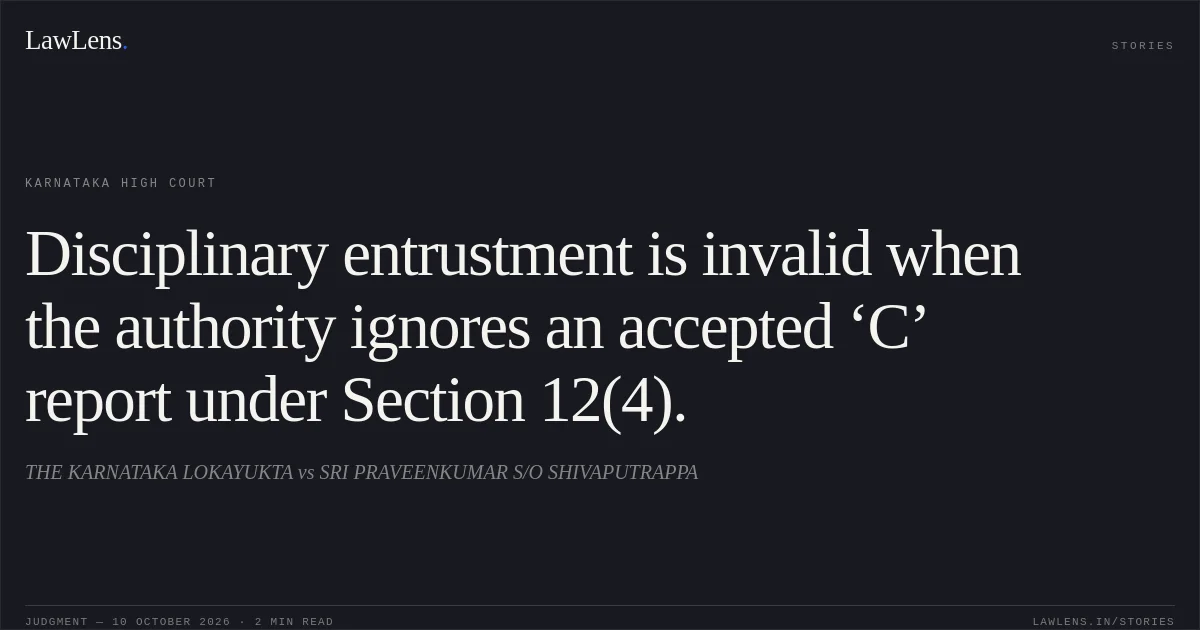
Source reference: pp. 3–5; paras. 3–4The Lokayukta trap did not establish demand or acceptance, and the criminal court accepted the investigating officer’s “C” report and closed the summary proceedings.
Source reference: pp. 3–5; paras. 3–4The State subsequently entrusted a departmental enquiry and articles of charge were issued on the same allegations.
Source reference: p. 5; para. 5The Karnataka State Administrative Tribunal set aside the entrustment order and charge articles, holding that the relevant material, including the “C” report, had not been considered.
Source reference: pp. 8–12; para. 13The Karnataka Lokayukta challenged that order before the High Court.
Source reference: pp. 6–7; paras. 6–8Issues
1. Whether the Tribunal’s order setting aside the enquiry entrustment and articles of charge warranted interference under Articles 226 and 227 of the Constitution.
Source reference: p. 7; para. 122. Whether departmental proceedings based on the same allegations could be sustained where the trap had failed and the criminal court had accepted the “C” report.
Source reference: pp. 7–8; paras. 12–13Law Applied
Section 12(4) of the Karnataka Lokayukta Act, read with Rule 14-A of the Karnataka Civil Services (Classification, Control and Appeal) Rules, was relied on by the Tribunal as requiring consideration of the relevant material before entrusting a disciplinary enquiry.
Source reference: pp. 8–10; para. 13The Tribunal also relied on State of Orissa v. Mamata Mohanty and Chairman, Coal India Ltd. v. Ananta Saha for the principles that disciplinary action must have a lawful foundation and that consequential proceedings may fall where the initial action is unlawful.
Source reference: pp. 10–11; para. 13The High Court’s stated basis for its decision was that the record disclosed no demand, acceptance, or successful trap, and it found no error in the Tribunal’s order.
Source reference: p. 8; para. 12; p. 14; para. 14Reasoning
The Court treated the absence of demand and acceptance, and the failure of the trap, as undisputed on the record.
Source reference: pp. 8–12; paras. 12–14Since the departmental charge arose from the same alleged demand and acceptance, the Court concluded that the charge could not stand on those facts.
Source reference: pp. 8–12; paras. 12–14It accordingly found no error in the Tribunal’s decision, which had also concluded that the entrustment was made without proper consideration of the material, including the accepted “C” report.
Source reference: pp. 8–12; paras. 12–14Holding
The High Court rejected the writ petition, finding no ground to interfere with the Tribunal’s order.
The Tribunal’s order setting aside the enquiry-entrustment order dated 2 November 2011 and the articles of charge dated 28 September 2012 therefore remained in force.
Source reference: pp. 11–12; para. 13Acts & Sections Cited
2 provisions across 2 statutes referred to in this judgment. Each provision opens on LawLens.
Prevention of Corruption Act, 19881
KARNATAKA LOKAYUKTA ACT, 19841
Original Court PDF
THE KARNATAKA LOKAYUKTAvsSRI PRAVEENKUMAR S/O SHIVAPUTRAPPA
Click to open original judgment
Original judgment, available to read, download and summarize on LawLens.in