Facts
The petitioners, V. Chithra and S. Kalaiselvi, were employees/contractual appointees associated with the Tamil Nadu Corporation for Development of Women and the Tamil Nadu State Rural Livelihood Mission.
Source reference: pp.3–4; paras.1, 3An FIR in Crime No.7 of 2022 was registered against them on 15.09.2022 under the Prevention of Corruption Act.
Source reference: pp.3–4; paras.1, 3Pursuant to the FIR, disciplinary action was initiated; S. Kalaiselvi was terminated and V. Chithra was relieved from service by orders dated 24.09.2022.
Source reference: pp.3–4; paras.1, 3The petitioners contended that the orders were founded solely on the FIR, were stigmatic, and were passed without observance of natural justice.
Source reference: pp.3–4; paras.1, 3The FIR was subsequently closed by a final report dated 08.03.2023 for want of sufficient material to prosecute, although the investigating agency informed the authorities that departmental action could be pursued.
Source reference: p.5; paras.6, 8The petitioners consequently sought quashing of the orders and reinstatement with consequential benefits.
Source reference: pp.2–3Issues
Whether the termination and relieving orders, having been founded on the registration of the FIR which was subsequently closed, could be sustained.
Source reference: p.5; paras.6–7Whether the impugned orders were liable to be quashed for having been passed without prior notice and in breach of the principles of natural justice, notwithstanding the petitioners’ contractual status.
Source reference: pp.4–5; paras.3–4Whether the respondents could be permitted to initiate fresh departmental proceedings in accordance with law.
Source reference: pp.5–7; paras.8–11Law Applied
The Court exercised its jurisdiction under Article 226 of the Constitution to review the legality of the impugned service orders.
Source reference: p.4; para.3It applied the principle that an adverse or stigmatic order affecting an employee’s service cannot ordinarily be sustained when passed without compliance with the principles of natural justice.
Source reference: p.4; para.3The Court further held that where an administrative order is based on a particular foundational circumstance, the collapse or removal of that foundation undermines the sustainability of the consequential order.
Source reference: p.5; para.7However, closure of criminal proceedings does not, by itself, establish the employee’s innocence or preclude an independent departmental inquiry based on available departmental material.
Source reference: p.6; para.8The Court relied on K. Murugan v. The Registrar & Ors., cited as W.P. No.25505 of 2022, where a similar order was set aside while liberty was reserved to the disciplinary authority to proceed afresh in accordance with law.
Source reference: pp.4–5, 6; paras.3, 9Reasoning
The Court found that the impugned orders were admittedly based on the FIR in Crime No.7 of 2022.
Source reference: p.5; paras.6–7Since the FIR was subsequently closed by the final report dated 08.03.2023, the factual foundation for the orders had collapsed, and the orders could not be sustained in their existing form.
Source reference: p.5; paras.6–7The Court also noted the petitioners’ contention that the orders were stigmatic and had been passed without notice or adherence to natural justice.
Source reference: p.4; para.3Nevertheless, it rejected the broader submission that closure of the criminal case or return of the alleged bribe amount conclusively demonstrated the petitioners’ innocence; the final report itself preserved the respondents’ right to examine the matter departmentally.
Source reference: p.6; para.8Following the approach in K. Murugan, the Court therefore quashed the existing orders while preserving the respondents’ authority to undertake fresh disciplinary proceedings in accordance with law.
Source reference: pp.6–7; paras.9–10Holding
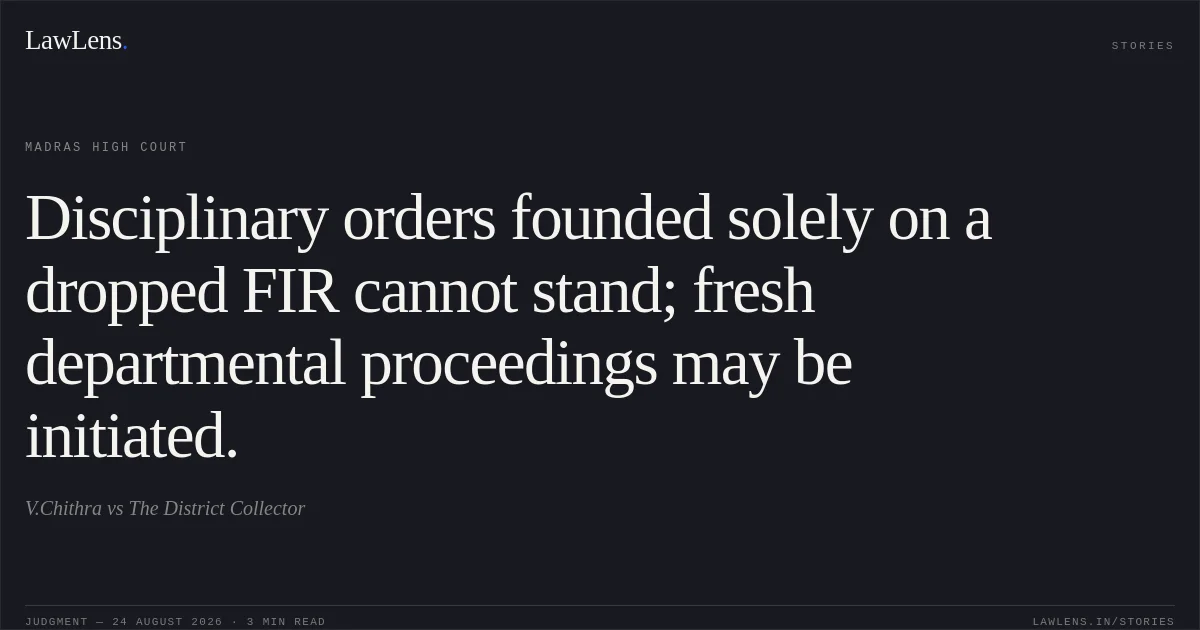
The writ petitions were allowed to the limited extent that the impugned orders dated 24.09.2022 were set aside.
The first respondent was granted liberty to proceed afresh departmentally, either by permitting the petitioners to rejoin duty or by placing them under suspension, and was directed to complete that exercise within three months from receipt of the order.
Source reference: p.7; para.11(b)No back wages were awarded at that stage; entitlement to monetary benefits was left to be determined after conclusion of the fresh departmental proceedings.
Source reference: p.7; para.11(c)The writ petitions were accordingly disposed of without costs, and the connected miscellaneous petitions were closed.
Source reference: p.7; para.12Original Court PDF
V.ChithravsThe District Collector
Click to open original judgment
Original judgment, available to read, download and summarize on LawLens.in
![Courts will not interfere with transfers absent mala fides or violation of statutory rules.. M Ramya vs EMPLOYEES STATE INSURANCE CORPORATION (ESIC). CAT - ['Chennai']. LawLens](/stories/thumbnails/courts-will-not-interfere-with-transfers-absent-mala-fides-or-violation-of-statutory-rules-a6845e9ca6f548fca284c51c8351957f.webp)
![Courts cannot direct one-time recruitment age relaxation absent authority in the governing rules or advertisement.. UT OF PUDUCHERRY vs M ANDAL. CAT - ['Chennai']. LawLens](/stories/thumbnails/courts-cannot-direct-one-time-recruitment-age-relaxation-absent-authority-in-the-governing-895d78fde47143e2a8ed0207c4b6a44f.webp)
![A review cannot correct an allegedly erroneous decision absent an error apparent on the record.. Ajit Kumar Jha vs RAILWAY BOARD. CAT - ['Delhi']. LawLens](/stories/thumbnails/a-review-cannot-correct-an-allegedly-erroneous-decision-absent-an-error-apparent-on-the-re-8ac952fd4eba470c92f7da20af72a220.webp)