Facts
The petitioner, a government servant, challenged an impugned order dated 06.08.2020 issued by the Commissioner, Chambal Division, Morena, which imposed a punishment of withholding two annual increments without cumulative effect.
Source reference: para. 1, 2The petitioner had submitted a detailed explanation/reply on 10.05.2019.
Source reference: para. 2The Commissioner passed the punishment order after seeking opinions from the CEO, Zila Panchayat, and the Collector, who expressed disagreement with the petitioner’s reply.
Source reference: para. 5The petitioner contended that the order was non-speaking and failed to consider the specific grounds raised in his defense.
Source reference: para. 2Issues
1. Whether the disciplinary authority is required to pass a speaking and reasoned order while exercising quasi-judicial powers to impose punishment on a government servant.
Source reference: para. 62. Whether the impugned order dated 06.08.2020 was legally sustainable given the alleged lack of independent reasoning and failure to consider the petitioner's explanation.
Source reference: para. 6, 11Law Applied
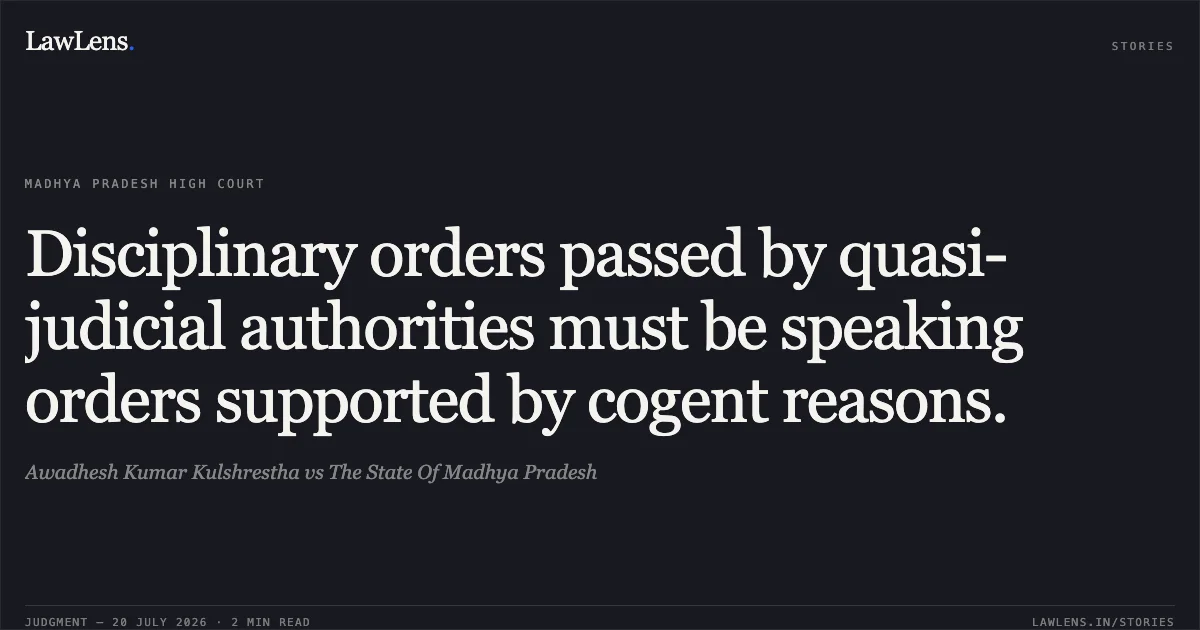
The court applied the principle that disciplinary authorities exercise quasi-judicial powers and must issue "speaking orders" that record valid and justifiable reasons.
Source reference: para. 6Administrative or executive decisions must be composite and self-sustaining, containing all prevailing reasons as established in State of Punjab v. Bandip Singh (2016).
Source reference: para. 8, 9Recording reasons is a component of natural justice, ensures transparency, and prevents the arbitrary exercise of power as summarized in Kranti Associates Private Limited v. Masood Ahmed Khan (2010).
Source reference: para. 10Reasoning
Upon perusing the impugned order, the Court found that the Disciplinary Authority merely recited the procedural history—noting that the Collector and CEO disagreed with the petitioner’s reply—rather than independently evaluating the merits of the petitioner's defense.
Source reference: para. 5, 6The Court observed that the order lacked reasoning and did not reflect an application of mind to the specific facts and circumstances.
Source reference: para. 6Applying the precedents of Bandip Singh and Kranti Associates, the Court reasoned that an order affecting a party's rights must "speak" so the affected party knows how their defense was considered.
Source reference: para. 7, 10The Court determined that a "rubber-stamp" or unreasoned order is a violation of the "due process" inherent in judicial and quasi-judicial decision-making.
Source reference: para. 10(l), 10(o)Holding
The Court answered the issues in the affirmative, holding that the impugned order was non-speaking and therefore legally unsustainable.
The High Court quashed the order dated 06.08.2020 and remanded the matter back to the Commissioner, Chambal Division with directions to pass a fresh, reasoned, and speaking order within three months after considering the petitioner's explanation and providing a personal hearing.
Source reference: para. 11, 12, 13Original Court PDF
Awadhesh Kumar KulshresthavsThe State Of Madhya Pradesh
Click to open original judgment
Original judgment, available to read, download and summarize on LawLens.in