Facts
The applicant, a Senior Auditor at the Ordnance Clothing Factory, Shahjahanpur, was transferred to Allahabad on 02.04.2003.
Source reference: p. 2-3He did not join the new post, claiming sudden illness on the date of relief.
Source reference: p. 2-3He challenged the transfer in OA No. 1236 of 2004, which resulted in the transfer order being quashed on 16.11.2005.
Source reference: p. 4, 11During the pendency of the transfer challenge, the respondents initiated disciplinary proceedings for unauthorized absence and "unbecoming conduct" under Rule 3(1)(iii) of the CCS (Conduct) Rules.
Source reference: p. 3, 14On 12.06.2009, the Disciplinary Authority imposed a major penalty of reduction to a lower stage in the pay scale for three years with cumulative effect.
Source reference: p. 2The Appellate Authority rejected the applicant's appeal on 15.01.2010.
Source reference: p. 3The applicant sought to quash these orders and regularize the period of absence (02.04.2003 to 12.01.2006) as duty with full benefits.
Source reference: p. 2Issues
1. Whether the disciplinary authority at the transferred station (Allahabad) had the jurisdiction to initiate an inquiry when the applicant had not yet joined duty there.
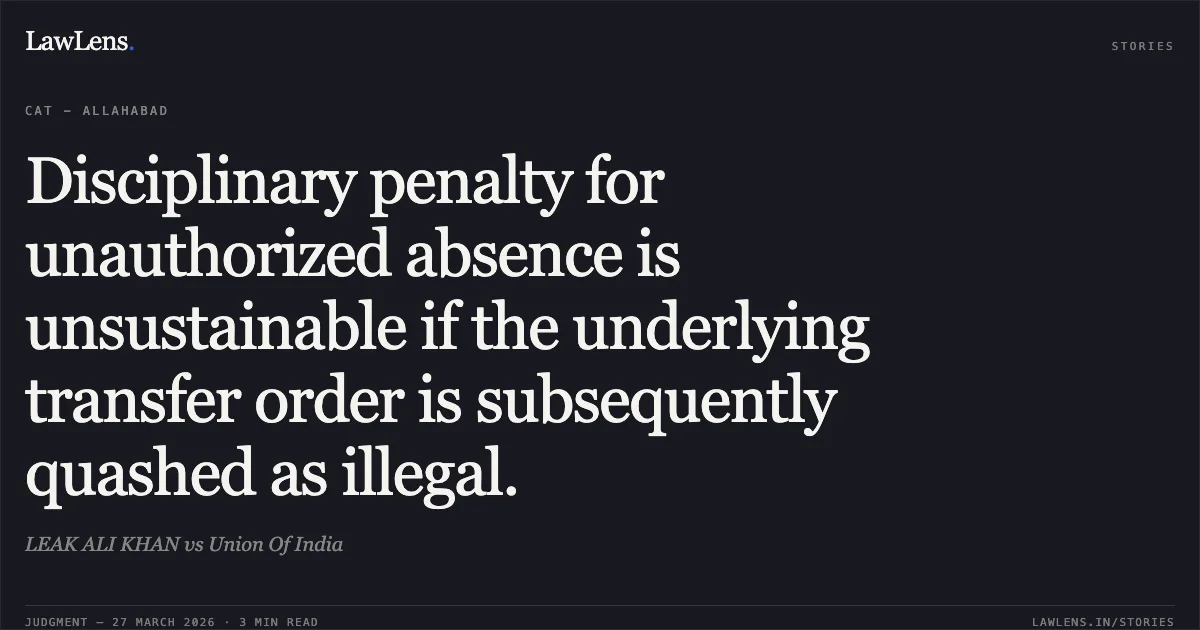
Source reference: p. 6, 142. Whether disciplinary action for unauthorized absence is sustainable when the underlying transfer order was subsequently quashed by a judicial forum.
Source reference: p. 5, 153. Whether the applicant is entitled to back wages and regularization of the absence period following the setting aside of the transfer and penalty orders.
Source reference: p. 17Law Applied
The court primarily applied Rule 3(1)(iii) of the CCS (Conduct) Rules regarding conduct unbecoming of a government servant.
Source reference: p. 14It relied on the jurisdictional principle from Kishori Lal Dogra v. Commissioner of Police, establishing that the authority to whose control an employee is transferred becomes the competent disciplinary authority upon the employee being relieved.
Source reference: p. 9, 14The court further applied the doctrine from Dr. Ramesh Chandra Tyagi v. Union of India, which holds that if a transfer order is found to be invalid or non est, a subsequent dismissal or penalty for failing to comply with that transfer falls automatically.
Source reference: p. 10, 16Finally, it followed the recent Supreme Court precedent in The Tamil Nadu Agricultural University v. R. Agila, which mandates that while service continuity and benefits must be restored if a transfer is quashed, back wages may be withheld if the employee remained absent without an interim stay order.
Source reference: p. 12-14, 17Reasoning
The Tribunal first addressed the jurisdictional challenge, holding that because the applicant was officially relieved from Shahjahanpur, he came under the administrative control of the Allahabad office; thus, that authority was competent to initiate proceedings.
Source reference: p. 14On the merits of the penalty, the Tribunal noted that the original transfer order of 2003 had already been declared legally unsustainable and quashed in earlier litigation.
Source reference: p. 15Reasoning that the disciplinary proceedings were rooted entirely in the applicant’s failure to report for an illegal transfer, the Tribunal concluded the punishment could not be sustained.
Source reference: p. 16However, applying the "no work, no pay" principle as refined in Tamil Nadu Agricultural University, the Tribunal observed that the applicant chose not to join the transferred post despite the absence of an interim stay from the Court.
Source reference: p. 17Consequently, while the period of absence must be regularized to ensure service continuity and qualifying service for pensionary benefits, the applicant is not entitled to salary for the period he did not actually serve.
Source reference: p. 17Holding
The Tribunal allowed the Original Application and quashed the impugned penalty order dated 12.06.2009 and the appellate order dated 15.01.2010.
The respondents were directed to pass orders regularizing the period from 02.04.2003 until the date the applicant was permitted to rejoin at Shahjahanpur as "period on duty".
Source reference: p. 17The court held that this period must be treated as qualifying service for all consequential benefits; however, it specifically ordered that the applicant shall not be entitled to any back wages for the said period.
Source reference: p. 17Original Court PDF
LEAK ALI KHANvsUnion Of India
Click to open original judgment
Original judgment, available to read, download and summarize on LawLens.in