Facts
The Petitioner, a retired Warehouse Manager of the Central Warehousing Corporation (CWC), challenged disciplinary proceedings initiated in 2015 regarding the non-accounting of 440 bags of FCI wheat at the Shahjahanpur warehouse
Source reference: p. 1-2The Petitioner initially claimed the stock was never received (August 2011), then later claimed it was found but untraceable earlier due to a "stacking fault" (February 2012), and finally claimed the second letter was written under "confusion"
Source reference: p. 3While the Inquiry Officer (IO) found the charge of misappropriation not proved, the IO held Article I "partly proved" on the grounds that the Petitioner’s contradictory letters constituted conduct unbecoming of a public servant
Source reference: p. 4Consequently, a penalty of reduction of pay by two stages for four years was imposed
Source reference: p. 1-2Issues
1. Whether the scope of judicial review under Article 226 allows for the reappreciation of evidence in disciplinary matters
Source reference: para. 17(i)2. Whether the finding that the Petitioner acted in a manner "unbecoming of a public servant" travelled beyond the specific charge of misappropriation
Source reference: para. 17(ii)3. Whether the penalty imposed was disproportionate to the misconduct sustained
Source reference: para. 17(v)Law Applied
The court applied the principle that judicial review under Article 226 is limited to correcting errors of law, procedural irregularities, or perversity, rather than acting as an appellate authority
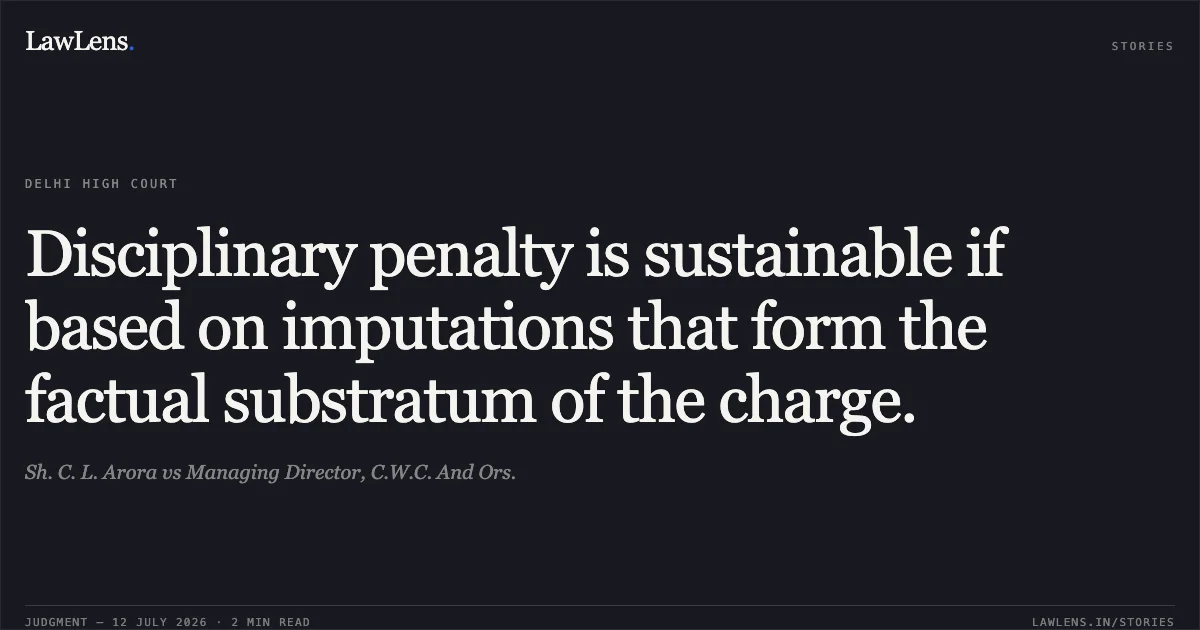
Source reference: para. 18-20; State of A.P. v. S. Sree Rama Rao; Union of India v. P. GunasekaranRegarding the framing of charges, the court held that an article of charge must be read in conjunction with the "statement of imputations" to determine if the delinquent had clear notice of the allegations
Source reference: para. 23; Union of India v. Gyan Chand ChattarFurthermore, the "prejudice doctrine" stipulates that procedural irregularities do not vitiate proceedings unless they cause demonstrable prejudice to the employee
Source reference: para. 29; State Bank of Patiala v. S.K. SharmaReasoning
The Court reasoned that although the primary charge was "misappropriation," the statement of imputations (Annexure-II) explicitly detailed the Petitioner’s conflicting correspondence and shifting explanations regarding the missing wheat
Source reference: para. 24-25The Court found that a Warehouse Manager making casual, fluctuating written assertions about public stock fails to maintain the standards required of a public servant
Source reference: para. 32-34The Court rejected the argument that "partial proof" is invalid, noting that the Inquiry Officer is entitled to establish components of a composite charge if they fall within the scope of the disclosed facts
Source reference: para. 38-40The Court observed that the Petitioner failed to prove any prejudice caused by the delay or the non-supply of documents since the findings were based on his own admitted letters
Source reference: para. 46-47Holding
It held that the disciplinary authority’s conclusion—that the Petitioner’s inconsistent official assertions constituted "conduct unbecoming of a public servant"—was supported by the record and did not travel beyond the scope of the charge memorandum when read with the statement of imputations
The Court dismissed the writ petition, upholding the findings and the penalty. The penalty of pay reduction was held to be proportionate and not "shocking to the conscience"
Source reference: para. 50, 51-52Original Court PDF
Sh. C. L. AroravsManaging Director, C.W.C. And Ors.
Click to open original judgment
Original judgment, available to read, download and summarize on LawLens.in