Facts
The petitioner, while serving as Sub Divisional Officer (Police) in Rewa, was issued a show-cause notice on 27.01.2014 alleging dereliction of duty.
Source reference: para 1It was alleged that despite evidence of offenses under Sections 302 and 201 IPC in a 2009 crime enquiry, the petitioner failed to instruct the SHO to register a case and kept the case diary pending from January 2009 to October 2010.
Source reference: para 1Following an enquiry report dated 04.01.2011, which suggested the petitioner was not solely responsible for the delay, the disciplinary authority disagreed and imposed a minor penalty of withholding one increment without cumulative effect via order dated 02.06.2014.
Source reference: paras 2-3This order was subsequently upheld by the appellate authority on 12.06.2015. The petitioner challenged these orders under Article 226 of the Constitution of India.
Source reference: para 3Issues
1. Whether the disciplinary and appellate authorities erred in law by failing to consider the petitioner's reply and the enquiry report's findings regarding shared responsibility for the delay.
Source reference: para 32. Whether the punishment of withholding one increment was proportionate to the alleged misconduct of dereliction of duty.
Source reference: para 7Law Applied
The court primarily assessed the validity of administrative action under Article 226 of the Constitution of India regarding the proportionality of punishments in service law.
Source reference: Order openingIt considered the procedural requirements of departmental enquiries where a disciplinary authority takes exception to an enquiry report.
Source reference: para 3While the core criminal matter involved Sections 302 and 201 of the IPC, the administrative focus was on the standard of "dereliction of duty" and the obligations of a Gazetted Officer (DSP level) to comply with senior mandates for prompt registration of FIRs.
Source reference: para 7Reasoning
The Court examined the enquiry report and noted that while the petitioner held the case diary for approximately 11 months, he had issued instructions to the SHO to appear for discussions, which the SHO ignored.
Source reference: para 6The Court observed that the diary moved back and forth between the petitioner and the SHO, indicating that the SHO was also reluctant to perform his duty. Consequently, the Court reasoned that the petitioner could not be made a "scapegoat" for the laboratory delay when the responsibility was shared.
Source reference: para 6-7However, the Court maintained that as a DSP-level officer, the petitioner had a heightened duty to ensure prompt registration of heinous crimes like murder. Applying the principle of proportionality, the Court concluded that while the petitioner was not entirely blameless, the formal punishment of withholding an increment was excessive given the contributory negligence of the SHO.
Source reference: para 7Holding
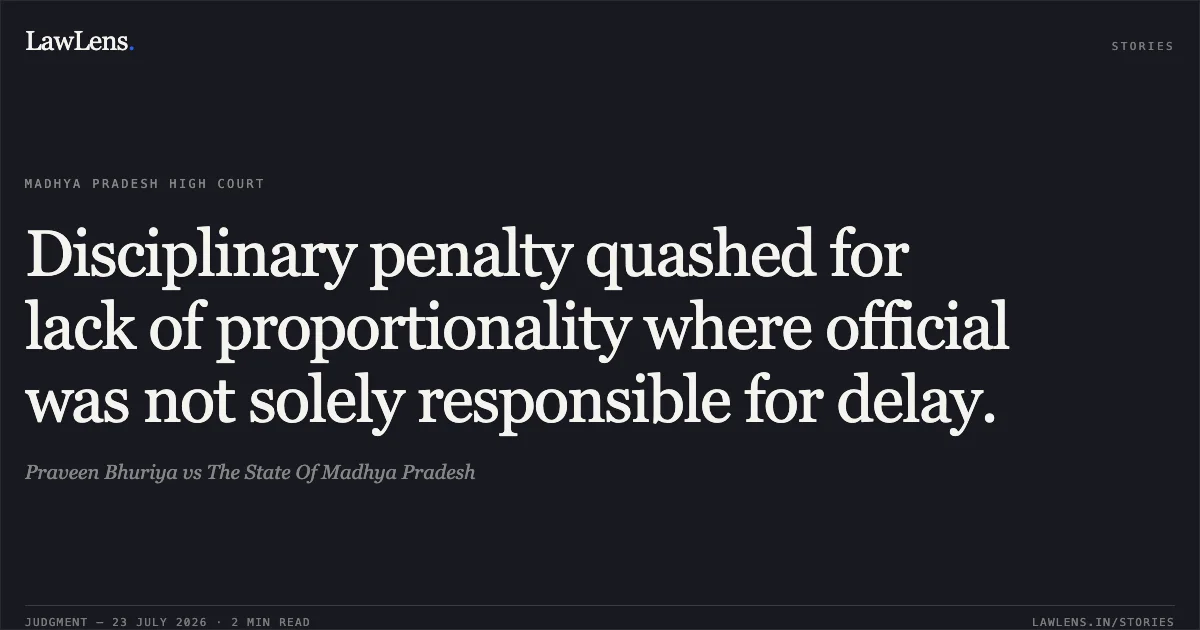
The Court held that the punishment inflicted was disproportionate to the misconduct.
It quashed the impugned disciplinary order dated 02.06.2014 and the appellate order dated 12.06.2015. The Court substituted the penalty with a formal warning to the petitioner to remain attentive to the orders of higher authorities and diligent in his duties in the future. The petition was accordingly disposed of.
Source reference: para 7-8Acts & Sections Cited
3 provisions across 2 statutes referred to in this judgment. Each provision opens on LawLens.
Indian Penal Code, 18602
Code of Criminal Procedure, 19731
Original Court PDF
Praveen BhuriyavsThe State Of Madhya Pradesh
Click to open original judgment
Original judgment, available to read, download and summarize on LawLens.in