Facts
The petitioner, while serving as a Deputy Registrar, impounded certain documents due to deficit stamp duty and referred them to the Collector of Stamps under Section 38 of the Indian Stamp Act on 18/10/2023
Source reference: para. 2The Collector, exercising quasi-judicial powers under Section 33, passed an order on 05/02/2024, concluding that no additional duty was required
Source reference: para. 3The respondents issued a charge-sheet against the petitioner on 24/11/2025, alleging that his failure to prefer an appeal against the Collector’s order caused a loss of Rs. 45 Crores to the public exchequer
Source reference: para. 2Subsequently, on 23/07/2025, a successor Collector directed the petitioner to file an appeal, which he did on the same day
Source reference: para. 3The Appellate Authority allowed said appeal on 06/04/2026, setting aside the Collector's original order
Source reference: para. 3Issues
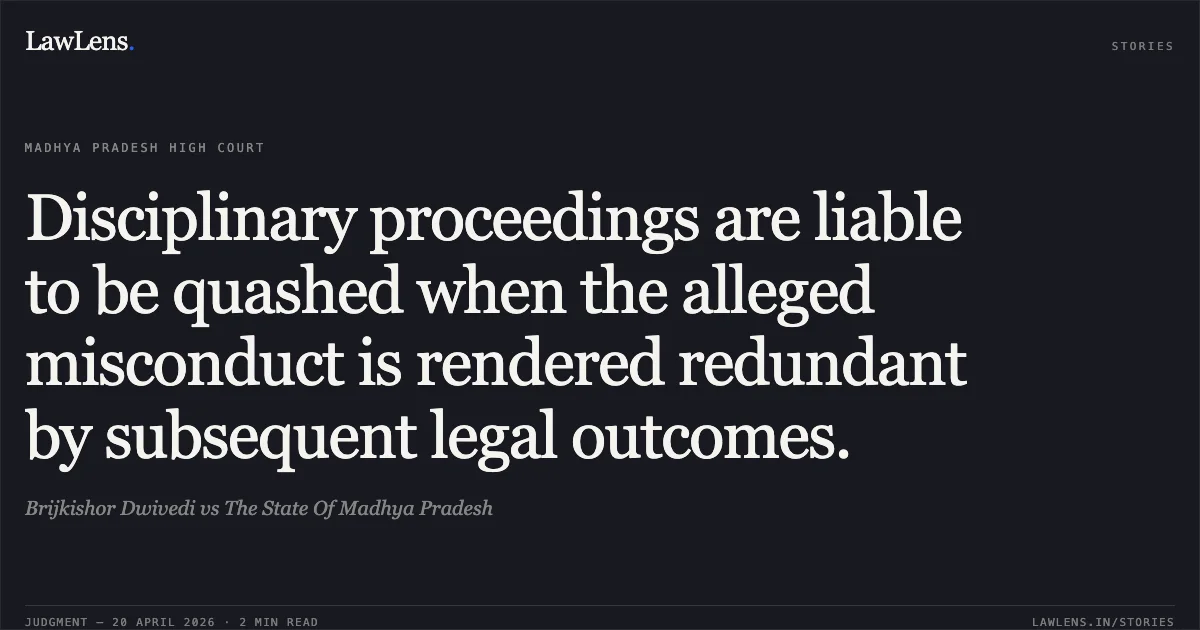
1. Whether the disciplinary proceedings against the petitioner are sustainable when the underlying quasi-judicial order alleged to have caused loss has been set aside in appeal
Source reference: para. 3, 72. Whether the High Court, under Article 226, can interfere with a charge-sheet at a preliminary stage if the allegations do not constitute misconduct
Source reference: para. 8, 9Law Applied
The court primarily considered Sections 33 and 38 of the Indian Stamp Act regarding the impounding of documents and the quasi-judicial powers of the Collector
Source reference: para. 2It referred to Rule 3(1)(i)(ii)(iii) of the Madhya Pradesh Civil Services (Conduct) Rules, 1965, regarding devotion to duty and misconduct
Source reference: para. 6the court relied on the precedent set in State of Rajasthan v. Heem Singh (2020 SCC OnLine SC 886), which established that while courts generally exercise restraint in disciplinary matters, judicial review is permissible when the charge of misconduct is supported by no evidence or lacks the "whisper of misconduct," requiring the exercise of "robust common sense"
Source reference: para. 8Reasoning
The Court observed that the petitioner had acted lawfully by impounding the documents and referring them to the competent authority (the Collector)
Source reference: para. 3The core allegation in the charge-sheet was the petitioner’s failure to appeal a quasi-judicial order; however, the Court noted that the petitioner filed the appeal immediately upon receiving directions from his superior on 23/07/2025
Source reference: para. 7since the Appellate Authority has already set aside the Collector’s order, the alleged loss to the exchequer no longer exists, and the basis for the disciplinary action has vanished
Source reference: para. 7The Court reasoned that continuing the proceedings would be an "exercise in futility" as there was no evidence of mala fide intent or irregularity on the part of the petitioner
Source reference: para. 7, 9Applying the Heem Singh doctrine, the Court found this to be a fit case to depart from the "hands-off mantra" typically applied to charge-sheets because the allegations, even if taken at face value, did not survive the subsequent legal developments
Source reference: para. 8, 9Holding
The High Court allowed the petition and quashed the impugned charge-sheet dated 18/11/2025, holding that the proceedings were an empty formality as the underlying lapse did not survive
The Court further directed the respondents to relieve the petitioner within 15 days to allow him to join his new appointment as Assistant Commissioner Cooperative, provided no other legal impediments exist
Source reference: para. 10Acts & Sections Cited
2 provisions across 1 statute referred to in this judgment. Each provision opens on LawLens.
Indian Stamp Act, 18992
Original Court PDF
Brijkishor DwivedivsThe State Of Madhya Pradesh
Click to open original judgment
Original judgment, available to read, download and summarize on LawLens.in