Facts
Niranjan Singh, employed as a Subedar in a unit-run station canteen, was suspended on 27 April 2004 following allegations that he had used derogatory language towards senior officers.
Source reference: para. 4–13No charge-sheet was issued; an inquiry was conducted treating the suspension order as the charge-sheet, and he was dismissed from service effective from the date of suspension.
Source reference: para. 4–13His appeal was rejected.
Source reference: para. 4–13The Central Administrative Tribunal set aside the dismissal and directed reinstatement under deemed suspension, while permitting the Union of India to proceed from the charge-sheet stage.
Source reference: para. 15A Division Bench of the High Court upheld the Tribunal’s decision with modifications, but that judgment was recalled on review because of the Supreme Court’s decision in R.R. Pillai.
Source reference: para. 21.1, 22.2The present Bench reconsidered the writ petition while a larger-bench reference concerning the status of unit-canteen employees remained pending.
Source reference: para. 25–28Issues
1. Whether employees of unit-run canteens are Central Government employees, given the conflicting Supreme Court decisions in Bheek Singh Rathore and R.R. Pillai.
Source reference: para. 31–362. Whether disciplinary proceedings and dismissal could stand when no charge-sheet was issued and the inquiry was initiated by treating the suspension order as the charge-sheet.
Source reference: para. 383. Whether the respondent should be relegated to fresh disciplinary proceedings or granted reinstatement-related relief, including back wages.
Source reference: para. 39–40Law Applied
Under Union Territory of Ladakh v. Jammu & Kashmir National Conference, when Supreme Court decisions of equal strength conflict, a High Court must follow the earlier decision unless directed otherwise; it should not defer a case merely because a reference is pending.
Source reference: para. 27.1Applying that rule, the Court followed Bheek Singh Rathore, which adopted Union of India v. M. Aslam and treated unit-canteen employees as Central Government employees, rather than the later decision in R.R. Pillai.
Source reference: para. 31–36The Court also applied the settled service-law principle that disciplinary proceedings commence with the issuance of a charge-sheet; an inquiry cannot lawfully proceed without one.
Source reference: para. 38Reasoning
The Court held that Bheek Singh Rathore preceded R.R. Pillai and, under Union Territory of Ladakh, was therefore the decision it had to follow; it accordingly proceeded on the basis that the respondent was a Central Government employee.
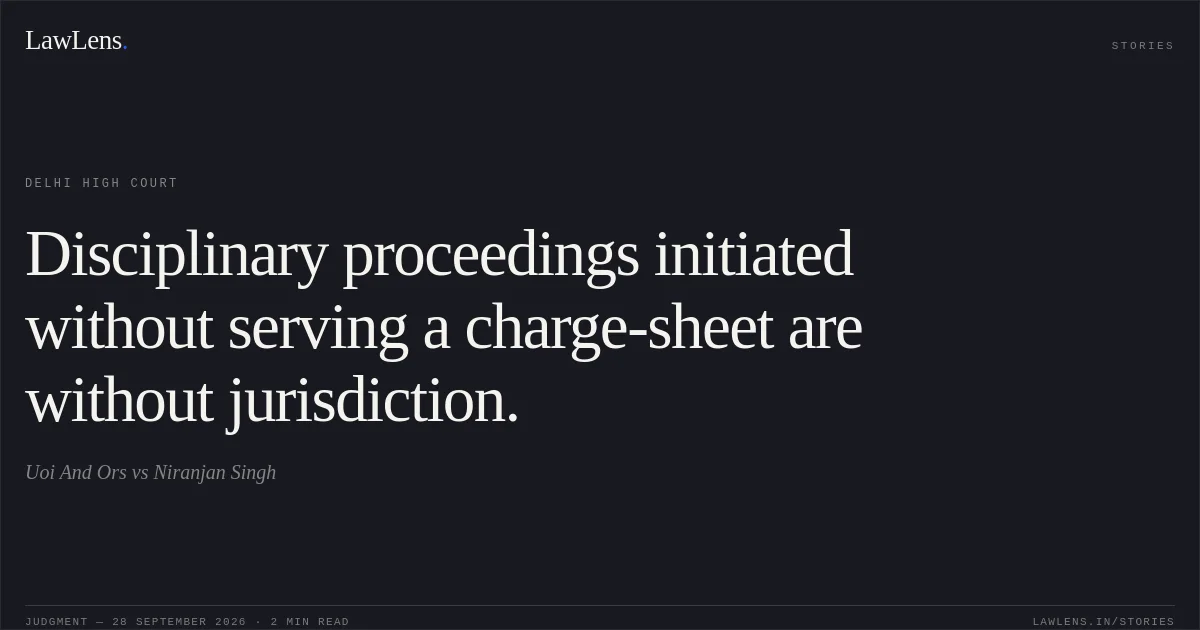
Source reference: para. 31–36On that basis, the disciplinary process was legally defective: the authorities had appointed an Inquiry Officer without issuing a charge-sheet, instead treating the suspension order as one, rendering the ensuing proceedings without jurisdiction.
Source reference: para. 38Given the passage of time, the Court agreed that requiring the respondent to face a fresh inquiry would be unjust; it also agreed that the appropriate relief was notional pay fixation and future arrears, rather than back wages.
Source reference: para. 39–41Holding
The writ petition was dismissed in the terms stated by the Court.
The dismissal was set aside; the respondent was entitled to notional fixation of pay and arrears for the future, but not back wages.
Source reference: para. 37, 40–42The direction placing him under deemed suspension and the liberty to initiate de novo proceedings were set aside.
Source reference: para. 37, 40–42Original Court PDF
Uoi And OrsvsNiranjan Singh
Click to open original judgment
Original judgment, available to read, download and summarize on LawLens.in